Results by title
10 books match the query 'Teacher & Student Mentoring'
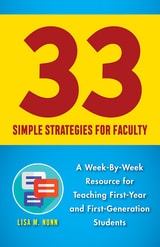
33 Simple Strategies for Faculty
A Week-by-Week Resource for Teaching First-Year and First-Generation StudentsNunn, Lisa M
Rutgers University Press, 2019
Many students struggle with the transition from high school to university life. This is especially true of first-generation college students, who are often unfamiliar with the norms and expectations of academia. College professors usually want to help, but many feel overwhelmed by the prospect of making extra time in their already hectic schedules to meet with these struggling students.
33 Simple Strategies for Faculty is a guidebook filled with practical solutions to this problem. It gives college faculty concrete exercises and tools they can use both inside and outside of the classroom to effectively bolster the academic success and wellbeing of their students. To devise these strategies, educational sociologist Lisa M. Nunn talked with a variety of first-year college students, learning what they find baffling and frustrating about their classes, as well as what they love about their professors’ teaching.
Combining student perspectives with the latest research on bridging the academic achievement gap, she shows how professors can make a difference by spending as little as fifteen minutes a week helping their students acculturate to college life. Whether you are a new faculty member or a tenured professor, you are sure to find 33 Simple Strategies for Faculty to be an invaluable resource.
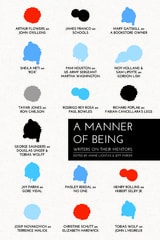
A Manner of Being
Writers on Their MentorsAnnie Liontas
University of Massachusetts Press, 2015
What do the punk singer Henry Rollins, the Guatemalan writer Rodrigo Rey Rosa, the American authors Tobias Wolff, Tayari Jones, and George Saunders, the Canadian writer Sheila Heti, and the Russian poet Polina Barskova have in common? At some point they all studied the art of writing deeply with someone.
The nearly seventy short essays in A Manner of Being, by some of the best contemporary writers from around the world, pay homage to mentors—the writers, teachers, nannies, and sages—who enlighten, push, encourage, and sometimes hurt, fail, and limit their protégés. There are mentors encountered in the schoolhouse and on farms, in NYC and in MFA programs; mentors who show up exactly when needed, offering comfort, a steadying hand, a commiseration, a dose of tough love. This collection is rich with anecdotes from the heartfelt to the salacious, gems of writing advice, and guidance for how to live the writing life in a world that all too often doesn't care whether you write or not.
Each contribution is intimate and distinct—yet a common theme is that mentors model a manner of being.
Selections include:
Arthur Flowers on John O'Killens
James Franco on Harmony Korine
Mary Gaitskill on an Ann Arbor bookstore owner
Noy Holland and Sam Lipsyte on Gordon Lish
Tayari Jones on Ron Carlson
Henry Rollins on Hubert Selby Jr.
Rodrigo Rey Rosa on Paul Bowles
George Saunders on Douglas Unger and Tobias Wolff
Christine Schutt on Elizabeth Hardwick
Tobias Wolff on John L'Heureux
. . . and many more
Becoming a Historian
An Informal GuideEdited by Penelope J. Corfield and Tim Hitchcock
University of London Press, 2022
Writing history is both an art and a craft. This handbook is designed as an instructional guide to support students, independent scholars, and more. Becoming a Historian guides prospective historians on how best to participate in this vibrant community of scholars. This friendly guide will teach readers how to design research projects, how to differentiate between quantitative and qualitative research methodologies, and how to follow a project through to a positive conclusion. Becoming a Historian is also frank about the pains and pleasures of sticking with a long-term project. Finally, this guide explains how to present original research to wider audiences, including the appropriate use of social media, the art of public lecturing, and strategies for publication.
Written by esteemed historians Penelope J. Corfield and Tim Hitchcock, who bring more than forty years of collective experience to the project, Becoming a Historian explodes the myths and systems that can make the world of research seem intimidating. Instead, this guide offers step-by-step advice designed to make it easier to join this community of scholarship.
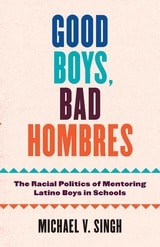
Good Boys, Bad Hombres
The Racial Politics of Mentoring Latino Boys in SchoolsMichael V Singh
University of Minnesota Press, 2024
The unintended consequences of youth empowerment programs for Latino boys
Educational research has long documented the politics of punishment for boys and young men of color in schools—but what about the politics of empowerment and inclusion? In Good Boys, Bad Hombres, Michael V. Singh focuses on this aspect of youth control in schools, asking on whose terms a positive Latino manhood gets to be envisioned.
Based on two years of ethnographic research in an urban school district in California, Good Boys, Bad Hombres examines Latino Male Success, a school-based mentorship program for Latino boys. Instead of attempting to shape these boys’ lives through the threat of punishment, the program aims to provide an “invitation to a respectable and productive masculinity” framed as being rooted in traditional Latinx signifiers of manhood. Singh argues, however, that the promotion of this aspirational form of Latino masculinity is rooted in neoliberal multiculturalism, heteropatriarchy, and anti-Blackness, and that even such empowerment programs can unintentionally reproduce attitudes that paint Latino boys as problematic and in need of control and containment.
An insightful gender analysis, Good Boys, Bad Hombres sheds light on how mentorship is a reaction to the alleged crisis of Latino boys and is governed by the perceived remedies of the neoliberal state. Documenting the ways Latino men and boys resist the politics of neoliberal empowerment for new visions of justice, Singh works to deconstruct male empowerment, arguing that new narratives and practices—beyond patriarchal redemption—are necessary for a reimagining of Latino manhood in schools and beyond.
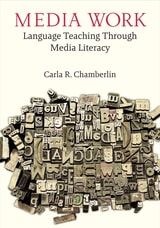
Media Work
Language Teaching Through Media LiteracyCarla R. Chamberlin
University of Michigan Press, 2025
Media Work offers a practical, hands-on approach to illustrate how language, imagery, and media platforms convey meaning. With almost 100 illustrations for use in teaching and many valuable sample lessons, the book brings to life the processes of observing, interrogating, interpreting, reflecting, and responding to a wide variety of media. Drawing upon critical perspectives from applied linguistics, communication, and media studies (e.g., semiotics, critical discourse analysis, media ecology), it develops a conceptual model that can be adapted for a range of ages and contexts. Chamberlin’s approach enables students to investigate the origins, purposes, and implications of messages that surround them in their everyday lives. With sample topics that range from pets and food to identity and discrimination, teachers can give students opportunities to learn more about their own communities and reflect on their reactions to media messages. By addressing the disinformation and propaganda that are prevalent in today’s media, teachers can also help students confront messages about social issues in order to gain knowledge, confidence, and agency.
Redefining Roles
The Professional, Faculty, and Graduate Consultant’s Guide to Writing CentersMegan Swihart Jewell
Utah State University Press, 2021
Thirty-two authors, consultants, and administrators from diverse centers—from large public four-year institutions to a private, online for-profit university—provide both theoretical frameworks and practical applications in eighteen chapters. Ten chapters focus on graduate consultants and address issues of authority, training, professional development, and mentoring, and eight focus on professional and faculty consultant training as well as specific issues of identity and authority. By sharing these voices, Redefining Roles broadens the very idea of writing centers while opening the door to more dialogue on the important role these practitioners play.
Redefining Roles is designed for writing center practitioners, scholars, and staff. It is also a necessary addition to help campus administrators in the ongoing struggle to validate the intellectually complex work that such staff performs.
Contributors: Fallon N. Allison, Vicki Behrens, Cassie J. Brownell, Matt Burchanoski, Megan Boeshart Burelle, Danielle Clapham, Steffani Dambruch, Elise Dixon, Elizabeth Festa, Will Fitzsimmons, Alex Frissell, Alex Funt, Genie Giaimo, Amanda Gomez, Lisa Lamson, Miriam E. Laufer, Kristin Messuri, Rebecca Nowacek, Kimberly Fahle Peck, Mark Pedretti, Irina Ruppo, Arundhati Sanyal, Anna Scanlon, Matthew Sharkey-Smith, Kelly A. Shea, Anne Shiell, Anna Sicari, Catherine Siemann, Meagan Thompson, Lisa Nicole Tyson, Marcus Weakley, Alex Wulff
Schooling, Democracy, and the Quest for Wisdom
Partnerships and the Moral Dimensions of TeachingRobert V. Bullough Jr. and John R. Rosenberg
Rutgers University Press, 2018
In response to growing concern in the 1980s about the quality of public education across the United States, a tremendous amount of energy was expended by organizations such as the Holmes Group and the Carnegie Forum to organize professional development schools (PDS) or “partner schools” for teacher education. On the surface, the concept of partnering is simple; however, the practice is very costly, complex, and difficult. In Schooling, Democracy, and the Quest for Wisdom, Robert V. Bullough, Jr. and John R. Rosenberg examine the concept of partnering through various lenses and they address what they think are the major issues that need to be, but rarely are, discussed by thousands of educators in the U.S. who are involved and invested in university-public school partnerships. Ultimately, they assert that the conversation around partnering needs re-centering (most especially on the purposes of public education), refreshing, and re-theorizing.
Teaching Israel
Studies of Pedagogy from the FieldEdited by Sivan Zakai and Matt Reingold
Brandeis University Press, 2024
Jewish Americans are divided in their views on Israel. While scholars have outlined philosophical principles to guide educators who teach about Israel, there has been less scholarship focused on the pedagogy surrounding the country. This book resituates teaching—the questions, dilemmas, and decision-making that teachers face—as central to both Israel studies and Israel education. Contributors illuminate how educators from differing pedagogical orientations, who teach in a range of educational settings learn, understand, undertake, and ultimately improve the work of teaching Israel. The volume also looks at the professional support and learning opportunities teachers may need to engage with these pedagogical questions.
The Synergistic Classroom
Interdisciplinary Teaching in the Small College SettingCorey Campion
Rutgers University Press, 2021
Written by faculty engaged in the design and delivery of interdisciplinary courses, programs, and experiential learning opportunities in the small college setting, The Synergistic Classroom addresses the many ways faculty can leverage their institutions' small size and openness to pedagogical experimentation to overcome the challenges of limited institutional resources and enrollment concerns and better prepare students for life and work in the twenty-first century. Taken together, the contributions in this volume invite reflection on a variety of important issues that attend the work of small college faculty committed to expanding student learning across disciplinary boundaries.
Using Servant Leadership
How to Reframe the Core Functions of Higher EducationLetizia, Angelo J.
Rutgers University Press, 2018