Results by title
4 books match the query 'Technology and law'

Matterphorics
On the Laws of TheoryDaniela Gandorfer
Duke University Press, 2026

Parchment, Paper, Pixels
Law and the Technologies of CommunicationPeter M. Tiersma
University of Chicago Press, 2010
Technological revolutions have had an unquestionable, if still debatable, impact on culture and society—perhaps none more so than the written word. In the legal realm, the rise of literacy and print culture made possible the governing of large empires, the memorializing of private legal transactions, and the broad distribution of judicial precedents and legislation. Yet each of these technologies has its shadow side: written or printed texts easily become static and the textual practices of the legal profession can frustrate ordinary citizens, who may be bound by documents whose implications they scarcely understand.
Parchment, Paper, Pixels offers an engaging exploration of the impact of three technological revolutions on the law. Beginning with the invention of writing, continuing with the mass production of identical copies of legal texts brought about by the printing press, and ending with a discussion of computers and the Internet, Peter M. Tiersma traces the journey of contracts, wills, statutes, judicial opinions, and other legal texts through the past and into the future.
Though the ultimate effects of modern technologies on our legal system remain to be seen, Parchment, Paper, Pixels offers readers an insightful guide as to how our shifting forms of technological literacy have shaped and continue to shape the practice of law today.
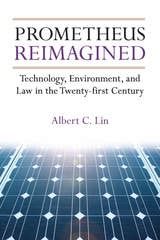
Prometheus Reimagined
Technology, Environment, and Law in the Twenty-first CenturyAlbert C. Lin
University of Michigan Press, 2013
Technologies such as synthetic biology, nanotechnology, artificial intelligence, and geoengineering promise to address many of our most serious problems, yet they also bring environmental and health-related risks and uncertainties. Moreover, they can come to dominate global production systems and markets with very little public input or awareness. Existing governance institutions and processes do not adequately address the risks of new technologies, nor do they give much consideration to the concerns of persons affected by them.
Instead of treating technology, health, and the environment as discrete issues, Albert C. Lin argues that laws must acknowledge their fundamental relationship, anticipating both future technological developments and their potential adverse effects. Laws should encourage international cooperation and the development of common global standards, while allowing for flexibility and reassessment.
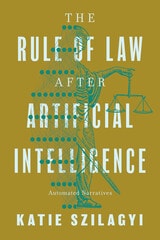
The Rule of Law After Artificial Intelligence
Automated NarrativesKatie Szilagyi
University of Chicago Press, 2026
A timely investigation of what is at stake when AI takes legal decision-making out of human hands.
Artificial intelligence is proliferating in many professions, and the legal field is no exception. In The Rule of Law After Artificial Intelligence, Katie Szilagyi investigates the philosophical and practical implications of using AI in legal spaces, beginning with several fundamental questions: What is the law supposed to do, and from where does it derive its authority? Would law still achieve these aims if automated? How might automation affect the rule of law’s integrity and democratic institutions’ operations?
Blending legal philosophy, applied case studies, and insights from both critical legal scholarship and science and technology studies, Szilagyi argues that law and storytelling are deeply connected. Through creating and contesting the law, we make sense of the information around us and generate narratives about our collective world. These narratives are not static: legal precedent evolves, and legal deliberation on hard cases can help to resolve unclear or unprecedented social issues.
Szilagyi demonstrates that technological innovations make the rule of law vulnerable because large language models and machine learning undermine the visioning function of legal narratives, collapsing exercises of legal interpretation into mere administration. Datafication of law—built on the biased data of our cultural past—threatens longstanding legal ideals, lessens the constraints against abuses of power by private actors, and hamstrings society’s ability to reach a more egalitarian future. Szilagyi argues instead for centering narratives within the law and, in turn, rediscovering the tales the law tells us about who we are.