Results by title
10 books match the query 'Technology and the arts'
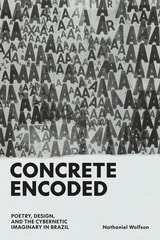
Concrete Encoded
Poetry, Design, and the Cybernetic Imaginary in BrazilNathaniel Wolfson
University of Texas Press, 2025
A study of concrete art and poetry, its implications, and influence in Brazil.
Concrete art and poetry burst onto Brazil’s cultural stage in the 1950s, while the country was embarking on a dizzying period of modernization. Bringing together key poets and visual artists alongside less recognized figures, Nathaniel Wolfson shows that concretism was hardly socially inert, as pundits have suggested. Rather, it presciently grappled with an emerging information age that would soon reorganize human relations globally.
Concrete Encoded describes a nascent cybernetic imaginary. Concretism has long been considered Brazil’s most global aesthetic movement. Wolfson traces new circles of international theorists and practitioners involved in critical technological thought. Wolfson argues that concrete poetry is the quintessential literary genre of the early information age. He shows that Brazilian poets, artists, and designers contested the military dictatorship’s technological authoritarianism and information-gathering operations. Vigorous experimentalists, their attention to form and semantics unveiled both the creative and nefarious possibilities of algorithmic writing. A highly original work, Concrete Encoded reckons with aesthetic responses from Brazil to an advancing capitalist and digital era.
Informatics of Domination
Zach Blas, Melody Jue, and Jennifer Rhee, editors
Duke University Press, 2025
Contributors. Dalida María Benfield, Zach Blas, Ama Josephine Budge Johnstone, micha cárdenas, Amy Sara Carroll, Shu Lea Cheang, Jian Neo Chen, Heather Dewey-Hagborg, Ranjodh Singh Dhaliwal, Stephanie Dinkins, Ricardo Dominguez, Ashley Ferro-Murray, Matthew Fuller, Jacob Gaboury, Jennifer Gabrys, Alexander R. Galloway, Jennifer Mae Hamilton, Donna J. Haraway, Eva Hayward, Stefan Helmreich, Kathy High, Leon J. Hilton, Ho Rui An, Hi'ilei Julia Kawehipuaakahaopulani Hobart, Tung-Hui Hu, Caroline A. Jones, Melody Jue, Homay King, Larissa Lai, Lawrence Lek, Esther Leslie, Alexis Lothian, Isadora Neves Marques, Radha May (Elisa Giardina-Papa, Nupur Mathur, and Bathsheba Okwenje), Shaka McGlotten, Mahan Moalemi, madison moore, Astrida Neimanis, Bahar Noorizadeh, Luciana Parisi, Thao Phan, Ana Teixeira Pinto, Luiza Prado de O. Martins, Rita Raley, Patricia Reed, Jennifer Rhee, Bassem Saad, Ashkan Sepahvand, Justin Talplacido Shoulder, Lucy Suchman, Ollie Zhang
Performance, Transparency, and the Cultures of Surveillance
James M. Harding
University of Michigan Press, 2018

Reframing Consciousness
Art, mind and technologyEdited by Roy Ascott
Intellect Books, 2000
Loosely themed around four key elements of Mind, Body, Art and Values, the editor leads the investigation through the familiar territories of interactive media and artificial life, combining them with new and ancient ideas about creativity and authorship, the body and personal identity. This is the first book to recognise the paradigmatic changes which art, in alliance with science and technology is currently undergoing.
Romance of Commerce and Culture
Capitalism, Modernism, and the Chicago-Aspen Crusade for Cultural Reform, Revised EditionJames Sloan Allen
University Press of Colorado, 2002
Systemic Dramaturgy
A Handbook for the Digital AgeMichael Mark Chemers and Mike Sell
Southern Illinois University Press, 2022
Systemic Dramaturgy offers an invigorating, practical look at the daunting cultural problems of the digital age as they relate to performance. Authors Michael Mark Chemers and Mike Sell reject the incompatibility of theatre with robots, digital media, or video games. Instead, they argue that technology is the original problem of theatre: How can we tell this story and move this audience with these tools? And if we have different tools, how can that change the stories we tell?
This volume attunes readers to “systemic dramaturgy”—the recursive elements of signification, innovation, and history that underlie all performance—arguing that theatre must be understood as a system of systems, a concatenation of people, places, things, politics, feelings, and interpretations, ideally working together to entertain and edify an audience. The authors discuss in-depth the application of time-tested dramaturgical skills to extra-theatrical endeavors, including multi-platform performance, installations, and videogames. And they identify the unique interventions that dramaturgs can and must make into these art forms.
More than any other book that has been published in the field, Systemic Dramaturgy places historical dramaturgy in conversation with technologies as old as the deus ex machina and as new as artificial intelligence. Spirited and playful in its approach, this volume collates histories, transcripts, and case studies and applies the concepts of systemic dramaturgy to works both old and avant-garde. Between chapters, Chemers and Sell talk with with some of the most forward-thinking, innovative, and creative people working in live media as they share their diverse approaches to the challenges of making performances, games, and digital media that move both heart and mind. This volume is nothing less than a guide for thinking about the future evolution of performance.
Technocrats of the Imagination
Art, Technology, and the Military-Industrial Avant-GardeJohn Beck and Ryan Bishop
Duke University Press, 2020
Technomodern Poetics
The American Literary Avant-Garde at the Start of the Information AgeTodd F. Tietchen
University of Iowa Press, 2018
After the second World War, the term “technology” came to signify both the anxieties of possible annihilation in a rapidly changing world and the exhilaration of accelerating cultural change. Technomodern Poetics examines how some of the most well-known writers of the era described the tensions between technical, literary, and media cultures at the dawn of the Digital Age. Poets and writers such as Allen Ginsberg, Charles Olson, Jack Kerouac, and Frank O’Hara, among others, anthologized in Donald Allen’s iconic The New American Poetry, 1945–1960, provided a canon of work that has proven increasingly relevant to our technological present. Elaborating on the theories of contemporaneous technologists such as Norbert Wiener, Claude Shannon, J. C. R. Licklider, and a host of noteworthy others, these artists express the anxieties and avant-garde impulses they wrestled with as they came to terms with a complex array of issues raised by the dawning of the nuclear age, computer-based automation, and the expansive reach of electronic media. As author Todd Tietchen reveals, even as these writers were generating novel forms and concerns, they often continued to question whether such technological changes were inherently progressive or destructive.
With an undeniable timeliness, Tietchen’s book is sure to appeal to courses in modern English literature and American studies, as well as among fans of Beat writers and early Cold War culture.
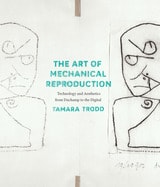
The Art of Mechanical Reproduction
Technology and Aesthetics from Duchamp to the DigitalTamara Trodd
University of Chicago Press, 2015
The Art of Mechanical Reproduction weaves a rich history of the experimental networks in which artists as diverse as Paul Klee, Hans Bellmer, Ellsworth Kelly, Robert Smithson, Gerhard Richter, Chris Marker, and Tacita Dean have worked, and it shows for the first time how extensively technological innovations of the moment have affected their work. Original and broad-ranging, The Art of Mechanical Reproduction challenges some of the most respected and entrenched criticism of the past several decades—and allows us to think about these artists anew.
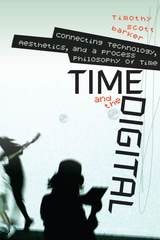
Time and the Digital
Connecting Technology, Aesthetics, and a Process Philosophy of TimeTimothy Scott Barker
Dartmouth College Press, 2012