Results by title

5 books match the query 'Technology and women'

cover of Black Girl Autopoetics: Agency in Everyday Digital Practice

Black Girl Autopoetics

Agency in Everyday Digital Practice

Ashleigh Greene Wade

Duke University Press, 2024
In Black Girl Autopoetics Ashleigh Greene Wade explores how Black girls create representations of themselves in digital culture with the speed and flexibility enabled by smartphones. She analyzes the double bind Black girls face when creating content online: on one hand, their online activity makes them hypervisible, putting them at risk for cyberbullying, harassment, and other forms of violence; on the other hand, Black girls are rarely given credit for their digital inventiveness, rendering them invisible. Wade maps Black girls’ everyday digital practices, showing what their digital content reveals about their everyday experiences and how their digital production contributes to a broader archive of Black life. She coins the term Black girl autopoetics to describe how Black girls’ self-making creatively reinvents cultural products, spaces, and discourse in digital space. Using ethnographic research into the digital cultural production of adolescent Black girls throughout the United States, Wade draws a complex picture of how Black girls navigate contemporary reality, urging us to listen to Black girls’ experience and learn from their techniques of survival.
[more]
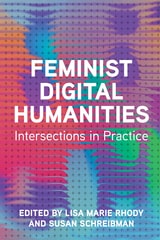
cover of Feminist Digital Humanities: Intersections in Practice

Feminist Digital Humanities

Intersections in Practice

Edited by Lisa Marie Rhody and Susan Schreibman

University of Illinois Press, 2025

Feminist digital humanities offers opportunities for exploring, exposing, and revaluing marginalized forms of knowledge and enacting new processes for creating meaning. Lisa Marie Rhody and Susan Schreibman present essays that explore digital humanities practice as rich terrain for feminist creativity and critique.

The editors divide the works into three categories. In the first section, contributors offer readings that demonstrate how feminist thought can be put into operation through digital practice or via analytical approaches, methodologies, and interpretations. A second section structured around infrastructure considers how technologies of knowledge creation, publication, access, and sharing can be formed or reformed through feminist values. The final section focuses on pedagogies and proposes feminist strategies for preparing students to become critical and confident readers with and against technologies.

Aimed at readers in and out of the classroom, Feminist Digital Humanities reveals the many ways scholars have pushed beyond critique to practice digital humanities in new ways.

Contributors: Daniela Agostinho, Monika Barget, Jenny Bergenmar, Susan Brown, Tanya E Clement, Katrine Dirckinck-Holmfeld, Jaime Lee Kirtz, Cecilia Lindhé, Laura Mandell, Lisa Marie Rhody, Mark Sample, Susan Schreibman, Andie Silva, Nikki L. Stevens, Ravynn K. Stringfield, Dhanashree Thorat, Nanna Bonde Thylstrup, Kristin Veel, Astrid von Rosen, and Jacqueline Wernimont

[more]
cover of Insufferable Tools: Feminism Against Big Tech

Insufferable Tools

Feminism Against Big Tech

Sarah Sharma

Duke University Press, 2026

In a world seemingly run by the whims and power plays of Musks and Zucks, Insufferable Tools cuts to the core of modern technology’s gendered politics. Sarah Sharma challenges the idea that the Big Tech broligarchs are neutral utilitarians who view technology as mere tools. She shows instead how these tech giants have turned the internet, and, increasingly, “real life” into a set of environments which they cultivate and manipulate to wield the real tools: us, the users. Sharma critiques a popular system of inclusion she calls “Big Tech Feminism” that attempts to incorporate and make useful people of color, queer people, and others who are seen as broken machines in the current gendered power structures. Deconstructing Big Tech’s patriarchal deployment of media theory to gain and maintain power, Sharma proposes a feminist techno-politics that can forge new futures free from the grip of the truly insufferable tools.
[more]
cover of My Fair Ladies: Female Robots, Androids, and Other Artificial Eves

My Fair Ladies

Female Robots, Androids, and Other Artificial Eves

Wosk, Julie

Rutgers University Press, 2015

Runner-up for the 2015 Science Fiction and Technoculture Studies Book Prize 

The fantasy of a male creator constructing his perfect woman dates back to the Greek myth of Pygmalion and Galatea. Yet as technology has advanced over the past century, the figure of the lifelike manmade woman has become nearly ubiquitous, popping up in everything from Bride of Frankenstein to Weird Science to The Stepford Wives. Now Julie Wosk takes us on a fascinating tour through this bevy of artificial women, revealing the array of cultural fantasies and fears they embody. 
 
My Fair Ladies considers how female automatons have been represented as objects of desire in fiction and how “living dolls” have been manufactured as real-world fetish objects. But it also examines the many works in which the “perfect” woman turns out to be artificial—a robot or doll—and thus becomes a source of uncanny horror. Finally, Wosk introduces us to a variety of female artists, writers, and filmmakers—from Cindy Sherman to Shelley Jackson to Zoe Kazan—who have cleverly crafted their own images of simulated women. 
 
Anything but dry, My Fair Ladies draws upon Wosk’s own experiences as a young female Playboy copywriter and as a child of the “feminine mystique” era to show how images of the artificial woman have loomed large over real women’s lives. Lavishly illustrated with film stills, artwork, and vintage advertisements, this book offers a fresh look at familiar myths about gender, technology, and artistic creation. 
 
 
[more]
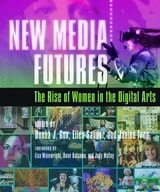
cover of New Media Futures: The Rise of Women in the Digital Arts

New Media Futures

The Rise of Women in the Digital Arts

Edited by Donna J. Cox, Ellen Sandor, and Janine Fron

University of Illinois Press, 2018

Trailblazing women working in digital arts media and education established the Midwest as an international center for the artistic and digital revolution in the 1980s and beyond. Foundational events at the University of Illinois and the School of the Art Institute of Chicago created an authentic, community-driven atmosphere of creative expression, innovation, and interdisciplinary collaboration that crossed gender lines and introduced artistically informed approaches to advanced research. Interweaving historical research with interviews and full-color illustrations, New Media Futures captures the spirit and contributions of twenty-two women working within emergent media as diverse as digital games, virtual reality, medicine, supercomputing visualization, and browser-based art. The editors and contributors give voice as creators integral to the development of these new media and place their works at the forefront of social change and artistic inquiry. What emerges is the dramatic story of how these Midwestern explorations in the digital arts produced a web of fascinating relationships. These fruitful collaborations helped usher in the digital age that propelled social media. Contributors: Carolina Cruz-Niera, Colleen Bushell, Nan Goggin, Mary Rasmussen, Dana Plepys, Maxine Brown, Martyl Langsdorf, Joan Truckenbrod, Barbara Sykes, Abina Manning, Annette Barbier, Margaret Dolinsky, Tiffany Holmes, Claudia Hart, Brenda Laurel, Copper Giloth, Jane Veeder, Sally Rosenthal, Lucy Petrovic, Donna J. Cox, Ellen Sandor, and Janine Fron.
 
[more]