Results by title
3 books match the query 'Technology in art'
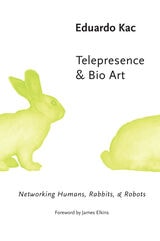
Telepresence and Bio Art
Networking Humans, Rabbits and RobotsEduardo Kac
University of Michigan Press, 2005
"Eduardo Kac's work represents a turning point. What it questions is our current attitudes to creativity, taking that word in its most fundamental sense."
-Edward Lucie-Smith, author of Visual Arts in the 20th Century
"His works introduce a vital new meaning into what had been known as the creative process while at the same time investing the notion of the artist-inventor with an original social and ethical responsibility."
-Frank Popper, author of Origins and Development of Kinetic Art
"Kac's radical approach to the creation and presentation of the body as a wet host for artificial memory and 'site-specific' work raises a variety of important questions that range from the status of memory in digital culture to the ethical dilemmas we are facing in the age of bioengineering and tracking technology."
-Christiane Paul, Whitney Museum of Art
For nearly two decades Eduardo Kac has been at the cutting edge of media art, first inventing early online artworks for the web and continuously developing new art forms that involve telecommunications and robotics as a new platform for art. Interest in telepresence, also known as telerobotics, exploded in the 1990s, and remains an important development in media art. Since that time, Kac has increasingly moved into the fields of biology and biotechnology.
Telepresence and Bio Art is the first book to document the evolution of bio art and the aesthetic development of Kac, the creator of the "artist's gene" as well as the controversial glow-in-the-dark, genetically engineered rabbit Alba. Kac covers a broad range of topics within media art, including telecommunications media, interactive systems and the Internet, telematics and robotics, and the contact between electronic art and biotechnology. Addressing emerging and complex topics, this book will be essential reading for anyone interested in contemporary art.
[more]
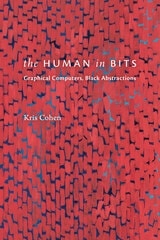
The Human in Bits
Graphical Computers, Black AbstractionsKris Cohen
Duke University Press, 2025
In The Human in Bits, Kris Cohen examines black abstractionist painting to demonstrate how race and computation are intimately entangled with the personal computer’s graphic user interface. He shows how the personal computer and the graphical field of its screen meant to transform the human by transforming what environments humans were to labor in. It also provided the means for whiteness to tie itself to notions of colorblind meritocracy. Cohen focuses on the post-1960s experiments of black abstractionists Alma Thomas, Jack Whitten, Charles Gaines, and Julie Mehretu, who developed a nonrepresentational approach to blackness that was oriented more toward constraint than human expression. From Gaines’s use of grids to Mehretu’s layering of paint, these artists—in their knowledge that black life had always been conflated with numbers and bits of information—flirted with repetition, systems, and formulas to test other ways of being human. By demonstrating how these artists bypassed the white fear that the human would become interchangeable with data, Cohen reframes modernism and modernist art to account for racialization in computational cultures.
[more]
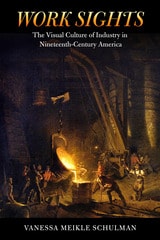
Work Sights
The Visual Culture of Industry in Nineteenth-Century AmericaVanessa Meikle Schulman
University of Massachusetts Press, 2015
In this extensively illustrated work, Vanessa Meikle Schulman reveals how visual representations of labor, technology, and industry were crucial in shaping the way nineteenth-century Americans understood their nation and its place in the world. Her focus is the period between 1857 and 1887, an era marked by the rapid expansion of rail and telegraph networks, the rise of powerful, centralized corporations, and the creation of specialized facilities for the mechanized production and distribution of products. Through the examination of popular as well as fine art—news illustrations and paintings of American machines, workers, factories, and technical innovations—she illuminates an evolving tension between the perception of technology and industry as rational, logical, and systemic on the one hand and as essentially unknowable, strange, or irrational on the other.
Ranging across the fields of art history, visual studies, the history of technology, and American studies, Work Sights captures both the richness of nineteenth-century American visual culture and the extent to which Americans had begun to perceive their country as a modern nation connected by a web of interlocking technological systems.
Ranging across the fields of art history, visual studies, the history of technology, and American studies, Work Sights captures both the richness of nineteenth-century American visual culture and the extent to which Americans had begun to perceive their country as a modern nation connected by a web of interlocking technological systems.
[more]