Results by title
4 books match the query 'Telò, Mario'
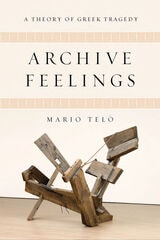
Archive Feelings
A Theory of Greek TragedyMario Telò
The Ohio State University Press, 2020
Do we take pleasure in reading ancient Greek tragedy despite the unsettling content or because of it? Does a safe aesthetic distance protect us from tragic suffering, or does the proximity to death tap into something more primal? Aristotle proposed catharsis, an emotional cleansing—or, in later interpretations, a sense of equilibrium—as tragedy’s outcome, and Sigmund Freud and Jacques Lacan, grand theorists of the forces of anti-mastery in human and nonhuman existence, surprisingly agreed. Notwithstanding this deferral to Aristotle, their theorizations of the death drive—together with Jacques Derrida’s notion of the archive as a place of conservation that inevitably fails—provide the groundwork for a radically new way of understanding tragic aesthetics.
With bold readings of thirteen plays by Aeschylus, Sophocles, and Euripides, including the Oedipus cycle, the Oresteia,Medea, and Bacchae; an eclectic synthesis of Freud, Lacan, Derrida, Žižek, Deleuze, and other critical theorists; and an engagement with art, architecture, and film, Mario Telò’s Archive Feelings: A Theory of Greek Tragedy locates Greek tragedy’s aesthetic allure beyond catharsis in a vertiginous sense of giddy suspension, in a spiral of life and death that resists equilibrium, stabilization, and all forms of normativity. In so doing, Telò forges a new model of tragic aesthetics.
With bold readings of thirteen plays by Aeschylus, Sophocles, and Euripides, including the Oedipus cycle, the Oresteia,Medea, and Bacchae; an eclectic synthesis of Freud, Lacan, Derrida, Žižek, Deleuze, and other critical theorists; and an engagement with art, architecture, and film, Mario Telò’s Archive Feelings: A Theory of Greek Tragedy locates Greek tragedy’s aesthetic allure beyond catharsis in a vertiginous sense of giddy suspension, in a spiral of life and death that resists equilibrium, stabilization, and all forms of normativity. In so doing, Telò forges a new model of tragic aesthetics.
[more]
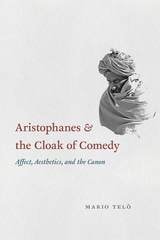
Aristophanes and the Cloak of Comedy
Affect, Aesthetics, and the CanonMario Telò
University of Chicago Press, 2016
The Greek playwright Aristophanes (active 427–386 BCE) is often portrayed as the poet who brought stability, discipline, and sophistication to the rowdy theatrical genre of Old Comedy. In this groundbreaking book, situated within the affective turn in the humanities, Mario Telò explores a vital yet understudied question: how did this view of Aristophanes arise, and why did his popularity eventually eclipse that of his rivals?
Telò boldly traces Aristophanes’s rise, ironically, to the defeat of his play Clouds at the Great Dionysia of 423 BCE. Close readings of his revised Clouds and other works, such as Wasps, uncover references to the earlier Clouds, presented by Aristophanes as his failed attempt to heal the audience, who are reflected in the plays as a kind of dysfunctional father. In this proto-canonical narrative of failure, grounded in the distinctive feelings of different comic modes, Aristophanic comedy becomes cast as a prestigious object, a soft, protective cloak meant to shield viewers from the debilitating effects of competitors’ comedies and restore a sense of paternal responsibility and authority. Associations between afflicted fathers and healing sons, between audience and poet, are shown to be at the center of the discourse that has shaped Aristophanes’s canonical dominance ever since.
Telò boldly traces Aristophanes’s rise, ironically, to the defeat of his play Clouds at the Great Dionysia of 423 BCE. Close readings of his revised Clouds and other works, such as Wasps, uncover references to the earlier Clouds, presented by Aristophanes as his failed attempt to heal the audience, who are reflected in the plays as a kind of dysfunctional father. In this proto-canonical narrative of failure, grounded in the distinctive feelings of different comic modes, Aristophanic comedy becomes cast as a prestigious object, a soft, protective cloak meant to shield viewers from the debilitating effects of competitors’ comedies and restore a sense of paternal responsibility and authority. Associations between afflicted fathers and healing sons, between audience and poet, are shown to be at the center of the discourse that has shaped Aristophanes’s canonical dominance ever since.
[more]
Classics Beyond the Pleasure Principle
Edited by Paul Allen Miller and Mario Telò
The Ohio State University Press, 2026
Classics Beyond the Pleasure Principle explores the concept of the Freudian death drive to interrogate both the ancient past and the present, highlighting how destruction and its remnants resist erasure and shape historical memory. Using Gaza’s rubble as a metaphor for the indestructibility of violence’s material traces, the text connects ancient Greco-Roman culture—from Homer and Sophocles to Ovid and Seneca—with modern figures and events, from Elena Ferrante to the war in Israel and Palestine. The volume engages psychoanalytic theory, queer theory, and feminism to challenge the boundaries of classical studies, arguing that only by confronting the discipline’s entanglement with the pleasure principle and its repressions can classics contribute to understanding the crises of the present and imagining a future distinct from the past.
Contributors:
Karen Bassi, Martin Devecka, Micaela Janan, Hagi Kenaan, Vered Lev Kenaan, Sara Lindheim, Paul Allen Miller, Helen Morales, Jay Oliver, Victoria Rimell, Mario Telò
Contributors:
Karen Bassi, Martin Devecka, Micaela Janan, Hagi Kenaan, Vered Lev Kenaan, Sara Lindheim, Paul Allen Miller, Helen Morales, Jay Oliver, Victoria Rimell, Mario Telò
[more]
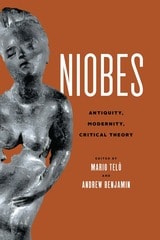
Niobes
Antiquity, Modernity, Critical TheoryEdited by Mario Telò and Andrew Benjamin
The Ohio State University Press, 2024
A marginalized but persistent figure of Greek tragedy, Niobe, whose many children were killed by Apollo and Artemis, embodies yet problematizes the philosophically charged dialectics between life and death, mourning and melancholy, animation and inanimation, silence and logos. The essays in Niobes present her as a set of complex figurations, an elusive mythical character but also an overdetermined figure who has long exerted a profound influence on various modes of modern thought, especially in the domains of aesthetics, ethics, psychoanalysis, and politics. As a symbol of both exclusion and resistance, Niobe calls for critical attention at a time of global crisis. Reconstructing the dialogues of Phillis Wheatley, G. W. F. Hegel, Walter Benjamin, Aby Warburg, and others with Niobe as she appears in Aeschylus, Sophocles, Ovid, and the visual arts, a collective of major thinkers—classicists, art historians, and critical theorists—reflect on the space that she can occupy in the humanities today. Inspiring new ways of connecting the classical tradition and ancient tragic discourse with crises and political questions relating to gender, race, and social justice, Niobe insists on living on. Contributors: Barbara Baert, Andrew Benjamin, drea brown, Adriana Cavarero, Rebecca Comay, Mildred Galland-Szymkowiak, John T. Hamilton, Paul A. Kottman, Jacques Lezra, Andres Matlock, Ben Radcliffe, Victoria Rimell, Mario Telò, Mathura Umachandran, Daniel Villegas Vélez
[more]