Results by title
4 books match the query 'Television and children'
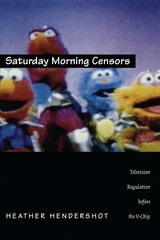
Saturday Morning Censors
Television Regulation before the V-ChipHeather Hendershot
Duke University Press, 1999
Many parents, politicians, and activists agree that there’s too much violence and not enough education on children’s television. Current solutions range from the legislative (the Children’s Television Act of 1990) to the technological (the V-chip). Saturday Morning Censors examines the history of adults’ attempts to safeguard children from the violence, sexism, racism, and commercialism on television since the 1950s. By focusing on what censorship and regulation are and how they work—rather than on whether they should exist—Heather Hendershot shows how adults use these processes to reinforce their own ideas about childhood innocence.
Drawing on archival studio material, interviews with censors and animators, and social science research, Hendershot analyzes media activist strategies, sexism and racism at the level of cartoon manufacture, and the product-linked cartoons of the 1980s, such as Strawberry Shortcake and Transformers. But in order to more fully examine adult reception of children’s TV, she also discusses “good” programs like Sesame Street and Fat Albert and the Cosby Kids. Providing valuable historical context for debates surrounding such current issues as the V-chip and the banning of Power Rangers toys in elementary schools, Saturday Morning Censors demonstrates how censorship can reveal more fears than it hides.
Saturday Morning Censors will appeal to educators, parents, and media activists, as well as to those in cultural studies, television studies, gender studies, and American social history.
[more]
Science as a Carreer Choice
Theoretical and Empirical StudiesBernice T. Ediuson
Russell Sage Foundation, 1974
How can we identify the young men and women who, as social and behavioral scientists of tomorrow, will do the needed research to resolve our burgeoning social problems? How can the most promising be attracted to an investigatory career? How can they become identified with the behaviors, attitudes and values that persons in science share? A provocative body of literature about the psychology of the scientist and his career emerged in the post-Sputnik era. Drs. Eiduson and Beckman bring together more than seventy of the most significant and representative studies. These range over childhood and family influences, academic experiences, motivations, interests, and intellectual and personality strengths that have been examined as precursors for choosing science as adult work. The psychological mechanisms involved in socializing a young person toward a scientific career are suggested in readings from the outstanding theoreticians in the field. Selections on scientific career lines, decisions and options at various stages of work, and factors influencing goals and career development contribute to the understanding of the psychological life of the highly endowed and well-functioning professional adult. Through showing the certain completeness of effort of what has been learned about the psychology of scientists to date, the authors anticipate a resurgence of interest in the creative individual, a renewed enthusiasm for application, and a refocusing of research on the issues unique to the social and behavioral research scientist.
[more]
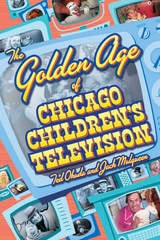
The Golden Age of Chicago Children's Television
Ted Okuda and Jack Mulqueen
Southern Illinois University Press, 2004
At one time every station in Chicago—a maximum of five, until 1964–produced or aired some programming for children. From the late 1940’s through the early 1970’s, local television stations created a golden age of children’s television unique in American broadcasting. Though the shows often operated under strict budgetary constraints, these programs were rich in imagination, inventiveness, and devoted fans. Now, discover the back stories and details of this special era from the people who created, lived, and enjoyed it—producers, on-air personalities, and fans.
[more]
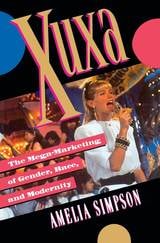
Xuxa
The Mega-Marketing of Gender, Race, and ModernityAmelia Simpson
Temple University Press, 1993
"A fascinating new book...[that] offers a lucid academic critique of Xuxa's persona."
--Entertainment Weekly
Former Playboy centerfold and soft-porn movie actress Xuxa (SHOO-sha) emerged in the 1980s as Brazil's mass media megastar. Through her children's television show, which reaches millions of people in Latin America and the United States, this blond sex symbol has attained extraordinary cultural authority. Reaching far beyond younger audiences, Xuxa's show informs the culture at large about gender relations, racial democracy, and idealized beauty.
Backed by Brazil's TV Globo, the fourth-largest commercial network in the world, Xuxa has built an empire. Amelia Simoson's colorful portrayal is the first book to explore how Xuxa's representation of femininity, her privileging of a white ideal of beauty, and her promotional approach to culture perpetuate inequality on an unprecedented scale. Simpson's thoughtful analysis exposes the complicity of a mass audience eager to celebrate Xuxa's deeply compromised representations of gender, race, and modernity.
Xuxa also explores the meaning behind the myth--Xuxa's long-term relationship with Brazil's soccer idol, Pelé, and the near-worship of her atypical blond, blue-eyed appearance by Brazil's population. As the author examines Xuxa's suggestive style juxtaposed with juvenile entertainment, and the phenomenon of Xuxa-look-alike teenaged paquitas, she unfold the symbolic territory of blond sex symbols worldwide.
"Simpson has brought the facts and persona of Xuxa together in this well-documented, well-written analysis of the Brazilian superstar. She touches bases on gender, race, and changing patterns in Brazil. Xuxa is rich with information, laced with insight about the methods, practices and abuses that abound with the marketing of a personality and its products, and the effect of TV on all who watch it, especially the children."
--News from Brazil
[more]