Results by title
7 books match the query 'Television and women'
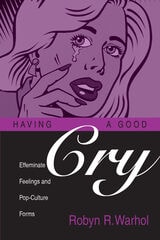
HAVING A GOOD CRY
Effeminate Feelings and Pop-Culture FormsRobyn R. Warhol
The Ohio State University Press, 2003
Robyn R. Warhol’s goal is to investigate the effects of readers’ emotional responses to formulaic fiction of the nineteenth and twentieth centuries on gendered subjectivity. She argues that modern literary and cultural studies have ignored nonsexual affectivity in their inquiries. The book elaborates on Warhol’s theory of affect and then focuses on sentimental stories, marriage plots, serialized novels, and soap operas as distinct genres producing specific feelings among fans.
Popular narrative forms use formulas to bring up familiar patterns of feelings in the audiences who love them. This book looks at the patterns of feelings that some nineteenth- and twentieth-century popular genres evoke, and asks how those patterns are related to gender. Soap operas and sentimentalism are generally derided as “effeminate” forms because their emotional range is seen as hyperfeminine. Having a Good Cry presents a celebration of effeminate feelings and works toward promoting more flexible, less pejorative concepts of gender. Using a psychophysiological rather than a psychoanalytic approach to reading and emotion, Warhol seeks to make readers more conscious of what is happening to the gendered body when we read.
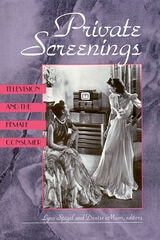
Private Screenings
Television and the Female ConsumerLynn Spigel
University of Minnesota Press, 1992
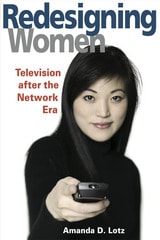
REDESIGNING WOMEN
Television after the Network EraAmanda D. Lotz
University of Illinois Press, 2010
Employing a cultural studies framework, Lotz examines whether the multiplicity of female-centric networks and narratives renders certain gender stereotypes uninhabitable, and how new dramatic portrayals of women have redefined narrative conventions. Redesigning Women also reveals how these changes led to narrowcasting, or the targeting of a niche segment of the overall audience, and the ways in which the new, sophisticated portrayals of women inspire sympathetic identification while also commodifying viewers into a marketable demographic for advertisers.
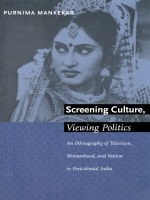
Screening Culture, Viewing Politics
An Ethnography of Television, Womanhood, and Nation in Postcolonial IndiaPurnima Mankekar
Duke University Press, 1999
Mankekar examines both “entertainment” narratives and advertisements designed to convey particular ideas about the nation. Organizing her study around the recurring themes in these shows—Indian womanhood, family, community, constructions of historical memory, development, integration, and sometimes violence—Mankekar dissects both the messages televised and her New Delhi subjects’ perceptions of and reactions to these messages. In the process, her ethnographic analysis reveals the texture of these women’s daily lives, social relationships, and everyday practices. Throughout her study, Mankekar remains attentive to the tumultuous historical and political context in the midst of which these programs’ integrationalist messages are transmitted, to the cultural diversity of the viewership, and to her own role as ethnographer. In an enlightening epilogue she describes the effect of satellite television and transnational programming to India in the 1990s.
Through its ethnographic and theoretical richness, Screening Culture, Viewing Politics forces a reexamination of the relationship between mass media, social life, and identity and nation formation in non-Western contexts. As such, it represents a major contribution to a number of fields, including media and communication studies, feminist studies, anthropology, South Asian studies, and cultural studies.

Speaking of Abortion
Television and Authority in the Lives of WomenAndrea L. Press and Elizabeth R. Cole
University of Chicago Press, 1999

Television, History, and American Culture
Feminist Critical EssaysMary Beth Haralovich and Lauren Rabinovitz, eds.
Duke University Press, 1999
The essays collected here focus on women in front of, behind, and on the TV screen, as producers, viewers, and characters. Using feminist and historical criticism, the contributors investigate how television has shaped our understanding of gender, power, race, ethnicity, and sexuality from the 1950s to the present. The topics range from the role that women broadcasters played in radio and early television to the attempts of Desilu Productions to present acceptable images of Hispanic identity, from the impact of TV talk shows on public discourse and the politics of offering viewers positive images of fat women to the negotiation of civil rights, feminism, and abortion rights on news programs and shows such as I Spy and Peyton Place.
Innovative and accessible, this book will appeal to those interested in women’s studies, American studies, and popular culture and the critical study of television.
Contributors. Julie D’Acci, Mary Desjardins, Jane Feuer, Mary Beth Haralovich, Michele Hilmes, Moya Luckett, Lauren Rabinovitz, Jane M. Shattuc, Mark Williams
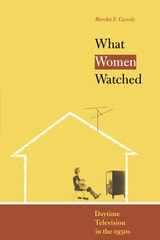
What Women Watched
Daytime Television in the 1950sBy Marsha F. Cassidy
University of Texas Press, 2005
In this pathfinding book, based on original archival research, Marsha F. Cassidy offers the first thorough analysis of daytime television's earliest and most significant women's genres, appraising from a feminist perspective what women watched before soap opera rose to prominence.
After providing a comprehensive history of the early days of women's programming across the nation, Cassidy offers a critical discussion of the formats, programs, and celebrities that launched daytime TV in America—Kate Smith's variety show and the famed singer's unsuccessful transition from patriotic radio star to 1950s TV idol; the "charm boys" Garry Moore, Arthur Godfrey, and Art Linkletter, whose programs honored women's participation but in the process established the dominance of male hosts on TV; and the "misery shows" Strike It Rich and Glamour Girl and the controversy, both critical and legal, they stirred up.
Cassidy then turns to NBC's Home show, starring the urbane Arlene Francis, who infused the homemaking format with Manhattan sophistication, and the ambitious daily anthology drama Matinee Theater, which strove to differentiate itself from soap opera and become a national theater of the air. She concludes with an analysis of four popular audience participation shows of the era—the runaway hit Queen for a Day; Ralph Edwards's daytime show of surprises, It Could Be You; Who Do You Trust?, starring a youthful Johnny Carson; and The Big Payoff, featuring Bess Myerson, the country's first Jewish Miss America. Cassidy's close feminist reading of these shows clearly demonstrates how daytime TV mirrored the cultural pressures, inconsistencies, and ambiguities of the postwar era.