Results by title
85 books match the query 'Television broadcasting' and 5 start with a
A Thousand Screenplays
The French Imagination in a Time of CrisisSabine Chalvon-Demersay
University of Chicago Press, 1999
The time of crisis presented by the amateur writers was not one of war, famine, or disease—it was the millennial dilemma of representation. In a world plagued by alienation, individualization, and a lack of mobility, how can members of a society combat their declining senses of self?
Although the contestants wrote about life in France, their concerns and struggles have a distinctly universal ring. A lucid, witty writer, Chalvon-Demersay offers a clear, if still developing, photograph of the contemporary imagination.
Adventures in Shondaland
Identity Politics and the Power of RepresentationGriffin, Rachel Alicia
Rutgers University Press, 2018
Shonda Rhimes is one of the most powerful players in contemporary American network television. Beginning with her break-out hit series Grey’s Anatomy, she has successfully debuted Private Practice, Scandal, How to Get Away with Murder, The Catch, For The People, and Station 19. Rhimes’s work is attentive to identity politics, “post-” identity politics, power, and representation, addressing innumerable societal issues. Rhimes intentionally addresses these issues with diverse characters and story lines that center, for example, on interracial friendships and relationships, LGBTIQ relationships and parenting, the impact of disability on familial and work dynamics, and complex representations of womanhood. This volume serves as a means to theorize Rhimes’s contributions and influence by inspiring provocative conversations about television as a deeply politicized institution and exploring how Rhimes fits into the implications of twenty-first century television.

Ambient Television
Visual Culture and Public SpaceAnna McCarthy
Duke University Press, 2001
Discussing the roles television has played in different institutions from 1945 to the present day, McCarthy draws on a wide array of sources. These include retail merchandising literature, TV industry trade journals, and journalistic discussions of public viewing, as well as the work of cultural geographers, architectural theorists, media scholars, and anthropologists. She also uses photography as a research tool, documenting the uses and meanings of television sets in the built environment, and focuses on such locations as the tavern and the department store to show how television is used to support very different ideas about gender, class, and consumption. Turning to contemporary examples, McCarthy discusses practices such as Turner Private Networks’ efforts to transform waiting room populations into advertising audiences and the use of point-of-sale video that influences brand visibility and consumer behavior. Finally, she inquires into the activist potential of out-of-home television through a discussion of the video practices of two contemporary artists in everyday public settings.
Scholars and students of cultural, visual, urban, American, film, and television studies will be interested in this thought-provoking, interdisciplinary book.
America's First Network TV Censor
The Work of NBC's Stockton HelffrichRobert Pondillo
Southern Illinois University Press, 2010
While other books have cited Helffrich’s reports, none have considered them as a body of work, complemented by the details of Helffrich’s life and the era in which he lived. America’s First Network TV Censor explores the ways in which Helffrich’s personal history and social class influenced his perception of his role as NBC-TV censor and his tendency to ignore certain political and cultural taboos while embracing others.
Author Robert Pondillo considers Helffrich’s life in broadcasting before and after the Second World War, and his censorial work in the context of 1950s American culture and emerging network television. Pondillo discusses the ways that cultural phenomena, including the arrival of the mid-twentieth-century religious boom, McCarthyism, the dawn of the Civil Rights era, and the social upheaval over sex, music, and youth, contributed to a general sense that the country was morally adrift and ripe for communist takeover.
Five often-censored subjects—advertising, language, and depictions of sex, violence, and race—are explored in detail, exposing the surprising complexity and nuance of early media censorship. Questions of whether too many sadistic westerns would coarsen America’s children, how to talk about homosexuality without using the word “homosexuality,” and how best to advertise toilet paper without offending people were on Helffrich’s mind; his answers to these questions helped shape the broadcast media we know today.
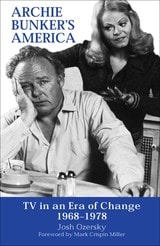
Archie Bunker's America
TV in an Era of Change 1968-1978Josh Ozersky. Foreword by Mark Crispin Miller
Southern Illinois University Press, 2003
Around 1968, advertisers who were anxious to break into the lucrative baby-boomer demographic convinced television networks to begin to abandon prime-time programming that catered to universal audiences. With the market splintering, networks ventured into more issue-based and controversial territories. While early network attempts at more “relevant” programming failed, Ozersky examines how CBS struck gold with the political comedy All in the Family in 1971 and how other successful, conflict-based comedies turned away from typical show business conventions. As the 1970s wore on, the innovations of the previous years began to lose their public appeal. After Vietnam and Watergate, Ozersky argues, Americans were exhausted from the political turbulence of the preceding decade and were ready for a televisual “return to normalcy.”
Straightforward, engaging, and liberally illustrated, Archie Bunker’s America is peppered with the stories of outsider cops and failed variety shows, of a young Bill Murray and an old Ed Sullivan, of Mary Tyler Moore, Fonzie, and the Skipper, too. Drawing on interviews with television insiders, trade publications, and the programs themselves, Ozersky chronicles the ongoing attempts of prime-time television to program for a fragmented audience—an audience whose greatest common denominator, by 1978, may well have been the act of watching television itself. The book also includes a foreword by renowned media critic Mark Crispin Miller and an epilogue of related commentary on the following decades.