Results by title
3 books match the query 'Television cop shows'
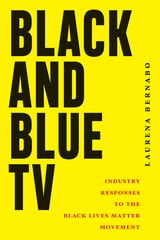
Black and Blue TV
Industry Responses to the Black Lives Matter MovementLaurena Bernabo
Rutgers University Press, 2026
Black and Blue TV explores the ways television productions have responded to the Black Lives Matter movement. Television programs’ engagement with BLM was common before George Floyd’s murder sparked international protests in the summer of 2020, at which point it became nearly unavoidable for many series. Images of police using violence against Black Americans fueled criticisms of the role of television—especially cop shows—in perpetuating “copaganda,” highlighting the fact that television’s cops are nearly always the good guys, even when they break the law and use excessive force. Black and Blue TV identifies trends and anomalies in television’s engagement with BLM but also investigates the people who influence what those representations look like. Pairing textual criticism with interviews with television creatives, executives, and media activists, author Laurena Bernabo traces shifts in how these individuals understand their role in televisual culture and the cultural forum of narratives that are produced and distributed as a result.
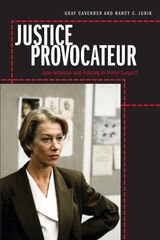
Justice Provocateur
Jane Tennison and Policing in Prime SuspectGray Cavender and Nancy C. Jurik
University of Illinois Press, 2012
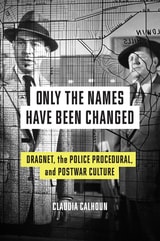
Only the Names Have Been Changed
Dragnet, the Police Procedural, and Postwar CultureClaudia Calhoun
University of Texas Press, 2022
Winner of the 2022 Peter C. Rollins Book Prize, Northeast Popular Culture Association (NEPCA)
In the postwar era, the police procedural series Dragnet informed Americans on the workings of the criminal justice system and instructed them in their responsibilities as citizens.
Among shifting politics, tastes, and technology in television history, one genre has been remarkably persistent: the cop show. Claudia Calhoun returns to Dragnet, the pioneering police procedural and an early transmedia franchise, appearing on radio in 1949, on TV and in film in the 1950s, and in later revivals. More than a popular entertainment, Dragnet was a signifier of America’s postwar confidence in government institutions—and a publicity vehicle for the Los Angeles Police Department.
Only the Names Have Been Changed shows how Dragnet’s “realistic” storytelling resonated across postwar culture. Calhoun traces Dragnet’s “semi-documentary” predecessors, and shows how Jack Webb, Dragnet’s creator, worked directly with the LAPD as he produced a series that would likewise inspire public trust by presenting day-to-day procedural justice, rather than shootouts and wild capers. Yet this realism also set aside the seething racial tensions of Los Angeles as it was. Dragnet emerges as a foundational text, one that taught audiences to see police as everyday heroes not only on TV but also in daily life, a lesson that has come under scrutiny as Americans increasingly seek to redefine the relationship between policing and public safety.