Results by title
17 books match the query 'Television viewers'
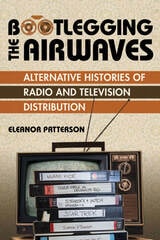
Bootlegging the Airwaves
Alternative Histories of Radio and Television DistributionEleanor Patterson
University of Illinois Press, 2024
Long before internet archives and the anytime, anywhere convenience of streaming, people collected, traded, and shared radio and television content via informal networks that crisscrossed transnational boundaries.
Eleanor Patterson’s fascinating cultural history explores the distribution of radio and TV tapes from the 1960s through the 1980s. Looking at bootlegging against the backdrop of mass media’s formative years, Patterson delves into some of the major subcultures of the era. Old-time radio aficionados felt the impact of inexpensive audio recording equipment and the controversies surrounding programs like Amos ‘n’ Andy. Bootlegging communities devoted to buddy cop TV shows like Starsky and Hutch allowed women to articulate female pleasure and sexuality while Star Trek videos in Australia inspired a grassroots subculture built around community viewings of episodes. Tape trading also had a profound influence on creating an intellectual pro wrestling fandom that aided wrestling’s growth into an international sports entertainment industry.
Broadcasting Hollywood
The Struggle over Feature Films on Early TVJennifer Porst
Rutgers University Press, 2021
Changing Minds or Changing Channels?
Partisan News in an Age of ChoiceKevin Arceneaux and Martin Johnson
University of Chicago Press, 2013
Creating the Viewer
Market Research and the Evolving Media EcosystemJustin Wyatt
University of Texas Press, 2024
A study of the largely hidden world of primary media market research and the different methods used to understand how the viewer is pictured in the industry.
The first book on the intersection between market research and media, Creating the Viewer takes a critical look at media companies’ studies of television viewers, the assumptions behind these studies, and the images of the viewer that are constructed through them. Justin Wyatt examines various types of market research, including talent testing, pilot testing, series maintenance, brand studies, and new show “ideation,” providing examples from a range of programming including news, sitcoms, reality shows, and dramas. He looks at brand studies for networks such as E!, and examines how the brands of individuals such as showrunner Ryan Murphy can be tested. Both an analytical and practical work, the book includes sample questionnaires and paths for study moderators and research analysts to follow. Drawn from over fifteen years of experience in research departments at various media companies, Creating the Viewer looks toward the future of media viewership, discussing how the concept of the viewer has changed in the age of streaming, how services such as Netflix view market research, and how viewers themselves can shift the industry through their media choices, behaviors, and activities.

Media and Values
Intimate Transgressions in a Changing Moral and Cultural LandscapeDavid E. Morrison, Matthew Kieran, Michael Svennevig and Sarah Ventress
Intellect Books, 2007
Millennial Fandom
Television Audiences in the Transmedia AgeLouisa Ellen Stein
University of Iowa Press, 2015
These conflicting narratives of entrepreneurial creativity and digital immorality operate to quell the growing threat represented by millennials’ media agency. With fan activities becoming ever more visible on social media platforms including YouTube, Facebook, LiveJournal, Twitter, Polyvore, and Tumblr, the fan has become the avatar of our digital hopes and fears.
In an ambitious study encompassing a wide range of media texts, including popular television series like Kyle XY, Glee, Gossip Girl, Veronica Mars, and Pretty Little Liars and online works like The Lizzie Bennet Diaries, as well as fan texts from blog posts and tweets to remix videos, YouTube posts, and image-sharing streams, author Louisa Ellen Stein traces the circulation of the contradictory tropes of millennial hope and millennial noir. Looking at what millennials do with digital technology demonstrates the molding impact of commercial representations, and at the same time reveals how millennials are undermining, negotiating, and changing those narratives.
This generation—and the fans it represents—is actively transforming the media landscape into a dynamic, culturally transgressive space of collective authorship. Offering a rich and complex vision of the relationship between fandom and millennial culture, Millennial Fandom will interest fans, millennials, students, and scholars of contemporary media culture alike.
Over and Over
Performance, Time, and Resonance in Serial Television DramaElliott Logan
Rutgers University Press, 2026
How does serial drama earn, keep, and reward our attention for so long—over episodes, seasons, months, and years? While we know that characters are the focus of story and viewer interest in television fiction, scholars have for decades overlooked the way those characters are performed on-screen and the lure of performance as a key formal and thematic aspect of long-form television storytelling. In Over and Over, Elliott Logan offers close readings of performance in some of the most celebrated television dramas of the century, casting new light on the attractions and significance of the medium’s seriality. The book shows how the patterning and expressive resonance of performers on-screen binds together otherwise unconnected episodes of shows like The Sopranos and Mad Men. In doing so, it highlights the provisionality of identity and meaning as crucial to their interest in the sustenance of human relationships over long periods of time. In accounting for the resonance of performance over time in serial drama, this book shows, we find the terms of our own attachment to its compelling depictions of human life
Private Screenings
Television and the Female ConsumerLynn Spigel
University of Minnesota Press, 1992
Queerbaiting and Fandom
Teasing Fans through Homoerotic PossibilitiesJoseph Brennan
University of Iowa Press, 2019
In this first-ever comprehensive examination of queerbaiting, fan studies scholar Joseph Brennan and his contributors examine cases that shed light on the sometimes exploitative industry practice of teasing homoerotic possibilities that, while hinted at, never materialize in the program narratives. Through a nuanced approach that accounts for both the history of queer representation and older fan traditions, these essayists examine the phenomenon of queerbaiting across popular TV, video games, children’s programs, and more.
Contributors: Evangeline Aguas, Christoffer Bagger, Bridget Blodgett, Cassie Brummitt, Leyre Carcas, Jessica Carniel, Jennifer Duggan, Monique Franklin, Divya Garg, Danielle S. Girard, Mary Ingram-Waters, Hannah McCann, Michael McDermott, E. J. Nielsen, Emma Nordin, Holly Eva Katherine Randell-Moon, Emily E. Roach, Anastasia Salter, Elisabeth Schneider, Kieran Sellars, Isabela Silva, Guillaume Sirois, Clare Southerton
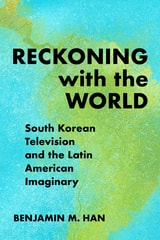
Reckoning with the World
South Korean Television and the Latin American ImaginaryBenjamin M. Han
Temple University Press, 2026
Historical dramas like The Land of Humans, about Korean migrants in Mexico, consider diasporic identity and nationalism, while the fantasy series Secret Garden explores issues of modernity. In addition, the TV drama Encounter and the entertainment show Traveler contrast the cultures of global Korea with Cuba. As these programs create appealing storytelling, characters, and aesthetics, they inspire and resonate with audiences and fans across the globe. However, Korean television’s imaginary of Latin America is not about its investment in fostering greater interculturality with Latin American nations and their cultures but instead projects a façade of progressive racial and cultural politics shaping Korea’s reckoning with the world.
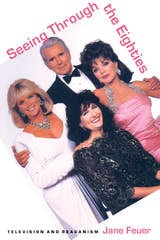
Seeing Through the Eighties
Television and ReaganismJane Feuer
Duke University Press, 1995
With a cast of characters including Michael, Hope, Elliot, Nancy, Melissa, and Gary; Alexis, Krystle, Blake, and all the other Carringtons; not to mention Maddie and David; even Crockett and Tubbs, Feuer smoothly blends close readings of well-known programs and analysis of television’s commercial apparatus with a thorough-going theoretical perspective engaged with the work of Baudrillard, Fiske, and others. Her comparative look at Yuppie TV, Prime Time Soaps, and made-for-TV-movie Trauma Dramas reveals the contradictions and tensions at work in much prime-time programming and in the frustrations of the American popular consciousness. Seeing Through the Eighties also addresses the increased commodification of both the producers and consumers of television as a result of technological innovations and the introduction of new marketing techniques. Claiming a close relationship between television and the cultures that create and view it, Jane Feuer sees the eighties through televison while seeing through television in every sense of the word.
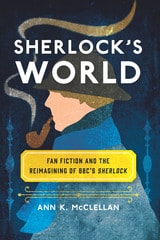
Sherlock's World
Fan Fiction and the Reimagining of BBC's SherlockAnn K. McClellan
University of Iowa Press, 2018
Sherlock Holmes remains more popular than ever some 130 years after the detective first appeared in print. These days, the iconic character’s staying power is due in large part to the success of the recent BBC series Sherlock, which brings the famous sleuth into the twenty-first century.
One of the most-watched television series in BBC history, Sherlock is set in contemporary London, where thirtysomething Sherlock and John (no longer fussy old Holmes and Watson), alongside New Scotland Yard, solve crimes with the help of smartphones, texting, online forums, and the internet. In their modernization of Sir Arthur Conan Doyle’s nineteenth-century world, Sherlock creators Stephen Moffatt and Mark Gatiss make London as much a character of their show as the actors themselves. The highly stylized series has inspired an impassioned fan community in Britain, the U.S., and beyond. Fans create and share their writings, which reimagine the characters in even more dramatic ways than the series can.
Interweaving fan fiction studies, world-building, and genre studies, Ann McClellan examines the hit series and the fan fiction it inspires. Using Sherlock to trace the changing face of fan fiction studies, McClellan’s book explores how far fans are willing to go to change the Sherlockian canon while still reinforcing its power and status as the source text. What makes Sherlock fanfic Sherlockian? How does it stay within the canon even while engaging in the wildest reimaginings? Sherlock’s World explores the boundaries between canon, genre, character, and reality through the lenses of fan fiction and world-building. This book promises to be a valuable resource for fan studies scholars, those who write fan fiction, and Sherlock fans alike.
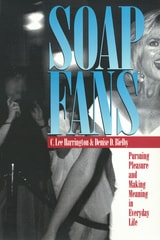
Soap Fans
Pursuing Pleasure and Making Meaning in Everyday LifeC. Lee Harrington and Denise D. Bielby
Temple University Press, 1995
Do soap opera fans deserve their reputation as lonely people, hopeless losers, or bored housewives? No, according to C. Lee Harrington and Denise D. Bielby. These authors—soap fans themselves—argue that soap fans are normal individuals who translate their soap watching into a broad range of public and private experience. People who cut across all categories of age, gender, race, ethnicity, income, education, and ideology incorporate a love of the soaps into their day-to-day leisure activities.
Interviews with soap opera viewers, actors, writers, producers, directors, the daytime press, and fan club staff members reveal fascinating details about the inside world of fandom and the multitude of outlets for fan expression—clubs, newsletters, electronic bulletin boards, and public events. Numerous examples illustrate the pleasure fans derive from critiquing characters, speculating on plot twists, and swapping memorabilia.
Examining the experiences that shape fan culture, Harrington and Bielby analyze the narrative structure and various aspects of the production of the soaps. Their examination reveals that the "meaning" of soaps is complex, individualized, and not simply a reflection of the narrative content of the stories. The authors show fans who actively contemplate what it means to be a fan, and who adjust their level of involvement accordingly.
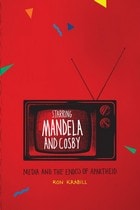
Starring Mandela and Cosby
Media and the End(s) of ApartheidRon Krabill
University of Chicago Press, 2010
During the worst years of apartheid, the most popular show on television in South Africa—among both Black and White South Africans—was The Cosby Show. Why did people living under a system built on the idea that Black people were inferior and threatening flock to a show that portrayed African Americans as comfortably mainstream? Starring Mandela and Cosby takes up this paradox, revealing the surprising impact of television on racial politics.
The South African government maintained a ban on television until 1976, and according to Ron Krabill, they were right to be wary of its potential power. The medium, he contends, created a shared space for communication in a deeply divided nation that seemed destined for civil war along racial lines. At a time when it was illegal to publish images of Nelson Mandela, Bill Cosby became the most recognizable Black man in the country, and, Krabill argues, his presence in the living rooms of white South Africans helped lay the groundwork for Mandela’s release and ascension to power.
Weaving together South Africa’s political history and a social history of television, Krabill challenges conventional understandings of globalization, offering up new insights into the relationship between politics and the media.
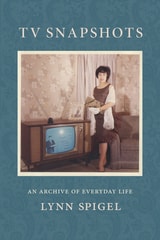
TV Snapshots
An Archive of Everyday LifeLynn Spigel
Duke University Press, 2022
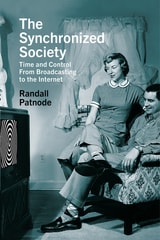
The Synchronized Society
Time and Control From Broadcasting to the InternetRandall Patnode
Rutgers University Press, 2023
The Synchronized Society traces the history of the synchronous broadcast experience of the twentieth century and the transition to the asynchronous media that dominate today. Broadcasting grew out of the latent desire by nineteenth-century industrialists, political thinkers, and social reformers to tame an unruly society by controlling how people used their time. The idea manifested itself in the form of the broadcast schedule, a managed flow of information and entertainment that required audiences to be in a particular place – usually the home – at a particular time and helped to create “water cooler” moments, as audiences reflected on their shared media texts. Audiences began disconnecting from the broadcast schedule at the end of the twentieth century, but promoters of social media and television services still kept audiences under control, replacing the schedule with surveillance of media use. Author Randall Patnode offers compelling new insights into the intermingled roles of broadcasting and industrial/post-industrial work and how Americans spend their time.
Uncomfortable Television
Hunter Hargraves
Duke University Press, 2023