Results by title
9 books match the query 'Tell'
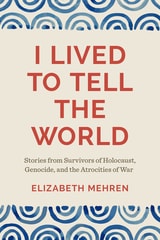
I Lived to Tell the World
Stories from Survivors of Holocaust, Genocide, and the Atrocities of WarElizabeth Mehren
Oregon State University Press, 2024
The 2025 Oregon Center for the Book Adult Readers' Selection
The 2025 NYC BIG BOOK AWARD Distinguished Favorite in the category of Cultural and Social Issues
Foreword INDIES 2024 Book of the Year Award Finalist - Multiculturalism & Regional
As Americans increasingly question how each of us fits into our nation's cultural tapestry, I Lived to Tell the World presents thirteen inspiring profiles of refugees who have settled in Oregon. They come from Rwanda, Myanmar, Bosnia, Syria, and more-different stories, different conflicts, but similar paths through loss and violence to a new, not always easy, life in the United States. The in-depth profiles are drawn from hours of interviews and oral histories; journalist Elizabeth Mehren worked collaboratively with the survivors to honor the complexity of their experiences and to ensure that the stories are told with, and not just about, them. Mehren also weaves in historical, cultural, and political context alongside these personal stories of resilience.
In the face of global cruelty and hatred, the courage and fortitude of these individuals illuminate the darkness. Their stories inspire readers to reflect on their own experiences and to view newcomers to America with renewed respect. As more states adopt Holocaust and genocide education curricula and as issues around refugees, immigration, and racial justice gain attention, I Lived to Tell the World highlights the purposeful lives led by these Oregonians despite their painful pasts. Their experiences not only humanize the atrocities often seen in headlines, but also convey a universal message of hope.
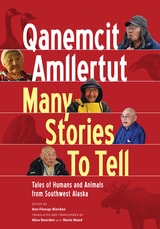
Qanemcit Amllertut/Many Stories to Tell
Tales of Humans and Animals from Southwest AlaskaEdited by Ann Fienup-Riordan
University of Alaska Press, 2017
This is the first region-wide collection of traditional Yup’ik tales and stories from Southwest Alaska. The elders and translators who contributed to this collection embrace the great irony of oral traditions: that the best way to keep these stories is to give them away. By retelling these stories, they hope to create a future in which the Yup’ik view of the world will be both recognized and valued.
Show and Tell
New and Selected PoemsJim Daniels
University of Wisconsin Press, 2003

Tell the Driver
A Biography of Elinor F.E. Black, MDJulie Vandervoort
University of Manitoba Press, 1992
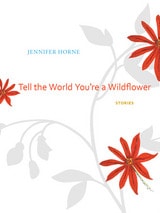
Tell the World You're a Wildflower
StoriesJennifer Horne
University of Alabama Press, 2014
In Tell the World You’re a Wildflower, each character must decide what to tell, whether to tell it, and to whom to tell it. Each struggles with questions of identity and truth, trying to understand who she is and what holds true for her. Some tell their stories plainly, directly, others more obliquely, nesting one within another. Anchored in the tradition of southern storytelling, these women contend with loss, change, and growth while going to church, school, and prison, navigating love and sex, and worrying too much about what people might think.
Yet these women generally refuse to behave, and they wander in and out of each other’s stories just like people do in small towns across the South. Small town lives are always interconnected: your third-grade teacher is your new neighbor’s aunt and the boy you dated your senior year falls from political grace after being caught in a hot tub with your second cousin. Though they may have had little say in where they were planted, Horne’s protagonists nevertheless do their best to bloom.
Rich, multifaceted, and unforgettable, Tell the World You’re a Wildflower is the work of a veteran explorer of the twentieth and twenty-first century South. Horne’s quest to understand her culture through decades of reading and observing has now yielded these narratives that imaginatively and insightfully enter the hearts and minds of southern women.

Tell
Love, Defiance, and the Military Trial at the Tipping Point for Gay RightsMajor Margaret Witt
University Press of New England, 2017
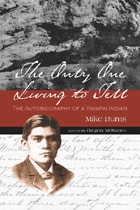
The Only One Living to Tell
The Autobiography of a Yavapai IndianMike Burns; Edited by Gregory McNamee
University of Arizona Press, 2012
Mike Burns—born Hoomothya—was around eight years old in 1872 when the US military murdered his family and as many as seventy-six other Yavapai men, women, and children in the Skeleton Cave Massacre in Arizona. One of only a few young survivors, he was adopted by an army captain and ended up serving as a scout in the US army and adventuring in the West. Before his death in 1934, Burns wrote about the massacre, his time fighting in the Indian Wars during the 1880s, and life among the Kwevkepaya and Tolkepaya Yavapai. His precarious position between the white and Native worlds gives his account a distinctive narrative voice.
Because Burns was unable to find a publisher during his lifetime, these firsthand accounts of history from a Native perspective remained unseen through much of the twentieth century, archived at the Sharlot Hall Museum in Prescott. Now Gregory McNamee has brought Burns's text to life, making this extraordinary tale an accessible and compelling read. Generations after his death, Mike Burns finally gets a chance to tell his story.
This autobiography offers a missing piece of Arizona history—as one of the only Native American accounts of the Skeleton Cave Massacre—and contributes to a growing body of history from a Native perspective. It will be an indispensable tool for scholars and general readers interested in the West—specifically Arizona history, the Apache wars, and Yavapai and Apache history and lifeways.
This Is All I Choose to Tell
History and Hybridity in Vietnamese American LiteratureAuthored by Isabelle T. Pelaud
Temple University Press, 2010
In the first book-length study of Vietnamese American literature, Isabelle Thuy Pelaud probes the complexities of Vietnamese American identity and politics. She provides an analytical introduction to the literature, showing how generational differences play out in genre and text. In addition, she asks, can the term Vietnamese American be disassociated from representations of the war without erasing its legacy?
Pelaud delineates the historical, social, and cultural terrains of the writing as well as the critical receptions and responses to them. She moves beyond the common focus on the Vietnam war to develop an interpretive framework that integrates post-colonialism with the multi-generational refugee, immigrant, and transnational experiences at the center of Vietnamese American narratives.
Her readings of key works, such as Andrew Pham's Catfish and Mandala and Lan Cao's Monkey Bridge show how trauma, racism, class and gender play a role in shaping the identities of Vietnamese American characters and narrators.
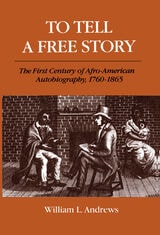
To Tell a Free Story
The First Century of Afro-American Autobiography, 1760-1865William L. Andrews
University of Illinois Press, 1986