Results by title
2 books match the query 'Templin, Mary'
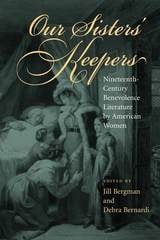
Our Sisters' Keepers
Nineteenth-Century Benevolence Literature by American WomenEdited by Jill Bergman and Debra Bernardi
University of Alabama Press, 2005
Essays on the roles played by women in forming American attitudes about benevolence and poverty relief
American culture has long had a conflicted relationship with assistance to the poor. Cotton Mather and John Winthrop were staunch proponents of Christian charity as fundamental to colonial American society, while transcendentalists harbored deep skepticism towards benevolence in favor of Emersonian self-reliance and Thoreau’s insistence on an ascetic life. Women in the 19th century, as these essays show, approached issues of benevolence far differently than their male counterparts, consistently promoting assistance to the impoverished, in both their acts and their writings.
American culture has long had a conflicted relationship with assistance to the poor. Cotton Mather and John Winthrop were staunch proponents of Christian charity as fundamental to colonial American society, while transcendentalists harbored deep skepticism towards benevolence in favor of Emersonian self-reliance and Thoreau’s insistence on an ascetic life. Women in the 19th century, as these essays show, approached issues of benevolence far differently than their male counterparts, consistently promoting assistance to the impoverished, in both their acts and their writings.
These essays address a wide range of subjects: images of the sentimental seamstress figure in women’s fiction; Rebecca Harding Davis’s rewriting of the “industrial” novel; Sarah Orne Jewett’s place in the transcendental tradition of skepticism toward charity, and her subversion of it; the genre of the poorhouse narrative; and the philanthropic work and writings of Hull House founder Jane Addams.
As the editors of Our Sisters’ Keepers argue, the vulnerable and marginal positions occupied by many women in the 19th century fostered an empathetic sensitivity in them to the plight of the poor, and their ability to act and write in advocacy of the impoverished offered a form of empowerment not otherwise available to them. The result was the reformulation of the concept of the American individual.
[more]
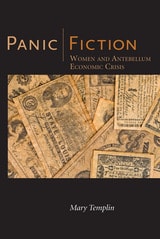
Panic Fiction
Women and Antebellum Economic CrisisMary Templin
University of Alabama Press, 2014
Panic Fiction explores a unique body of antebellum American women’s writing that illuminates women’s relationships to the marketplace and the links between developing ideologies of domesticity and the formation of an American middle class.
Between the mid-1830s and the late 1850s, authors such as Hannah Lee, Catharine Sedgwick, Eliza Follen, Maria McIntosh, and Maria Cummins wrote dozens of novels and stories depicting the effects of financial panic on the home and proposing solutions to economic instability. This unique body of antebellum American women’s writing, which integrated economic discourse with the language and conventions of domestic fiction, is what critic Mary Templin terms “panic fiction.”
In Panic Fiction: Antebellum Women Writers and Economic Crisis, Templin draws in part from the methods of New Historicism and cultural studies, situating these authors and their texts within the historical and cultural contexts of their time. She explores events surrounding the panics of 1837 and 1857, prevalent attitudes toward speculation and failure as seen in newspapers and other contemporaneous texts, women’s relationships to the marketplace, and the connections between domestic ideology and middle-class formation.
Although largely unknown today, the phenomena of “panic fiction” was extremely popular in its time and had an enormous influence on nineteenth-century popular conceptions of speculation, failure, and the need for marketplace reform, providing a distinct counterpoint to the analysis of panic found in newspapers, public speeches, and male-authored literary texts of the time.
[more]