Results by title
2 books match the query 'Tempo'

Evolutionary Patterns
Growth, Form, and Tempo in the Fossil RecordEdited by Jeremy B. C. Jackson, Scott Lidgard, and Frank K. McKinney
University of Chicago Press, 2001
With all the recent advances in molecular and evolutionary biology, one could almost wonder why we need the fossil record. Molecular sequence data can resolve taxonomic relationships, experiments with fruit flies demonstrate evolution and development in real time, and field studies of Galapagos finches have provided the strongest evidence for natural selection ever measured in the wild. What, then, can fossils teach us that living organisms cannot?
Evolutionary Patterns demonstrates the rich variety of clues to evolution that can be gleaned from the fossil record. Chief among these are the major trends and anomalies in species development revealed only by "deep time," such as periodic mass extinctions and species that remain unchanged in form for millions of years. Contributors explore modes of development, the tempo of speciation and extinction, and macroevolutionary patterns and trends. The result is an important contribution to paleobiology and evolutionary biology, and a spirited defense of the fossil record as a crucial tool for understanding evolution and development.
The contributors are Ann F. Budd, Efstathia Bura, Leo W. Buss, Mike Foote, Jörn Geister, Stephen Jay Gould, Eckart Hâkansson, Jean-Georges Harmelin, Lee-Ann C. Hayek, Jeremy B. C. Jackson, Kenneth G. Johnson, Nancy Knowlton, Scott Lidgard, Frank K. McKinney, Daniel W. McShea, Ross H. Nehm, Beth Okamura, John M. Pandolfi, Paul D. Taylor, and Erik Thomsen.
[more]
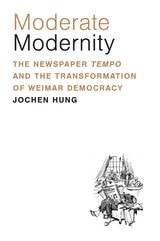
Moderate Modernity
The Newspaper Tempo and the Transformation of Weimar DemocracyJochen Hung
University of Michigan Press, 2023
Focusing on the fate of a Berlin-based newspaper during the 1920s and 1930s, Moderate Modernity: The Newspaper Tempo and the Transformation of Weimar Democracy chronicles the transformation of a vibrant and liberal society into an oppressive and authoritarian dictatorship. Tempo proclaimed itself as “Germany’s most modern newspaper” and attempted to capture the spirit of Weimar Berlin, giving a voice to a forward-looking generation that had grown up under the Weimar Republic’s new democratic order. The newspaper celebrated modern technology, spectator sports, and American consumer products, constructing an optimistic vision of Germany’s future as a liberal consumer society anchored in Western values.
The newspaper’s idea of a modern, democratic Germany was undermined by the political and economic crises that hit Germany at the beginning of the 1930s. The way the newspaper described German democracy changed under these pressures. Flappers, American fridges, and modern music—the things that Tempo had once marshalled as representatives of a German future—were now rejected by the newspaper as emblems of a bygone age. The changes in Tempo’s vision of Germany’s future show that descriptions of Weimar politics as a standoff between upright democrats and rabid extremists do not do justice to the historical complexity of the period. Rather, we need to accept the Nazis as a lethal product of a German democracy itself. The history of Tempo teaches us how liberal democracies can create and nurture their own worst enemies.
The newspaper’s idea of a modern, democratic Germany was undermined by the political and economic crises that hit Germany at the beginning of the 1930s. The way the newspaper described German democracy changed under these pressures. Flappers, American fridges, and modern music—the things that Tempo had once marshalled as representatives of a German future—were now rejected by the newspaper as emblems of a bygone age. The changes in Tempo’s vision of Germany’s future show that descriptions of Weimar politics as a standoff between upright democrats and rabid extremists do not do justice to the historical complexity of the period. Rather, we need to accept the Nazis as a lethal product of a German democracy itself. The history of Tempo teaches us how liberal democracies can create and nurture their own worst enemies.
[more]