Results by title

8 books match the query 'Temporality'
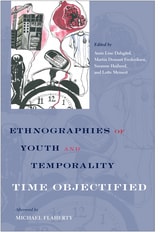
cover of Ethnographies of Youth and Temporality: Time Objectified

Ethnographies of Youth and Temporality

Time Objectified

Anne Line Dalsgard

Temple University Press, 2014

As we experience and manipulate time—be it as boredom or impatience—it becomes an object: something materialized and social, something that affects perception, or something that may motivate reconsideration and change. The editors and contributors to this important new book, Ethnographies of Youth and Temporality, have provided a diverse collection of ethnographic studies and theoretical explorations of youth experiencing time in a variety of contemporary socio-cultural settings.
 
The essays in this volume focus on time as an external and often troubling factor in young people’s lives, and shows how emotional unrest and violence but also creativity and hope are responses to troubling times. The chapters discuss notions of time and its and its “objectification” in diverse locales including the Georgian Republic, Brazil, Denmark and Uganda.
 
Based on long-term ethnographic fieldwork, the essays in Ethnographies of Youth and Temporality use youth as a prism to understand time and its subjective experience. 

In the series Global Youth, edited by Craig Jeffrey and Jane Dyson
[more]
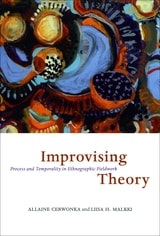
cover of Improvising Theory: Process and Temporality in Ethnographic Fieldwork

Improvising Theory

Process and Temporality in Ethnographic Fieldwork

Allaine Cerwonka and Liisa H. Malkki

University of Chicago Press, 2007

Scholars have long recognized that ethnographic method is bound up with the construction of theory in ways that are difficult to teach. The reason, Allaine Cerwonka and Liisa H. Malkki argue, is that ethnographic theorization is essentially improvisatory in nature, conducted in real time and in necessarily unpredictable social situations. In a unique account of, and critical reflection on, the process of theoretical improvisation in ethnographic research, they demonstrate how both objects of analysis, and our ways of knowing and explaining them, are created and discovered in the give and take of real life, in all its unpredictability and immediacy.

Improvising Theory centers on the year-long correspondence between Cerwonka, then a graduate student in political science conducting research in Australia, and her anthropologist mentor, Malkki. Through regular e-mail exchanges, Malkki attempted to teach Cerwonka, then new to the discipline, the basic tools and subtle intuition needed for anthropological fieldwork. The result is a strikingly original dissection of the processual ethics and politics of method in ethnography.
[more]
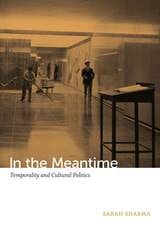
cover of In the Meantime: Temporality and Cultural Politics

In the Meantime

Temporality and Cultural Politics

Sarah Sharma

Duke University Press, 2014

The world is getting faster. This sentiment is proclaimed so often that it is taken for granted, rarely questioned or examined by those who celebrate the notion of an accelerated culture or by those who decry it. Sarah Sharma engages with that assumption in this sophisticated critical inquiry into the temporalities of everyday life. Sharma conducted ethnographic research among individuals whose jobs or avocations involve a persistent focus on time: taxi drivers, frequent-flyer business travelers, corporate yoga instructors, devotees of the slow-food and slow-living movements. Based on that research, she develops the concept of "power-chronography" to make visible the entangled and uneven politics of temporality. Focusing on how people's different relationships to labor configures their experience of time, she argues that both "speed-up" and "slow-down" often function as a form of biopolitical social control necessary to contemporary global capitalism.
[more]
cover of Mortal Forms: Affect and Temporality in Early English Poetry

Mortal Forms

Affect and Temporality in Early English Poetry

Evelyn Reynolds

The Ohio State University Press, 2026
In Mortal Forms, Evelyn Reynolds introduces the concept of the “absorption-denial dynamic” to explore how medieval English poetic forms simultaneously invite and resist imaginative and affective engagement. She thus offers a model for understanding how language engages audiences with that which is beyond language. This new methodology helps us understand how poetic forms communicate the unspeakable—especially of loss and grief, pain and disgust, joy and eternity—without circumscribing it. Connecting medieval English poetics to modern aesthetic theory and broader questions about the limits of representation, Reynolds considers Old and Middle English poems alongside one another and reads texts achronologically, thus revising standard histories of English poetics that insist on dramatic change from Old to Middle English. Overall, Reynolds deftly deploys her innovative theoretical framework to attend to how medieval poems, from Beowulf to Piers Plowman, navigate the limits of the unspeakable—and thus to develop an understanding of poetics that can enrich our capacity to meet the losses of our own time.
[more]
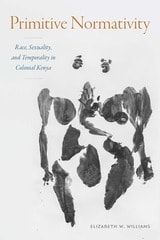
cover of Primitive Normativity: Race, Sexuality, and Temporality in Colonial Kenya

Primitive Normativity

Race, Sexuality, and Temporality in Colonial Kenya

Elizabeth W. Williams

Duke University Press, 2024
In Primitive Normativity Elizabeth W. Williams traces the genealogy of a distinct narrative about African sexuality that British colonial authorities in Kenya used to justify their control over indigenous populations. She identifies a discourse of “primitive normativity” that suggested that Africans were too close to nature to develop sexual neuroses and practices such as hysteria, homosexuality, and prostitution which supposedly were common among Europeans. Primitive normativity framed Kenyan African sexuality as less polluted than that of the more deviant populations of their colonizers. Williams shows that colonial officials and settlers used this narrative to further the goals of white supremacy by arguing that Africans’ sexuality was proof that Kenyan Africans must be protected from the forces of urbanization, Western-style education, and political participation, lest they be exposed to forms of civilized sexual deviance. Challenging the more familiar notion that Europeans universally viewed Africans as hypersexualized, Williams demonstrates how narratives of African sexual normativity rather than deviance reinforced ideas about the evolutionary backwardness of African peoples and their inability to govern themselves.
[more]
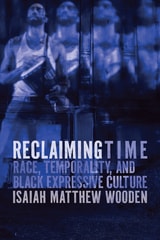
cover of Reclaiming Time: Race, Temporality, and Black Expressive Culture

Reclaiming Time

Race, Temporality, and Black Expressive Culture

Isaiah Matthew Wooden

Northwestern University Press, 2025

Showing how twenty-first-century Black theater and media arts challenge dominant conceptualizations of time

Reclaiming Time: Race, Temporality, and Black Expressive Culture examines works by contemporary Black artists in multiple media—drama, film, performance art, and photography—that trouble dominant conceptualizations and normative configurations of time in relation to race in the twenty-first century. Isaiah Matthew Wooden explores the ways in which an intentional and sometimes ludic engagement with time and temporality has enabled these artists to probe urgent questions and themes concerning the conditions of contemporary Black life.

Wooden surveys a diverse array of performance-based and visual texts to explore the rich practices of contemporary Black expressive culture: dramatic works by playwrights Eisa Davis, Tarell Alvin McCraney, and Robert O’Hara; performance art and photography by visual artists Jefferson Pinder and LaToya Ruby Frazier; and feature-length cinema by director-producer Tanya Hamilton. These works expose normative time as specious and evidence the transformative potential in honing practices of Black temporal experimentation and intervention. By putting this cross-disciplinary set of texts in conversation with each other, Wooden sheds new light on the shrewd ways that they each reflect an investment in unbinding time from the exigencies of normativity and teleology, as well as on their shared commitments to reclaiming time to reimagine and represent Blackness in all its multiplicities.

[more]
cover of Theatre, Time and Temporality: Melting Clocks and Snapped Elastics

Theatre, Time and Temporality

Melting Clocks and Snapped Elastics

David Ian Rabey

Intellect Books, 2016

Theatre, Time and Temporality is the first book-length exploration of the subject of temporality within theater and performance. David Ian Rabey brings in sources ranging from medieval and Renaissance theater to contemporary performances—in addition to recent writings from physics, philosophy, and psychology—to analyze ways that time can be presented, communicated, and transformed in the theater. How do we experience time in theater, and how can that experience be altered or manipulated? Rabey’s analysis and exploration will spark discussion among students and scholars of drama, as well as among practicing performers and dramatic writers.
 
[more]
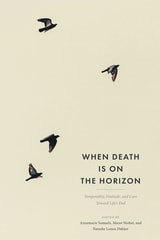
cover of When Death Is on the Horizon: Temporality, Finitude, and Care Toward Life’s End

When Death Is on the Horizon

Temporality, Finitude, and Care Toward Life’s End

Annemarie Samuels

Rutgers University Press, 2026

The urge to engage with finitude is increasingly central in our present apocalyptic time of political and ecological turmoil. Aging populations and the rapid development of advanced, but expensive, technologies to ever further postpone death pose significant healthcare challenges for societies around the world. In these times, how do people care when the end of life is near? How do they orient toward death? Do they see death as an absolute end, and if not, what sort of horizon does death present? Questioning taken for granted assumptions about end-of-life care, When Death Is on the Horizon analyzes how people approach death in a wide variety of geographical locations and social contexts. Through in-depth ethnographic case studies, it shows how people orient toward, beyond, and away from death, and how they do so within a world marked by historic and ongoing socio-political and structural inequalities.

This book is also freely available online as an open access digital edition.

[more]