Results by title

4 books match the query 'Tension'
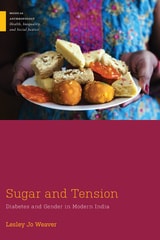
cover of Sugar and Tension: Diabetes and Gender in Modern India

Sugar and Tension

Diabetes and Gender in Modern India

Weaver, Lesley Jo

Rutgers University Press, 2019
Women in North India are socialized to care for others, so what do they do when they get a disease like diabetes that requires intensive self-care? In Sugar and Tension, Lesley Jo Weaver uses women’s experiences with diabetes in New Delhi as a lens to explore how gendered roles and expectations are taking shape in contemporary India. Weaver argues that although women’s domestic care of others may be at odds with the self-care mandates of biomedically-managed diabetes, these roles nevertheless do important cultural work that may buffer women’s mental and physical health by fostering social belonging. Weaver describes how women negotiate the many responsibilities in their lives when chronic disease is at stake. As women weigh their options, the choices they make raise questions about whose priorities should count in domestic, health, and family worlds. The varied experiences of women illustrate that there are many routes to living well or poorly with diabetes, and these are not always the ones canonized in biomedical models of diabetes management.  
[more]
cover of Teaching with Tension: Race, Resistance, and Reality in the Classroom

Teaching with Tension

Race, Resistance, and Reality in the Classroom

Edited by Philathia Bolton, Cassander L. Smith, and Lee Bebout

Northwestern University Press, 2019

Teaching with Tension is a collection of seventeen original essays that address the extent to which attitudes about race, impacted by the current political moment in the United States, have produced pedagogical challenges for professors in the humanities. As a flashpoint, this current political moment is defined by the visibility of the country's first black president, the election of his successor, whose presidency has been associated with an increased visibility of the alt-right, and the emergence of the neoliberal university. Together these social currents shape the tensions with which we teach.

Drawing together personal reflection, pedagogical strategies, and critical theory, Teaching with Tension offers concrete examinations that will foster student learning. The essays are organized into three thematic sections: "Teaching in Times and Places of Struggle" examines the dynamics of teaching race during the current moment, marked by neoconservative politics and twenty-first century freedom struggles. "Teaching in the Neoliberal University" focuses on how pressures and exigencies of neoliberalism (such as individualism, customer-service models of education, and online courses) impact the way in which race is taught and conceptualized in college classes. The final section, "Teaching How to Read Race and (Counter)Narratives," homes in on direct strategies used to historicize race in classrooms comprised of millennials who grapple with race neutral ideologies. Taken together, these sections and their constitutive essays offer rich and fruitful insight into the complex dynamics of contemporary race and ethnic studies education.
 
[more]
cover of Tension: Mental Distress and Embodied Inequality in the Western Himalayas

Tension

Mental Distress and Embodied Inequality in the Western Himalayas

Nikita Kaur Simpson

Duke University Press, 2026

In Tension, Nikita Kaur Simpson examines the effects of rapid development in the Himalayas on the minds and bodies of the Gaddi people who inhabit them through attention to the multifaceted state of distress they call “tension.” This “tension” takes many forms: Kamzori, or weakness, in the bodies of elderly women; “Future tension” accumulating in the minds of young girls; or Opara, or black magic, afflicting whole families. Through her long-term ethnographic fieldwork, Simpson follows the ways in which Gaddi people tie this distress to broader structural changes, such as land dispossession and caste, class, tribal and gender inequality, which are growing alongside modernity and prosperity. In doing so, she shows how “tension” acts as an everyday diagnostic of the problems of cultural, economic and environmental change as they shape intimate life. At once a lived historical account, a cartography of care relations, and a multi-sensory exploration of the intimate experiences of atmosphere and body, Tension puts forth a novel theory of distress, that inequality is often determined by who is made to feel, hold, and absorb distress.
[more]
cover of The Tension Of Paradox: José Donoso’s the Obscene Bird of Night As Spiritual Exercises

The Tension Of Paradox

José Donoso’s the Obscene Bird of Night As Spiritual Exercises

Pamela May Finnegan

Ohio University Press, 1992

Pamela Finnegan provides a detailed criticism of a major novel written by one of Chile’s leading literary figures. She analyzes the symbolism and the use of language in The Obscene Bird of Night, showing that the novel’s world becomes an icon characterized by entropy, parody, and materiality. Her study concludes that all linguistic ordering fictionalizes, that the lack of spirituality within the novel’s world is symptomatic of language gone stale, and that blindness to this fact leads to dogma or solipsism, each counter-productive to communication and human endeavor. To revive the linguistic system, she argues, we must revive the creative power of language.

[more]