Results by title

10 books match the query 'Territories and possessions'
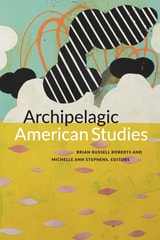
cover of Archipelagic American Studies

Archipelagic American Studies

Brian Russell Roberts and Michelle Ann Stephens, editors

Duke University Press, 2017

Departing from conventional narratives of the United States and the Americas as fundamentally continental spaces, the contributors to Archipelagic American Studies theorize America as constituted by and accountable to an assemblage of interconnected islands, archipelagoes, shorelines, continents, seas, and oceans. They trace these planet-spanning archipelagic connections in essays on topics ranging from Indigenous sovereignty to the work of Édouard Glissant, from Philippine call centers to US militarization in the Caribbean, and from the great Pacific garbage patch to enduring overlaps between US imperialism and a colonial Mexican archipelago. Shaking loose the straitjacket of continental exceptionalism that hinders and permeates Americanist scholarship, Archipelagic American Studies asserts a more relevant and dynamic approach for thinking about the geographic, cultural, and political claims of the United States within broader notions of America.
 
Contributors
Birte Blascheck, J. Michael Dash, Paul Giles, Susan Gillman, Matthew Pratt Guterl, Hsinya Huang, Allan Punzalan Isaac, Joseph Keith, Yolanda Martínez-San Miguel, Brandy Nālani McDougall, Ifeoma Kiddoe Nwankwo, Craig Santos Perez, Brian Russell Roberts, John Carlos Rowe, Cherene Sherrard-Johnson, Ramón E. Soto-Crespo, Michelle Ann Stephens, Elaine Stratford, Etsuko Taketani, Alice Te Punga Somerville, Teresia Teaiwa, Lanny Thompson, Nicole A. Waligora-Davis
[more]
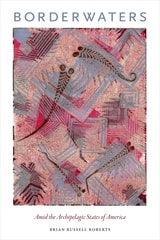
cover of Borderwaters: Amid the Archipelagic States of America

Borderwaters

Amid the Archipelagic States of America

Brian Russell Roberts

Duke University Press, 2021

Conventional narratives describe the United States as a continental country bordered by Canada and Mexico. Yet, since the late twentieth century the United States has claimed more water space than land space, and more water space than perhaps any other country in the world. This watery version of the United States borders some twenty-one countries, particularly in the archipelagoes of the Pacific and the Caribbean. In Borderwaters Brian Russell Roberts dispels continental national mythologies to advance an alternative image of the United States as an archipelagic nation. Drawing on literature, visual art, and other expressive forms that range from novels by Mark Twain and Zora Neale Hurston to Indigenous testimonies against nuclear testing and Miguel Covarrubias's visual representations of Indonesia and the Caribbean, Roberts remaps both the fundamentals of US geography and the foundations of how we discuss US culture.
[more]
cover of Cultures of United States Imperialism

Cultures of United States Imperialism

Amy Kaplan and Donald Pease, editors

Duke University Press, 1994

Cultures of United States Imperialism represents a major paradigm shift that will remap the field of American Studies. Pointing to a glaring blind spot in the basic premises of the study of American culture, leading critics and theorists in cultural studies, history, anthropology, and literature reveal the "denial of empire" at the heart of American Studies. Challenging traditional definitions and periodizations of imperialism, this volume shows how international relations reciprocally shape a dominant imperial culture at home and how imperial relations are enacted and contested within the United States.
Drawing on a broad range of interpretive practices, these essays range across American history, from European representations of the New World to the mass media spectacle of the Persian Gulf War. The volume breaks down the boundary between the study of foreign relations and American culture to examine imperialism as an internal process of cultural appropriation and as an external struggle over international power. The contributors explore how the politics of continental and international expansion, conquest, and resistance have shaped the history of American culture just as much as the cultures of those it has dominated. By uncovering the dialectical relationship between American cultures and international relations, this collection demonstrates the necessity of analyzing imperialism as a political or economic process inseparable from the social relations and cultural representations of gender, race, ethnicity, and class at home.

Contributors. Lynda Boose, Mary Yoko Brannen, Bill Brown, William Cain, Eric Cheyfitz, Vicente Diaz, Frederick Errington, Kevin Gaines, Deborah Gewertz, Donna Haraway, Susan Jeffords, Myra Jehlen, Amy Kaplan, Eric Lott, Walter Benn Michaels, Donald E. Pease, Vicente Rafael, Michael Rogin, José David Saldívar, Richard Slotkin, Doris Sommer, Gauri Viswanathan, Priscilla Wald, Kenneth Warren, Christopher P. Wilson
[more]
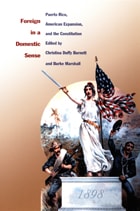
cover of Foreign in a Domestic Sense: Puerto Rico, American Expansion, and the Constitution

Foreign in a Domestic Sense

Puerto Rico, American Expansion, and the Constitution

Christina Duffy Burnett and Burke Marshall, eds.

Duke University Press, 2001

In this groundbreaking study of American imperialism, leading legal scholars address the problem of the U.S. territories. Foreign in a Domestic Sense will redefine the boundaries of constitutional scholarship.

More than four million U.S. citizens currently live in five “unincorporated” U.S. territories. The inhabitants of these vestiges of an American empire are denied full representation in Congress and cannot vote in presidential elections. Focusing on Puerto Rico, the largest and most populous of the territories, Foreign in a Domestic Sense sheds much-needed light on the United States’ unfinished colonial experiment and its legacy of racially rooted imperialism, while insisting on the centrality of these “marginal” regions in any serious treatment of American constitutional history. For one hundred years, Puerto Ricans have struggled to define their place in a nation that neither wants them nor wants to let them go. They are caught in a debate too politicized to yield meaningful answers. Meanwhile, doubts concerning the constitutionality of keeping colonies have languished on the margins of mainstream scholarship, overlooked by scholars outside the island and ignored by the nation at large.
This book does more than simply fill a glaring omission in the study of race, cultural identity, and the Constitution; it also makes a crucial contribution to the study of American federalism, serves as a foundation for substantive debate on Puerto Rico’s status, and meets an urgent need for dialogue on territorial status between the mainland and the territories.

Contributors. José Julián Álvarez González, Roberto Aponte Toro, Christina Duffy Burnett, José A. Cabranes, Sanford Levinson, Burke Marshall, Gerald L. Neuman, Angel R. Oquendo, Juan Perea, Efrén Rivera Ramos, Rogers M. Smith, E. Robert Statham Jr., Brook Thomas, Richard Thornburgh, Juan R. Torruella, José Trías Monge, Mark Tushnet, Mark Weiner
[more]
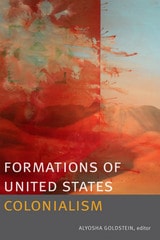
cover of Formations of United States Colonialism

Formations of United States Colonialism

Alyosha Goldstein

Duke University Press, 2014

Bridging the multiple histories and present-day iterations of U.S. settler colonialism in North America and its overseas imperialism in the Caribbean and the Pacific, the essays in this groundbreaking volume underscore the United States as a fluctuating constellation of geopolitical entities marked by overlapping and variable practices of colonization. By rethinking the intertwined experiences of Native Americans, Puerto Ricans, Chamorros, Filipinos, Hawaiians, Samoans, and others subjected to U.S. imperial rule, the contributors consider how the diversity of settler claims, territorial annexations, overseas occupations, and circuits of slavery and labor—along with their attendant forms of jurisprudence, racialization, and militarism—both facilitate and delimit the conditions of colonial dispossession. Drawing on the insights of critical indigenous and ethnic studies, postcolonial theory, critical geography, ethnography, and social history, this volume emphasizes the significance of U.S. colonialisms as a vital analytic framework for understanding how and why the United States is what it is today.

Contributors. Julian Aguon, Joanne Barker, Berenika Byszewski, Jennifer Nez Denetdale, Augusto Espiritu, Alyosha Goldstein, J. K?haulani Kauanui, Barbara Krauthamer, Lorena Oropeza, Vicente L. Rafael, Dean Itsuji Saranillio, Lanny Thompson, Lisa Uperesa, Manu Vimalassery
 
[more]
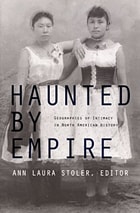
cover of Haunted by Empire: Geographies of Intimacy in North American History

Haunted by Empire

Geographies of Intimacy in North American History

Ann Laura Stoler, ed.

Duke University Press, 2006

A milestone in U.S. historiography, Haunted by Empire brings postcolonial critiques to bear on North American history and draws on that history to question the analytic conventions of postcolonial studies. The contributors to this innovative collection examine the critical role of “domains of the intimate” in the consolidation of colonial power. They demonstrate how the categories of difference underlying colonialism—the distinctions advanced as the justification for the colonizer’s rule of the colonized—were enacted and reinforced in intimate realms from the bedroom to the classroom to the medical examining room. Together the essays focus attention on the politics of comparison—on how colonizers differentiated one group or set of behaviors from another—and on the circulation of knowledge and ideologies within and between imperial projects. Ultimately, this collection forces a rethinking of what historians choose to compare and of the epistemological grounds on which those choices are based.

Haunted by Empire includes Ann Laura Stoler’s seminal essay “Tense and Tender Ties” as well as her bold introduction, which carves out the exciting new analytic and methodological ground animated by this comparative venture. The contributors engage in a lively cross-disciplinary conversation, drawing on history, anthropology, literature, philosophy, and public health. They address such topics as the regulation of Hindu marriages and gay sexuality in the early-twentieth-century United States; the framing of multiple-choice intelligence tests; the deeply entangled histories of Asian, African, and native peoples in the Americas; the racial categorizations used in the 1890 U.S. census; and the politics of race and space in French colonial New Orleans. Linda Gordon, Catherine Hall, and Nancy F. Cott each provide a concluding essay reflecting on the innovations and implications of the arguments advanced in Haunted by Empire.

Contributors. Warwick Anderson, Laura Briggs, Kathleen Brown, Nancy F. Cott, Shannon Lee Dawdy, Linda Gordon, Catherine Hall, Martha Hodes, Paul A. Kramer, Lisa Lowe, Tiya Miles, Gwenn A. Miller, Emily S. Rosenberg, Damon Salesa, Nayan Shah, Alexandra Minna Stern, Ann Laura Stoler, Laura Wexler
[more]
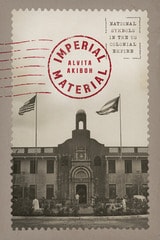
cover of Imperial Material: National Symbols in the US Colonial Empire

Imperial Material

National Symbols in the US Colonial Empire

Alvita Akiboh

University of Chicago Press, 2023

An ambitious history of flags, stamps, and currency—and the role they played in US imperialism.
 
In Imperial Material, Alvita Akiboh reveals how US national identity has been created, challenged, and transformed through embodiments of empire found in US territories, from the US dollar bill to the fifty-star flag. These symbolic objects encode the relationships between territories—including the Philippines, the Hawaiian Islands, Puerto Rico, and Guam—and the empire with which they have been entangled. Akiboh shows how such items became objects of local power, their original intent transmogrified. For even if imperial territories were not always front and center for federal lawmakers and administrators, their inhabitants remained continuously aware of the imperial United States, whose presence announced itself on every bit of currency, every stamp, and the local flag.
[more]
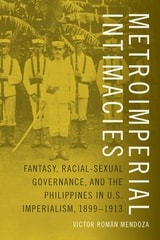
cover of Metroimperial Intimacies: Fantasy, Racial-Sexual Governance, and the Philippines in U.S. Imperialism, 1899-1913

Metroimperial Intimacies

Fantasy, Racial-Sexual Governance, and the Philippines in U.S. Imperialism, 1899-1913

Victor Román Mendoza

Duke University Press, 2015
In Metroimperial Intimacies Victor Román Mendoza combines historical, literary, and archival analysis with queer-of-color critique to show how U.S. imperial incursions into the Philippines enabled the growth of unprecedented social and sexual intimacies between native Philippine and U.S. subjects. The real and imagined intimacies—whether expressed through friendship, love, or eroticism—threatened U.S. gender and sexuality norms. To codify U.S. heteronormative behavior, the colonial government prohibited anything loosely defined as perverse, which along with popular representations of Filipinos, regulated colonial subjects and depicted them as sexually available, diseased, and degenerate. Mendoza analyzes laws, military records, the writing of Philippine students in the United States, and popular representations of Philippine colonial subjects to show how their lives, bodies, and desires became the very battleground for the consolidation of repressive legal, economic, and political institutions and practices of the U.S. colonial state. By highlighting the importance of racial and gendered violence in maintaining control at home and abroad, Mendoza demonstrates that studies of U.S. sexuality must take into account the reach and impact of U.S. imperialism.
 
[more]
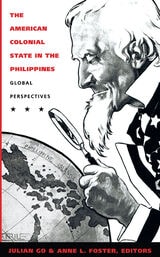
cover of The American Colonial State in the Philippines: Global Perspectives

The American Colonial State in the Philippines

Global Perspectives

Julian Go and Anne L. Foster, eds.

Duke University Press, 2003

In 1898 the United States declared sovereignty over the Philippines, an archipelago of seven thousand islands inhabited by seven million people of various ethnicities. While it became a colonial power at the zenith of global imperialism, the United States nevertheless conceived of its rule as exceptional—an exercise in benevolence rather than in tyranny and exploitation. In this volume, Julian Go and Anne L. Foster untangle this peculiar self-fashioning and insist on the importance of studying U.S. colonial rule in the context of other imperialist ventures. A necessary expansion of critical focus, The American Colonial State in the Philippines is the first systematic attempt to examine the creation and administration of the American colonial state from comparative, global perspectives.

Written by social scientists and historians, these essays investigate various aspects of American colonial government through comparison with and contextualization within colonial regimes elsewhere in the world—from British Malaysia and Dutch Indonesia to Japanese Taiwan and America's other major overseas colony, Puerto Rico. Contributors explore the program of political education in the Philippines; constructions of nationalism, race, and religion; the regulation of opium; connections to politics on the U.S. mainland; and anticolonial resistance. Tracking the complex connections, circuits, and contests across, within, and between empires that shaped America's colonial regime, The American Colonial State in the Philippines sheds new light on the complexities of American imperialism and turn-of-the-century colonialism.

Contributors. Patricio N. Abinales, Donna J. Amoroso, Paul Barclay, Vince Boudreau, Anne L. Foster, Julian Go, Paul A. Kramer
[more]
cover of Unmaking Botany: Science and Vernacular Knowledge in the Colonial Philippines

Unmaking Botany

Science and Vernacular Knowledge in the Colonial Philippines

Kathleen Cruz Gutierrez

Duke University Press, 2025

In Anglo-European botany, it is customary to think of the vernacular as that which is not a Latin or Latinized scientific plant name. In Unmaking Botany, Kathleen Cruz Gutierrez traces a history of botany in the Philippines during the last decades of Spanish rule and the first decades of US colonization. Through this history, she redefines the vernacular, expanding it to include embodied, cosmological, artistic, and varied taxonomic practices. From the culinary textures of rice and the lyrics crooned to honor a flower to the touch of a skirt woven from banana fiber, she illuminates how vernaculars of plant knowing in the Philippines exposed the philosophical and practical limits of botany. Such vernaculars remained as sovereign forms of knowledge production. Yet, at the same time, they fueled botany’s dominance over other ways of knowing plants. Revealing this tension allows Gutierrez to theorize “sovereign vernaculars,” or insight into plants that made and unmade the science, which serves as a methodological provocation to examine the interplay of different knowledge systems and to study the history of science from multiple vantage points.
[more]