Results by title
2 books match the query 'Terror in literature'
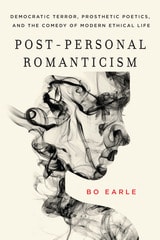
Post-Personal Romanticism
Democratic Terror, Prosthetic Poetics, and the Comedy of Modern Ethical LifeBo Earle
The Ohio State University Press, 2017
Post-Personal Romanticism: Democratic Terror, Prosthetic Poetics, and the Comedy of Modern Ethical Life by Bo Earle offers a broad recasting of Romantic lyric’s formal innovations in terms of Hegel’s historical ethics. These innovations attempt to come to terms with the Enlightenment’s paradoxical legacy: industrial and consumerist modernity depends on the Enlightenment norm of rationally autonomous individuality even as it makes this norm ever more implausible. In turn, a key insight of the Romantics is that modernity depends most crucially upon the very elusiveness of this norm of autonomous individuality. The Romantics emphasize that modernity is constitutively a culture of fantasy, a culture self-conscious about the impossibility of its own organizing values and goals.
Tracing this insight to Hegel’s suggestion that modern subjectivity is in some sense post-individual or even posthumous, Earle argues that signature Romantic lyrics offer a way forward that avoids postmodernism’s wholesale rejection of autonomous selfhood. With chapters on Wordsworth, Blake, Byron, Shelley, and Keats, Earle traces how Romantic lyrics mine this interminability to recover figurative emblems or masks of selfhood from experiences of its inevitable normative failure. This model is of particularly urgent value today when the costs of modern narcissism, economic exploitation, and political imperialism have come to include the normalization of torture, signature drone strikes, and climate change.
Tracing this insight to Hegel’s suggestion that modern subjectivity is in some sense post-individual or even posthumous, Earle argues that signature Romantic lyrics offer a way forward that avoids postmodernism’s wholesale rejection of autonomous selfhood. With chapters on Wordsworth, Blake, Byron, Shelley, and Keats, Earle traces how Romantic lyrics mine this interminability to recover figurative emblems or masks of selfhood from experiences of its inevitable normative failure. This model is of particularly urgent value today when the costs of modern narcissism, economic exploitation, and political imperialism have come to include the normalization of torture, signature drone strikes, and climate change.
[more]
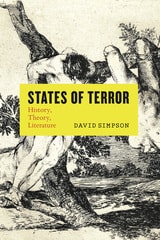
States of Terror
History, Theory, LiteratureDavid Simpson
University of Chicago Press, 2019
How have we come to depend so greatly on the words terror and terrorism to describe broad categories of violence? David Simpson offers here a philology of terror, tracking the concept’s long, complicated history across literature, philosophy, political science, and theology—from Plato to NATO.
Introducing the concept of the “fear-terror cluster,” Simpson is able to capture the wide range of terms that we have used to express extreme emotional states over the centuries—from anxiety, awe, and concern to dread, fear, and horror. He shows that the choices we make among such words to describe shades of feeling have seriously shaped the attribution of motives, causes, and effects of the word “terror” today, particularly when violence is deployed by or against the state. At a time when terror-talk is widely and damagingly exploited by politicians and the media, this book unpacks the slippery rhetoric of terror and will prove a vital resource across humanistic and social sciences disciplines.
Introducing the concept of the “fear-terror cluster,” Simpson is able to capture the wide range of terms that we have used to express extreme emotional states over the centuries—from anxiety, awe, and concern to dread, fear, and horror. He shows that the choices we make among such words to describe shades of feeling have seriously shaped the attribution of motives, causes, and effects of the word “terror” today, particularly when violence is deployed by or against the state. At a time when terror-talk is widely and damagingly exploited by politicians and the media, this book unpacks the slippery rhetoric of terror and will prove a vital resource across humanistic and social sciences disciplines.
[more]