Results by title
4 books match the query 'Teston, Christa'
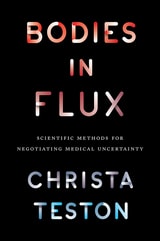
Bodies in Flux
Scientific Methods for Negotiating Medical UncertaintyChrista Teston
University of Chicago Press, 2017
Bodies in Flux explores the inventive ways humans and nonhumans work together to manufacture medical evidence. Each chapter draws on rhetorical theory to investigate a specific scientific method for negotiating medical uncertainty in cancer care, including evidential visualization, assessment, synthesis, and computation. Case studies unveil how doctors rely on visuals when deliberating about a patient’s treatment options, how members of the FDA use inferential statistics to predict a drug’s effectiveness, how researchers synthesize hundreds of clinical trials into a single evidence-based recommendation, and how genetic testing companies compute and commoditize human health. Teston concludes by advocating for an ethic of care that pushes back against the fetishization of certainty—an ethic of care that honors human fragility and bodily flux.
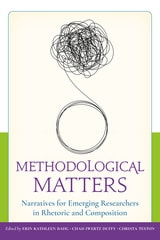
Methodological Matters
Narratives for Emerging Researchers in Rhetoric and CompositionErin Kathleen Bahl
Utah State University Press, 2026
Methodological Matters offers a series of investigative reflections from experienced and emerging researchers to provide guidance for researchers who are navigating important complexities early in their careers. Each chapter explores a larger research-related question by narrating how one researcher negotiated a unique methodological challenge while working on a dissertation in the field of rhetoric and composition.
Given the constraints placed on new researchers’ time and resources, one way to navigate research-related precarities is to learn from others who have successfully traversed the same investigative terrain. This volume curates investigative reflections from researchers who, at the time of writing, were in the process of completing (or had just completed) their dissertations. Three parts explore issues of identity, craft, and practice in conducting research as an emerging scholar in rhetoric and composition, and the collection concludes with critical reflections on the role of precarity in conducting research.
Both a curated series of investigative reflections from emerging researchers and a resource guide with tangible tools for use in graduate seminars and fieldwork, Methodological Matters amplifies voices of those who learned how to do research in precarious contexts while simultaneously situated within the sometimes frustrating developmental phase located between “student” and “practitioner.”
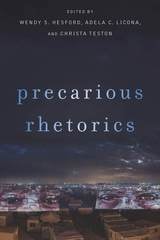
Precarious Rhetorics
Edited by Wendy S. Hesford, Adela C. Licona, and Christa Teston
The Ohio State University Press, 2018
This collection features cross-disciplinary contributions from leading scholars, including the editors of the volume as well as James J. Brown Jr., Gale Coskan-Johnson, Ronald Greene, Lavinia Hirsu, Arabella Lyon, Louis Maraj, Sara McKinnon, Alexandra Schultheis Moore, Kimberlee Pérez, Margaret Price, Amy Shuman, Kristin Swenson, Becca Tarsa, and Belinda Walzer. Chapters emphasize a materialist-rhetorical approach while also drawing on feminist studies, women of color feminisms, affect studies, critical disability studies, critical race and ethnic studies, medical humanities, sexuality studies, queer migration studies, and human rights and humanitarian studies. While theoretically rich, this volume intentionally features chapters that explore precarious rhetorics as they operate in practice—whether in borderlands, politics, public policy, or the quotidian spaces of human activity, such as school, work, social media, and medicine.
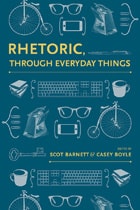
Rhetoric, Through Everyday Things
Edited by Scot Barnett and Casey Boyle
University of Alabama Press, 2016
The fifteen essays in Rhetoric, Through Everyday Things persuasively overturn the stubborn assumption that objects are passive tools in the hands of objective human agents. Rhetoric has proved that forms of communication such as digital images, advertising, and political satires do much more than simply lie dormant, and Rhetoric, Through Everyday Things shows that objects themselves also move, circulate, and produce opportunities for new rhetorical publics and new rhetorical actions. Objects are not simply inert tools but are themselves vibrant agents of measurable power.
Organizing the work of leading and emerging rhetoric scholars into four broad categories, the collection explores the role of objects in rhetorical theory, histories of rhetoric, visual rhetoric, literacy studies, rhetoric of science and technology, computers and writing, and composition theory and pedagogy. A rich variety of case studies about objects such as women’s bicycles in the nineteenth century, the QWERTY keyboard, and little free libraries ground this study in fascinating, real-life examples and build on human-centered approaches to rhetoric to consider how material elements—human and nonhuman alike—interact persuasively in rhetorical situations.
Taken together, Rhetoric, Through Everyday Things argues that the field of rhetoric’s recent attention to material objects should go further than simply open a new line of inquiry. To maximize the interdisciplinary turn to things, rhetoricians must seize the opportunity to reimagine and perhaps resolve rhetoric’s historically problematic relationship to physical reality and ontology. By tapping the rich resource of inanimate agents such as "fish, political posters, plants, and dragonflies,” rhetoricians can more fully grasp the rhetorical implications at stake in such issues.