Results by title
8 books match the query 'Texas, East'
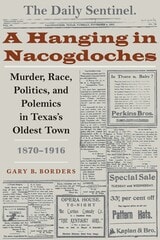
A Hanging in Nacogdoches
Murder, Race, Politics, and Polemics in Texas's Oldest Town, 1870-1916By Gary B. Borders
University of Texas Press, 2006
On October 17, 1902, in Nacogdoches, Texas, a black man named James Buchanan was tried without representation, condemned, and executed for the murder of a white family—all in the course of three hours. Two white men played pivotal roles in these events: Bill Haltom, a leading local Democrat and the editor of the Nacogdoches Sentinel, who condemned lynching but defended lynch mobs, and A. J. Spradley, a Populist sheriff who, with the aid of hundreds of state militiamen, barely managed to keep the mob from burning Buchanan alive, only to escort him to the gallows following his abbreviated trial. Each man's story serves to illuminate a part of the path that led to the terrible parody of justice which lies at the heart of A Hanging in Nacogdoches.
The turn of the twentieth century was a time of dramatic change for the people of East Texas. Frightened by the Populist Party's attempts to unite poor blacks and whites in a struggle for economic justice, white Democrats defended their power base by exploiting racial tensions in a battle that ultimately resulted in the complete disenfranchisement of the black population of East Texas. In telling the story of a single lynching, Gary Borders dramatically illustrates the way politics and race combined to bring horrific violence to small southern towns like Nacogdoches.
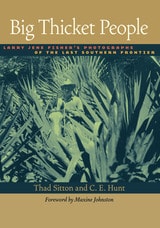
Big Thicket People
Larry Jene Fisher's Photographs of the Last Southern FrontierBy Thad Sitton and C.E. Hunt
University of Texas Press, 2008
Living off the land—hunting, fishing, and farming, along with a range of specialized crafts that provided barter or cash income—was a way of life that persisted well into the twentieth century in the Big Thicket of southeast Texas. Before this way of life ended with World War II, professional photographer Larry Jene Fisher spent a decade between the 1930s and 1940s photographing Big Thicket people living and working in the old ways. His photographs, the only known collection on this subject, constitute an irreplaceable record of lifeways that first took root in the southeastern woodlands of the colonial United States and eventually spread all across the Southern frontier.
Big Thicket People presents Fisher's photographs in suites that document a wide slice of Big Thicket life-people, dogs, camps, deer hunts, farming, syrup mills, rooter hogs and stock raising, railroad tie making, barrel stave making, chimney building, peckerwood sawmills, logging, turpentining, town life, church services and picnics, funerals and golden weddings, and dances and other amusements. Accompanying each suite of images is a cultural essay by Thad Sitton, who also introduces the book with a historical overview of life in the Big Thicket. C. E. Hunt provides an informative biography of Larry Jene Fisher.
Fruit of the Orchard
Environmental Justice in East TexasPhyllis Glazer
University of North Texas Press, 2006
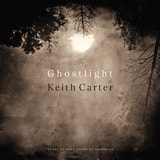
Ghostlight
Photographs by Keith CarterStory by Bret Anthony Johnston
University of Texas Press, 2022
A collection of otherworldly photographs of Southern wetlands featuring an original ghost story.
Southern wetlands, with their moss-draped trees and dark water obscuring mysteries below, are eerily beautiful places, home to ghost stories and haunting, ethereal light. The newest collection from award-winning photographer Keith Carter, Ghostlight captures the otherwordly spirits of swamps, marshes, bogs, baygalls, bayous, and fens in more than a hundred photographs.
From Ossabaw Island, Georgia, to his home ground of East Texas, Carter seeks “the secretive and mysterious” of this often-overlooked landscape: wisps of fog drifting between tree branches; faceless figures contemplating a bog; owls staring directly at the camera lens; infinite paths leading to unknown parts. Similarly, spectral images are evoked in the original short story that opens this book. Ghostlight, writes best-selling author Bret Anthony Johnston, “hovers, darts, disappears. It can be as mean as a cottonmouth, as mischievous aes a child. The closer you get, the farther the light recedes.” A masterpiece of “Bayou Gothic,” Ghostlight challenges our perceptions and invites us to experience the beauty of this elusive world.
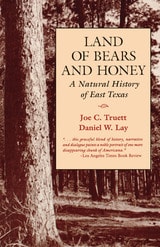
Land of Bears and Honey
A Natural History of East TexasBy Joe C. Truett and Daniel W. Lay
University of Texas Press, 1994
Winner, Ottis Lock Endowment Award for the best book on East Texas, East Texas Historical Association, 1985
Texas Literary Festival Award for Nonfiction (Southwestern Booksellers Association & Dallas Times Herald), 1985
Annual Publication Award, Texas Chapter of the Wildlife Society, 1984
The story of the land, wildlife, and ecology of East Texas.
Out the Summerhill Road
A NovelJane Roberts Wood
University of North Texas Press, 2010
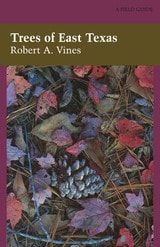
Trees of East Texas
By Robert A. Vines
University of Texas Press, 1977
This comprehensive and compact field guide covers the richest plant-life region in the state—the Upper Gulf Coast Prairie, the Post Oak Savannah, and the Pineywoods of east Texas. Eastern, northern, Gulf coast, and western Texas trees occur together in the Big Thicket area of the Pineywoods, where abundant rainfall and mild temperatures also make possible much tropical growth.
Trees of East Texas is drawn from Robert A. Vines' monumental Trees, Shrubs, and Woody Vines of the Southwest (University of Texas Press, 1960). Without sacrificing the essential detail of the original work, this guide has been designed to travel info the field for on-the-spot identification. Meant to be carried and consulted, Trees of East Texas is conveniently organized, and virtually every description is accompanied by a finely executed illustration.
This book contains new and updated information, and every native and naturalized tree in the area is identified. In addition to the technical descriptions, the author provides, in his "Remarks" sections, common names and fascinating bits of history and lore on each tree cited.

War in East Texas
Bill O'Neal
University of North Texas Press, 2006