Results by title
11 books match the query 'Textile workers'
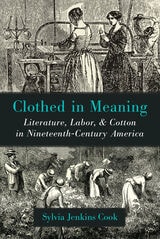
Clothed in Meaning
Literature, Labor, and Cotton in Nineteenth-Century AmericaSylvia Jenkins Cook
University of Michigan Press, 2020
Cloth and clothing provide potent tropes not only for physical but also for intellectual forms of self-expression. Drawing on sources ranging from fugitive slave narratives, newspapers, manifestos, and mill workers’ magazines to fiction, poetry, and autobiographies, Clothed in Meaning examines the significant part played by mill workers and formerly enslaved people, many of whom still worked picking cotton, in this revolution of literary self-expression. They created a new literature from their palpable daily intimacy with cotton, cloth, and clothing, as well as from their encounters with grimly innovative modes of work. In the materials of their labor they discovered vivid tropes for formulating their ideas and an exotic and expert language for articulating them. The harsh conditions of their work helped foster in their writing a trenchant irony toward the demeaning reduction of human beings to “hands” whose minds were unworthy of interest. Ultimately, Clothed in Meaning provides an essential examination of the intimate connections between oppression and luxury as recorded in the many different voices of nineteenth-century labor.
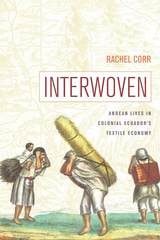
Interwoven
Andean Lives in Colonial Ecuador’s Textile EconomyRachel Corr
University of Arizona Press, 2018
Interwoven is the untold story of indigenous people’s historical experience in colonial Ecuador’s textile economy. It focuses on the lives of Native Andean families in Pelileo, a town dominated by one of Quito’s largest and longest-lasting textile mills. Quito’s textile industry developed as a secondary market to supply cloth to mining centers in the Andes; thus, the experience of indigenous people in Pelileo is linked to the history of mining in Bolivia and Peru.
Although much has been written about colonial Quito’s textile economy, Rachel Corr provides a unique perspective by putting indigenous voices at the center of that history. Telling the stories of Andean families of Pelileo, she traces their varied responses to historical pressures over three hundred years; the responses range from everyday acts to the historical transformation of culture through ethnogenesis. These stories of ordinary Andean men and women provide insight into the lived experience of the people who formed the backbone of Quito’s textile industry.
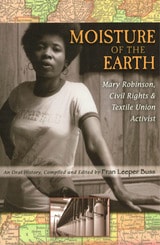
Moisture of the Earth
Mary Robinson, Civil Rights and Textile Union ActivistAn Oral History, Compiled and Edited by Fran Leeper Buss
University of Michigan Press, 2009
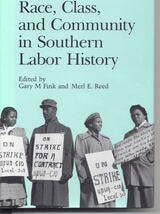
Race, Class, and Community in Southern Labor History
Gary M. Fink
University of Alabama Press, 1994
Exploring the intertwined histories of race, labor, and community in the American South.
Under the leadership of Gary M. Fink and Merl E. Reed, Georgia State University hosts the Southern Labor Studies Conferences approximately every two years. The conferences have yielded two previous volumes, published in 1977 and 1981, and this volume, which contains selected papers from the seventh conference held in 1991.
As evidence by the quality of these essays, the field of southern labor history has come into its own. Research interest is peaking: the practitioners are younger scholars, and much of their work emphasizes the new social and political history. While the topics covered in this volume usually reflect that methodology, their chronology ranges from the antebellum period to the 1970s, suggesting the variety of sources and changing research approaches that can be used in rendering new meaning to the past. Although the subject of gender was generally a minor theme in these sessions, work now being done leaves no doubt that at some future conference gender will attract a commanding amount of attention.
In introducing and describing their respective areas, the associate editors, Robert H. Zieger (textile workers), Joe W. Trotter (African Americans), and Clifford Kuhn (labor politics), have provided a rich historiographical background.
The essays in this volume will enlighten the reader on many important aspects of the history of southern labor, and they will also raise new questions to be explained by other scholars and future conferences.

Southern Workers and the Search for Community
Spartanburg County, South CarolinaG. C. Waldrep III
University of Illinois Press, 2000
Spartanburg County, South Carolina, offered an example of the enduring legacy of the southern textile industry, company-owned mill villages, and union struggles of the 1930s. G. C. Waldrep illuminates the complex meshing of community ties and traditions with the goals and ideals of unionism. Unions aligned with a social vision of mutuality, equality, and interdependency already established in mill villages. But because companies owned the villages, labor conflicts involved not only work issues like wages and hours but virtually every other aspect of life. In documenting the high stakes of labor protest, Waldrep shows how the erosion or outright destruction of community undermined the ability of workers to respond to the assaults of employers overwhelmingly supported by government agencies and agents.
Beautifully written and persuasively argued, Southern Workers and the Search for Community opens the gates of southern company towns to illuminate the human issues behind the mechanics of labor.

The Archive of Loss
Lively Ruination in Mill Land MumbaiMaura Finkelstein
Duke University Press, 2019
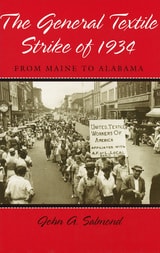
The General Textile Strike of 1934
From Maine to AlabamaJohn A. Salmond
University of Missouri Press, 2002
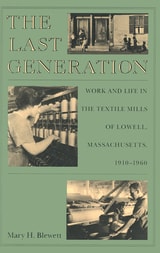
The Last Generation
Work and Life in the Textile Mills of Lowell, Massachusetts, 1910-1960Mary H. Blewett
University of Massachusetts Press, 1990
Oral histories of many of the last generation of Lowell, MA, textile mill workers preceded by two introductory sections. The first presents the historic setting of economic development and subsequent decline of the textile industry in Lowell. The second is a brief explanation of the production process wherein the last generation of mill workers expended so many of their skills and so much of their energy.
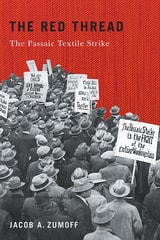
The Red Thread
The Passaic Textile StrikeJacob A. Zumoff
Rutgers University Press, 2021
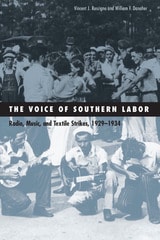
Voice Of Southern Labor
Radio, Music, And Textile Strikes, 1929-1934Vincent J. Roscigno
University of Minnesota Press, 2004
Vividly shows how music united striking workers
The 1934 strike of southern textile workers, involving nearly 400,000 mill hands, remains perhaps the largest collective mobilization of workers in U.S. history. How these workers came together in the face of the powerful and coercive opposition of management and the state is the remarkable story at the center of this book.
The Voice of Southern Labor chronicles the lives and experiences of southern textile workers and provides a unique perspective on the social, cultural, and historical forces that came into play when the group struck, first in 1929, and then on a massive scale in 1934. The workers’s grievances, solidarity, and native radicalism of the time were often reflected in the music they listened to and sang, and Vincent J. Roscigno and William F. Danaher offer an in-depth context for understanding this intersection of labor, politics, and culture. The authors show how the message of the southern mill hands spread throughout the region with the advent of radio and the rise of ex–mill worker musicians, and how their sense of opportunity was further bolstered by Franklin D. Roosevelt’s radio speeches and policies.
When the Air Became Important
A Social History of the New England and Lancashire Textile IndustriesJanet Greenlees
Rutgers University Press, 2019