Results by title
6 books match the query 'Textuality'
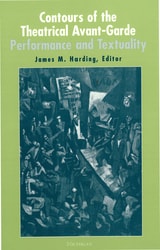
Contours of the Theatrical Avant-Garde
Performance and TextualityJames M. Harding, Editor
University of Michigan Press, 2000
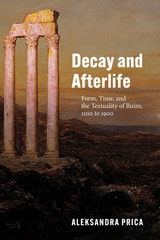
Decay and Afterlife
Form, Time, and the Textuality of Ruins, 1100 to 1900Aleksandra Prica
University of Chicago Press, 2022
Western ruins have long been understood as objects riddled with temporal contradictions, whether they appear in baroque poetry and drama, Romanticism’s nostalgic view of history, eighteenth-century paintings of classical subjects, or even recent photographic histories of the ruins of postindustrial Detroit. Decay and Afterlife pivots away from our immediate, visual fascination with ruins, focusing instead on the textuality of ruins in works about disintegration and survival. Combining an impressive array of literary, philosophical, and historiographical works both canonical and neglected, and encompassing Latin, Italian, French, German, and English sources, Aleksandra Prica addresses ruins as textual forms, examining them in their extraordinary geographical and temporal breadth, highlighting their variability and reflexivity, and uncovering new lines of aesthetic and intellectual affinity. Through close readings, she traverses eight hundred years of intellectual and literary history, from Seneca and Petrarch to Hegel, Goethe, and Georg Simmel. She tracks European discourses on ruins as they metamorphose over time, identifying surprising resemblances and resonances, ignored contrasts and tensions, as well as the shared apprehensions and ideas that come to light in the excavation of these discourses.
English after the Fall
From Literature to TextualityRobert Scholes
University of Iowa Press, 2011
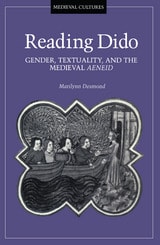
Reading Dido
Gender, Textuality, and the Medieval AeneidMarilynn Desmond
University of Minnesota Press, 1994
Describes the variations in the figure of Dido as she emerges from ancient literary texts.
If we view the Aeneid—the poem of empire, conquest, and male hierarchy-as the West's quintessential canonical text and Latin primer, then the history of Virgil readership should tell us much about the concept of education in the West. In this book, Marilynn Desmond reveals how a constructed and mediated tradition of reading Virgil has conditioned various interpretations among readers responding to medieval cultural and literary texts. In particular, she shows how the story of Dido has been marginalized within canonical readings of the Aeneid. Reaching back to the Middle Ages and vernacular poetic readings of Dido, Desmond recovers an alternative Virgil from historical tradition and provides another paradigm for reading the Aeneid.
Desmond follows the figure of Dido as she emerges from ancient historical and literary texts (from Timaeus and Justin to Virgil and Ovid) and circulates in medieval textual cultures. Her study ranges from the pedagogical discourses of Latin textual traditions (including Servius, Augustine, Bernard Silvestris, and John of Salisbury) to the French and English vernacular cultures inscribed in the Roman d'Eneas, the Histoire ancienne jusqu'à César, and the work of Dante, Chaucer, Gavin Douglas, Caxton, and Christine de Pizan. The positions of all these readers point to the cultural specificity and historical contingency of all traditions of reading; thus, this book demonstrates how medieval traditions of reading Dido offer the modern reader a series of countertraditions that support feminist, antihomophobic, and postcolonial interpretive gestures.
The Textuality of Soulwork
Jack Kerouac's Quest for Spontaneous ProseTim Hunt
University of Michigan Press, 2014
Tim Hunt’s The Textuality of Soulwork: Jack Kerouac’s Quest for Spontaneous Proseexamines Kerouac’s work from a new critical perspective with a focus on the author’s unique methods of creating and working with text. Additionally, The Textuality of Soulwork delineates Kerouac’s development of “Spontaneous Prose” to differentiate the preliminary experiment of On the Road from the more radical experiment of Visions of Cody, and to demonstrate Kerouac’s transition from working within the textual paradigm of modern print to the textual paradigm of secondary orality. From these perspectives, Tim Hunt crafts a new critical approach to Beat poetics and textual theory, marking an important contribution to the current revival of Kerouac and Beat studies underway at universities in the U.S. and abroad, as reflected by a growing number of conferences, courses, and a renewal in scholarship.

Vision and Textuality
Stephen Melville and Bill Readings, eds.
Duke University Press, 1995
With essays by Rosalind Krauss, Hal Foster, Norman Bryson, Victor Burgin, Martin Jay, Louis Marin, Thomas Crow, Griselda Pollock, and others, the volume is organized into sections devoted to the discipline of art history, the implications of semiotics, the new cultural history of art, and the impact of psychoanalysis. The works discussed in these essays range from Rembrandt’s Danae to Jorge Immendorf’s Café Deutschland, from Vauxhall Gardens to Max Ernst, and from the Imagines of Philostratus to William Godwin’s novel Caleb Williams. Each section is preceded by a short introduction that offers further contexts for considering the essays that follow, while the editors’ general introduction presents an overall exploration of the relation between vision and textuality in a variety of both institutional and theoretical contexts. Among other issues, it examines the relevance of aesthetics, the current concern with modernism and postmodernism, and the possible development of new disciplinary formations in the humanities.
Contributors. Mieke Bal, John Bender, Norman Bryson, Victor Burgin, Thomas Crow, Peter de Bolla, Hal Foster, Michael Holly, Martin Jay, Rosalind Krauss, Françoise Lucbert, Louis Martin, Stephen Melville, Griselda Pollock, Bill Readings, Irit Rogoff, Bennet Schaber, John Tagg