Results by title
4 books match the query 'Thaw'
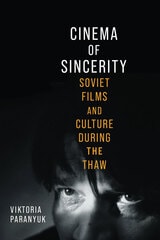
Cinema of Sincerity
Soviet Films and Culture During the ThawViktoria Paranyuk
University of Wisconsin Press, 2025
Using both theory and close readings of specific films produced in the Soviet Union during the Thaw, a period known for its relative political and cultural liberalization, Cinema of Sincerity treats sincerity as both a concept and an aesthetic strategy. Viktoria Paranyuk argues that Soviet cinema’s use of sincerity was a reworking of a trend in global cinema that sought to bridge the gap between reality and the filmed image. This period saw increased accessibility to world cinematic traditions, new voices in criticism, and, above all, the multigenerational effort in filmmaking that developed and thrived in centers outside Moscow. Paranyuk demonstrates how these changes allowed Soviet cinema to renew its visual language and use film as a space for collective self-examination.
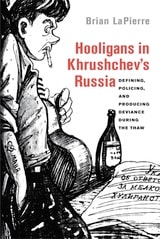
Hooligans in Khrushchev's Russia
Defining, Policing, and Producing Deviance during the ThawBrian LaPierre
University of Wisconsin Press, 2012
Hooligans in Khrushchev's Russia offers the first comprehensive study of how Soviet police, prosecutors, judges, and ordinary citizens during the Khrushchev era (1953–64) understood, fought against, or embraced this catch-all category of criminality. Using a wide range of newly opened archival sources, it portrays the Khrushchev period—usually considered as a time of liberalizing reform and reduced repression—as an era of renewed harassment against a wide range of state-defined undesirables and as a time when policing and persecution were expanded to encompass the mundane aspects of everyday life. In an atmosphere of Cold War competition, foreign cultural penetration, and transatlantic anxiety over "rebels without a cause," hooliganism emerged as a vital tool that post-Stalinist elites used to civilize their uncultured working class, confirm their embattled cultural ideals, and create the right-thinking and right-acting socialist society of their dreams.
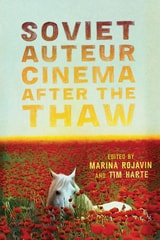
Soviet Auteur Cinema After the Thaw
Edited by Marina Rojavin and Tim Harte
University of Wisconsin Press, 2027
Following Stalin’s death, Soviet film—like Soviet culture—changed in meaningful ways. Emerging from a system that had stymied individual, creative voices, prominent directors now found their own respective styles, as they embraced their personal visions to produce works that diverged significantly from the mainstream. Grounded in auteur theory, this volume explores how these filmmakers expressed themselves through creative cinematic means rather than through a narrow emphasis on narrative or in accordance with popular—and governmental—whims. Each chapter focuses on a specific filmmaker, all of whom impacted the Soviet cinematic sphere despite harsh censorship and the repression of artists throughout the nation. By integrating cinematic and theoretical perspectives into a discussion of auteur Soviet films, this volume illuminates the significance of a cinematic trend that took place in both Soviet culture and international film history.
Contributors: Robert Efird, Tim Harte, Lilya Kaganovsky, David Gomiero Molina, Lida Oukaderova, Elizabeth A. Papazian, Marina Rojavin, Rita Safariants, Sydney Stotter, Sergey Toymentsev

The Interval of Freedom
Soviet Literature During the Thaw, 1954-1957George Gibian
University of Minnesota Press, 1960
The Interval of Freedom was first published in 1960. Minnesota Archive Editions uses digital technology to make long-unavailable books once again accessible, and are published unaltered from the original University of Minnesota Press editions.
When Boris Pasternak's Doctor Zhivago was published in Europe and America in 1957 and 1958, the Western world was astonished and elated. But Doctor Zhivago is not the only significant literary work to come out of Soviet Russia recently. During four extraordinary years, 1954 to 1957, from Stalin's death to the aftermath of the Hungarian revolt, Soviet Russian authors were able to express their minds with unusual freedom. In this volume Professor Gibian examines various revelations made in Soviet literature during this interval of comparative freedom.
Nearly a score of contemporary Soviet writers are considered in detail. The authors and their works are grouped according to three major subjects to which Soviet writers have devoted much attention: science, love and sex, and the literary villain or "negative" character. Works of the following writers are discussed in depth: Alexander Bek, Leonid Leonov, Daniel Granin, Venyamin Kaverin, Vladimir Dudintsev, Semen Kirsanov, S. Aleshin, Viktor Nekrasov, Nikolai Pogodin, Galina Nikolaeva, Alexander Korneichuk, Alexander Shtein, Alexander Volodin, Nikolai Gorbunov, Nikolai Zhdanov, and Alexander Yahin. An entire chapter is devoted to Doctor Zhivago. In an introductory chapter, the author provides a survey of literary developments during the interval of freedom. In a final chapter he draws conclusions about the nature of the thinking of Soviet literary intelligentsia, comparing it with Western literary thought. The book is illuminating from social and political as well as literary viewpoints.