Results by title
4 books match the query 'Theater critics'
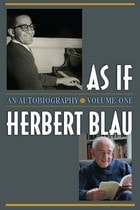
As If
An AutobiographyHerbert Blau
University of Michigan Press, 2012
As If: An Autobiography traces the complex life and career of director, scholar, and theorist Herbert Blau, one of the most innovative voices in the American theater. From his earliest years on the streets of Brooklyn, with gang wars there, to the often embattled, now-legendary Actor's Workshop of San Francisco, the powerfully told story of Blau's first four decades is also a social history, moving from the Great Depression to the cold war, with fallout from "the balance of terror" on what he once described in an incendiary manifesto as The Impossible Theater.
Blau has always forged his own path, from his activist resistance to the McCarthy witch hunts to his emergence as a revolutionary director whose work included the controversial years at The Workshop, which introduced American audiences to major playwrights of the European avant-garde, including Brecht, Beckett, Genet, and Pinter. There is also an account here of that notorious production of Waiting for Godot at the maximum-security prison at San Quentin, which became the insignia of the Theater of the Absurd.
Blau went on from The Workshop to become codirector of the Repertory Theater of Lincoln Center, and then founding provost of California Institute of the Arts, where he developed and became artistic director of the experimental group KRAKEN. Currently Byron W. and Alice L. Lockwood Professor of the Humanities at the University of Washington, Blau has been visionary in the passage from theater to theory, and his many influential and award-winning books include The Dubious Spectacle: Extremities of Theater, 1976–2000; Sails of the Herring Fleet: Essays on Beckett; Nothing in Itself: Complexions of Fashion; To All Appearances: Ideology and Performance; The Audience; The Eye of Prey: Subversions of the Postmodern; and Take Up the Bodies: Theater at the Vanishing Point.
This richly evocative book includes never-before-published photographs of the author, his family and friends, collaborators in the theater, and theater productions.
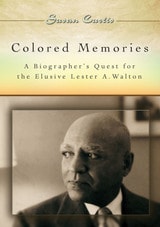
Colored Memories
A Biographer's Quest for the Elusive Lester A. WaltonSusan Curtis
University of Missouri Press, 2008
Lester A. Walton was a well-known public figure in his day. An African American journalist, cultural critic, diplomat, and political activist, he was an adviser to presidents and industrialists in a career that spanned the first six decades of the twentieth century. He was a steadfast champion of democracy and lived to see the passage of major civil rights legislation. But one word best describes Walton today: forgotten.
Exploring the contours of this extraordinary life, Susan Curtis seeks to discover why our collective memory of Walton has failed. In a unique narrative of historical research, she recounts a fifteen-year journey, from the streets of Harlem and “The Ville” in St. Louis to scattered archives and obscure public records, as she uncovers the mysterious circumstances surrounding Walton’s disappearance from national consciousness. And despite numerous roadblocks and dead ends in her quest, she tells how she came to know this emblematic citizen of the American Century in surprising ways.
In this unconventional book—a postmodern ghost story, an unprecedented experiment in life-writing—Curtis shares her discoveries as a researcher. Relating her frustrating search through long-overlooked documents to discover this forgotten man, she offers insight into how America’s obsession with race has made Walton’s story unwelcome. She explores the treachery, duplicity, and archival accidents that transformed a man dedicated to the fulfillment of American democracy into a shadowy figure.
Combining anecdotal memories with the investigative instincts of the historian, Curtis embraces the subjectivity of her research to show that what a society forgets or suppresses is just as important as what it includes in its history. Colored Memories is a highly original work that not only introduces readers to a once-influential figure but also invites us to reconsider how we view, understand, and preserve the past.
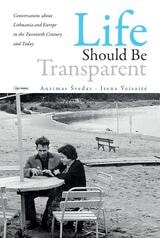
Life should be Transparent
Conversations about Lithuania and Europe in the Twentieth Century and TodayAurimas Svedas
Central European University Press, 2020
This book of thirteen conversations introduces us to the life of an exceptional person—theatre critic, Germanist, and long-time chair of the Open Lithuania Fund board—Irena Veisaitė. The dialogue between Lithuanian historian Aurimas Švedas and a woman who reflects deeply on her experiences reveals both one individual’s historically dramatic life and the fate of Europe and Lithuania in the twentieth century.
Through the complementary lenses of history and memory, we confront with Veisaitė the horrific events of the Holocaust, which brought about the end of the Lithuanian Jewish world. We also meet an array of world-class cultural figures, see fragments of legendary theatre performances, and hear meaningful words that were spoken or heard decades ago.
This book’s interlocutors do not so much seek to answer the question “What was it like?” but instead repeatedly ask each other: “What, how, and why do we remember? What is the meaning of our experiences? How can history help us to live in the present and create the future? How do we learn to understand and forgive?”
A series of Veisaitė’s texts, statements, and letters, presented at the end of the book suggest further ways of answering these questions.
The Making of Theatrical Reputations
Studies from the Modern London TheatreYael Zarhy-Levo
University of Iowa Press, 2008
Today's successful plays and playwrights achieve their prominence not simply because of their intrinsic merit but because of the work of mediators, who influence the whole trajectory of a playwright's or a theatre company's career. Critics and academic writers are primarily considered the makers of reputations, but funding organizations and various media agents as well as artistic directors, producers, and directors also pursue separate agendas in shaping the reputations of theatrical works. In The Making of Theatrical Reputations Yael Zarhy-Levo demonstrates the processes through which these mediatory practices by key authority figures situate theatrical companies and playwrights within cultural and historical memory.
To reveal how these authorizing powers-that-be promote theatrical events, companies, and playwrights, Zarhy-Levo presents four detailed case studies that reflect various angles of the modern London theatre. In the case of the English Stage Company's production of John Osborne's Look Back in Anger, she centers on a specific event. She then focuses on the trajectory of a single company, the Theatre Workshop, particularly through its first decade at the Theatre Royal, Stratford East, London. Next, she explores the career of the dramatist John Arden, especially its first ten years, in part drawing upon an interview with Arden and his wife, actress and playwright Margaretta D'Arcy, before turning to her fourth study: the playwright Harold Pinter's shifting reputation throughout the different phases of his career.
Zarhy-Levo's accounts of these theatrical events, companies, and playwrights through the prism of mediation bring fresh insights to these landmark productions and their creators.