Results by title
2 books match the query 'Their'
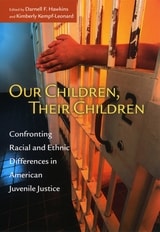
Our Children, Their Children
Confronting Racial and Ethnic Differences in American Juvenile JusticeEdited by Darnell F. Hawkins and Kimberly Kempf-Leonard
University of Chicago Press, 2005
Our Children, Their Children provides a state-of-the-science examination of racial and ethnic disparities in the American juvenile justice system. Here, contributors document the precise magnitude of these disparities, seek to determine their causes, and propose potential solutions. In addition to race and ethnicity, contributors also look at the effects on juvenile justice of suburban sprawl, the impact of family and neighborhood, bias in postarrest decisions, and mental health issues. Assessing the implications of these differences for public policy initiatives and legal reforms, this volume is the first critical summary of what is known and unknown in this important area of social research.
RSF
The Russell Sage Foundation Journal of the Social Sciences: Climate Hazards and Their Social, Political, and Economic Consequences in the United StatesMax Besbris
Russell Sage Foundation, 2026
As climate change intensifies, weather becomes more extreme and climate hazards like wildfires and hurricanes become more frequent and more destructive. While climate change affects the entire global population, the risk and consequences of experiencing climate hazards are not shared equally. In the U.S. lower socioeconomic status groups and people of color are disproportionately more at risk for experiencing climate hazards and face more difficulty recovering from them. In this issue of RSF, sociologists Max Besbris, Manuel Pastor, and Anna Rhodes, economist Wolfram Schlenker, political scientist Pamela Winston, and an interdisciplinary group of contributors examine the impact of climate change on inequality in the U.S.
The 11 articles in this issue investigate the consequences of climate hazards for inequality, examining impacts on housing, neighborhoods, and employment; the ways inequality emerges in recovery from climate-related disasters; and how politicians and other actors respond to climate change. As flood risk increases in communities across the U.S., local authorities are partnering with federal agencies to implement buyout programs as a tool for managed retreat. James R. Elliott and colleagues find that in majority-White communities, where most buyouts take place, homeowners more commonly opt to sell their homes on the private market instead, which creates a revolving door of risk rather than eliminating it. Property insurance is essential for mediating losses and facilitating hurricane recovery, yet timely and fair claims are not guaranteed. Bad faith claims handling can put residents’ housing stability and financial wellbeing at risk, leading many to file lawsuits to dispute the outcome of their claims. Hannah K. Friedrich and colleagues find that litigation against insurers is more likely in areas that have a higher percentage of Black residents and that case duration is longer for residents in these areas, reflecting that systemic procedural inequalities can amplify disparities in disaster recovery. Cadence Willse finds that in the wake of major climate-related disasters, Democrats are more likely to increase their support for environmental policy issues, while Republicans are less likely to vote in favor of environmental policies.Megan Mullin investigates whether support for managed retreat programs by local governments differ if residents are viewed as wealthy or low-income. She finds that local elected officials are more likely to support buyout programs for low-income homeowners.
This timely issue of RSF expertly enhances our understanding of the intersection of climate disasters and inequality.