Results by title
8 books match the query 'Their Own'
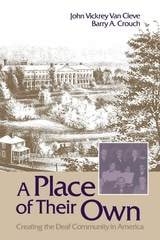
A Place of Their Own
Creating the Deaf Community in AmericaJohn Vickrey Van Cleve
Gallaudet University Press, 1989
Using original sources, this unique book focuses on the Deaf community during the 19th century. Largely through schools for the deaf, deaf people began to develop a common language and a sense of community.
A Place of Their Own brings the perspective of history to bear on the reality of deafness and provides fresh and important insight into the lives of deaf Americans.
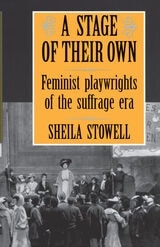
A Stage of Their Own
Feminist Playwrights of the Suffrage EraSheila Stowell
University of Michigan Press, 1994
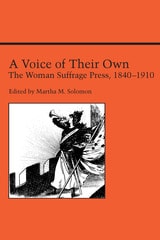
A Voice Of Their Own
The Woman Suffrage Press, 1840-1910Martha Solomon
University of Alabama Press, 1991
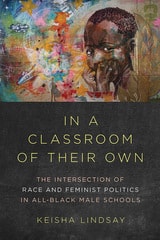
In a Classroom of Their Own
The Intersection of Race and Feminist Politics in All-Black Male SchoolsKeisha Lindsay
University of Illinois Press, 2018
Keisha Lindsay explains the complex politics of ABMSs by situating these schools within broader efforts at neoliberal education reform and within specific conversations about both "endangered” black males and a “boy crisis” in education. Lindsay also demonstrates that intersectionality, long considered feminist, is in fact a politically fluid framework. As such, it represents a potent tool for advancing many political agendas, including those of ABMSs supporters who champion antiracist education for black boys while obscuring black girls’ own race and gender-based oppression in school. Finally, Lindsay theorizes a particular means by which black men and other groups can form antiracist and feminist coalitions even when they make claims about their experiences that threaten bridge building. The way forward, Lindsay shows, allows disadvantaged groups to navigate the racial and gendered politics that divide them in pursuit of productive—and progressive—solutions.
Far-thinking and boldly argued, In a Classroom of Their Own explores the dilemmas faced by professionals and parents in search of equitable schooling for all students—black boys and otherwise.

Lives of Their Own
Blacks, Italians, and Poles in Pittsburgh, 1900-1960John Bodnar, Roger Simon, and Michael P. Weber
University of Illinois Press, 1982
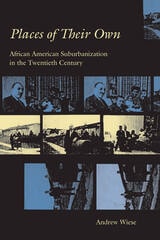
Places of Their Own
African American Suburbanization in the Twentieth CenturyAndrew Wiese
University of Chicago Press, 2005
For most people, this cozy image of suburbia does not immediately evoke images of African Americans. But as this pioneering work demonstrates, the suburbs have provided a home to black residents in increasing numbers for the past hundred years—in the last two decades alone, the numbers have nearly doubled to just under twelve million. Places of Their Own begins a hundred years ago, painting an austere portrait of the conditions that early black residents found in isolated, poor suburbs. Andrew Wiese insists, however, that they moved there by choice, withstanding racism and poverty through efforts to shape the landscape to their own needs. Turning then to the 1950s, Wiese illuminates key differences between black suburbanization in the North and South. He considers how African Americans in the South bargained for separate areas where they could develop their own neighborhoods, while many of their northern counterparts transgressed racial boundaries, settling in historically white communities. Ultimately, Wiese explores how the civil rights movement emboldened black families to purchase homes in the suburbs with increased vigor, and how the passage of civil rights legislation helped pave the way for today's black middle class.
Tracing the precise contours of black migration to the suburbs over the course of the whole last century and across the entire United States, Places of Their Own will be a foundational book for anyone interested in the African American experience or the role of race and class in the making of America's suburbs.
Winner of the 2005 John G. Cawelti Book Award from the American Culture
Association.
Winner of the 2005 Award for Best Book in North American Urban
History from the Urban History Association.
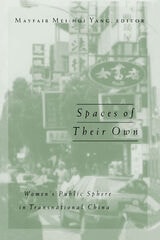
Spaces Of Their Own
Women’s Public Sphere in Transnational ChinaMayfair Mei-Hui Yang
University of Minnesota Press, 1999
An exploration of women’s public expression--in China and beyond.
How are the public and political lives of Chinese women constrained by states and economies? And how have pockets of women’s consciousness come to be produced in and disseminated from this traditionally masculine milieu? The essays in this volume examine the possibilities for a public sphere for Chinese women, one that would emerge from concrete historical situations and local contexts and also cut across the political boundaries separating the Mainland, Taiwan, Hong Kong, and the West.
The challenges of this project are taken up in essays on the legacy of state feminism on the Mainland as contrasted with a grassroots women’s movement in Taiwan; on the role of the capitalist consumer economy in the emerging lesbian movement in Taiwan; and on the increased trafficking of women as brides, prostitutes, and mistresses between the Mainland and wealthy male patrons in Taiwan and Hong Kong. The writers’ examples of masculine domination in the media include the reformulation of Chinese women in Fifth Generation films for a transnational Western male film audience and the portrayal of Mainland women in Taiwanese and Hong Kong media. The contributors also consider male nationalism as it is revealed through both international sports coverage on television and in a Chinese television drama. Other works examine a women’s museum, a telephone hotline in Beijing, the films of Hong Kong filmmaker Ann Hui, the transnational contacts of a Taiwanese feminist organization, the diaspora of Mainland women writers, and the differences between Chinese and Western feminist themes.Contributors: Susan Brownell, U of Missouri; Virginia Cornue; Dai Jinhua, Beijing U; Kathleen Erwin; Elaine Yee Lin Ho, Hong Kong U; Lee Yuan-chen, Tamkang U; Li Xiaojiang, Zhengzhou U and Henan U; Lisa Rofel, U of California, Santa Cruz; Tze-lan Deborah Sang, U of Oregon; Shu-mei Shih, UCLA; Zhang Zhen. ISBN 0-8166-3145-X Cloth $49.95xxISBN 0-8166-3146-8 Paper $19.95x336 pages 9 black-and-white photos 5 7/8 x 9 FebruaryPublic Worlds Series, volume 4Translation inquiries: University of Minnesota Press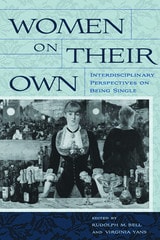
Women on Their Own
Interdisciplinary Perspectives on Being SingleEdited by Rudolph M. Bell and Virginia Yans
Rutgers University Press, 2007
Modern American culture has raised generations of women who believed that their true and most important role in society was to get married and have children. Anything short of this role was considered abnormal, unfulfilling, and suspect. This female stereotype has been exploited and perpetuated by some key films in the late 40's and early 50's. But more recently we have seen a shift in the cultural view of the spinster. The erosion of the traditional nuclear family, as well as a larger range of acceptable life choices, has caused our perceptions of unmarried women to change. The film industry has reflected this shift with updated stereotypes that depict this cultural trend. The shift in the way we perceive spinsters is the subject of current academic research which shows that a person's perception of particular societal roles influences the amount of stress or depression they experience when in that specific role. Further, although the way our culture perceives spinsters and the way the film industry portrays them may be evolving, we still are still left with a negative stereotype.
Themes of choice and power have informed the lives of single women in all times and places. When considered at all in a scholarly context, single women have often been portrayed as victims, unhappily subjected to forces beyond their control. This collection of essays about "women on their own" attempts to correct that bias, by presenting a more complex view of single women in nineteenth- and twentieth-century United States and Europe.
Topics covered in this book include the complex and ambiguous roles that society assigns to widows, and the greater social and financial independence that widows have often enjoyed; widow culture after major wars; the plight of homeless, middle-class single women during the Great Depression; and comparative sociological studies of contemporary single women in the United States, Britain, Ireland, and Cuba.
Composed of papers presented to the Rutgers Center for Historical Analysis project on single women, this collection incorporates the work of specialists in anthropology, art history, history, and sociology. It is deeply connected with the emerging field of singleness studies (to which the RCHA has contributed an Internet-based bibliography of more than 800 items). All of the essays are new and have not been previously published.