Results by title
3 books match the query 'Their World'
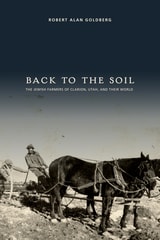
Back to the Soil
The Jewish Farmers of Clarion, Utah, and Their WorldRobert Alan Goldberg
University of Utah Press, 1986
The image of the Jew solely as urbanite may stem from the period of 1880 to 1920, when two million Jews left their homes in Eastern Europe and established themselves in the urban centers of America. Lesser known are the agrarian efforts of Jewish immigrants. In Back to the Soil, Robert Goldberg focuses on the attempt of one such Jewish colony in Clarion, Utah. In 1911, eighty-one families left eastern cities to farm the Clarion tract. Jewish families funded the venture, the governor of Utah en-couraged it, and the Mormon Church financially aided the community. Despite these efforts, Clarion died as an organizational entity in 1916, with the dozen remaining families departing by the mid-1920s.
Goldberg sheds light on the values and ideals of the colonists, the daily rhythm of life, the personalities of the settlers, and the struggle for and eventual collapse of their dream. Of all the attempts to establish a Jewish colony on the land, Clarion was the largest and had the longest existence of any colony west of the Appalachians. The Clarion fragment, lost and forgotten, thus becomes a crucial part of the larger mosaic of Jewish history in the West.
Release of this new paperback edition is timed to coincide with the celebration of the centennial of the founding of the Clarion colony.
The Hittites and Their World
Billie Jean Collins
SBL Press, 2007
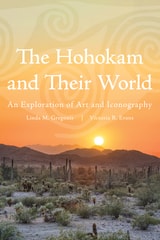
The Hohokam and Their World
An Exploration of Art and IconographyLinda M. Gregonis and Victoria R. Evans
University of Arizona Press, 2025
Southwest Books of the Year Pick
People traveling around the Sonoran Desert will see the traces of an ancient society, the Hohokam, through the material that they left behind—pottery, shell ornaments, carved stone, and rock imagery.
The Hohokam and Their World offers readers the opportunity to explore how these various images and objects may have been used by the Hohokam, and what the icons and objects may have meant, including how the Hohokam conveyed ideas about water, the Sonoran Desert, the ocean, travel, ancestors, and the cosmos.
Authors Linda M. Gregonis and Victoria R. Evans discuss how artists drew inspiration from their Sonoran Desert homeland and were also influenced by the cultures of western Mexico, the hunter-gatherers of the western desert, the Mogollon to the east, and the Pueblo cultures of the northern Southwest. Unlike traditional archaeological texts, this book takes a holistic approach by examining a diverse range of artistic expressions used by the Hohokam. From intricately crafted pottery to mesmerizing carvings in rock, each medium offers a unique glimpse into the Hohokam’s relationship with their environment and the wider world.
Whether you’re planning a visit to national parks or museums in the Southwest or simply intrigued by ancient civilizations, The Hohokam and Their World is a must-read. The work includes a glossary of key archaeological and anthropological terms, as well as endnotes and an extensive list of references for those who want to dig deeper.