Results by title
2 books match the query 'Theodicy'
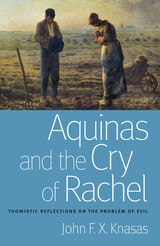
Aquinas and the Cry of Rachel
John F.X. Knasas
Catholic University of America Press, 2013
In Aquinas and the Cry of Rachel , John F. X. Knasas explores Thomas Aquinas's philosophical thinking about evil, and brings the results into discussion with the contemporary theodicies - philosophies of the problem of evil. It examines the relation of the human person and human nature to nature as a whole.
Generally speaking, possible philosophical accounts for evil are two kinds: cosmological or personal. The cosmological account has evils rebounding to the perfection of creation. The personal account would have evils suffered rebounding to the good of the sufferer. Knasas argues that for Aquinas no philosophical resolution of these two kinds of accounts
is possible. This argument is based upon Aquinas's understanding of the human as an intellector of analogical being. Such an understanding establishes two truths. First, the human is by nature only a principal part of the created whole. Second, there is the philosophically discernible possibility of supernatural elevation by the creator.
Hence, as far as philosophy can discern, evil may have a natural explanation or it may have a supernatural one. The Thomistic philosopher has no answer as to why evil exists because that philosopher discerns too many possible ones. In that respect, Aquinas's thinking on evil is similar to his thinking about the philosophical knowledge of the biblical
truth of the world's creation in time. Such a creation is one metaphysical possibility among others. Some authors that Aquinas and the Cry of Rachel considers are: Anthony Flew and Albert Camus, Jacques Maritain and Charles Journet, William Rowe, Marily McCord Adams, William Hasker, John Hick, David Ray Griffin, David Hume, Diogenes Allen, J. L. Mackie, Alvin Plantinga, Richard Swinburne, Bruce Reichenbach,
Brian Davies, and Eleonore Stump.
[more]
Evil & the Evidence For God
The Challenge of John Hick's TheodicyR. Geivett
Temple University Press, 1995
"By appealing to recent scientific opinion that the universe may well have had an absolute beginning, Geivett develops an interesting, forceful argument for the rationality of belief in God. He then expounds the Augustinian free will theodicy and defends it against Hick's criticisms."
--William L. Rowe
How to reconcile the existence of evil with the belief in a benevolent God has long posed a philosophical problem to the system of Christian theism. John Hick's book, Evil and the Love of God, is perhaps the best known work to redress this difficulty in modern terms. Sharing Hick's interest in responding to the question of evil, R. Douglas Geivett constructs his own new "theodicy for today." But Geivett departs from Hick by embracing the Augustinian tradition of free will and returning the responsibility for evil to human beings themselves.
Reviews
"Moving from a comparison of the Irenaean and Augustinian traditions in theodicy to a powerfully original critique of Hick's influential 'soul-making' theodicy, Geivett presents a richly developed natural theology drawing on contemporary scientific opinion in support of an ex nihilo creation. Geivett's writing on natural theology is lucid and informed, honestly engaging many of that tradition's critics....This work is notable for its exceptionally thorough documentation and references, making it a valuable sourcebook for reflection on God and evil. A stimulating afterword by Hick himself significantly enriches this book's provocative analyses."
--Religious Studies Review
"Geivett details a natural theology and develops a way of understanding the existence of evil that places the fact of evil within, rather than in opposition to, a theistic view. Both the natural theology and the theodicy are rich and complex."
--Keith E. Yandell, University of Wisconsin
"In this interesting and worthwhile work, Geivett's statement of arguments in natural theology is fuller and fairer than that given by Hick in his writings. This book is an outstanding contribution to the field."
--Richard L. Purtill, Western Washington University
Contents
Preface
Part I: Two Traditions
1. The Problem of Evil
2. The Augustinian Tradition
3. John Hick's Theodicy
Part II: Religious Epistemology
4. The Value of Natural Theology
5. The Danger of Dismissing Natural Theology
6. The Possibility of Natural Theology, Part 1: The Argument for a Non-Natural Reality
7. The Possibility of Natural Theology, Part 2: Personality, Power, and Providence
8. Explanation and Religious Ambiguity
Part III: Theodicy Proper
9. John Hick's View of Divine Purpose
10. The Augustinian View of Divine Purpose
11. Free Will and Evil
12. Evil and the Afterlife
Afterword by John Hick
Notes
Index
About the Author(s)
R. Douglas Geivett is Associate Professor of Philosophy at Biola University in La Mirada, California.
[more]