248 books match the query 'Theology' and 23 start with a
cover of A Companion to Martin Buber

A Companion to Martin Buber

Edited by Paul Mendes-Flohr

University of Chicago Press, 2025

A definitive, international guide to the thought of the most important twentieth-century Jewish philosopher.
 
In his 1923 essay, I and Thou, the philosopher, theologian, and activist Martin Buber introduced a philosophy of dialogue that achieved a global, interdisciplinary resonance. For Buber, dialogue was more than a conversation; dialogue discloses something essential about our orientation and our lives with one another. This companion assembles twenty-six scholars from a dozen countries to explore Buber’s international reputation and legacy in education, interfaith relations, Judaism, philosophy, politics, and psychology. The result is an essential guide to one of the most influential Jewish thinkers of the twentieth century.
[more]
cover of A Gift of Presence: The Theology and Poetry of the Eucharist in Thomas Aquinas

A Gift of Presence

The Theology and Poetry of the Eucharist in Thomas Aquinas

Jan Heiner Tück

Catholic University of America Press, 2018
Jan-Heiner Tück presents a work that explores the sacramental theology, lived spirituality, and Eucharistic poetry of the Church’s doctor communis, St. Thomas Aquinas. Although Aquinas’ Eucharistic poetry has long occupied an important place in the Church’s liturgical prayer and her repertoire of sacred music, the depth of these poems remains hidden until one grasps the rich sacramental theology underlying it. Consequently, Tück first offers a detailed but approachable primer of Aquinas’ theology of the sacraments, before diving deeply into the Angelic Doctor’s theology and poetry of the Eucharist. The Scriptural accounts stand at the heart of the systematic framework developed by Aquinas, and thus significant attention is devoted to showing the harmony between the accounts of Christ’s passion and the detailed exposition of the Summa theologiae. Moreover, the Eucharistic controversies of the ninth and eleventh centuries provide the contrapuntal context in which Aquinas did his thinking, praying, and writing. Not surprisingly, therefore, the response he crafts to these controversies draws upon both speculative powers and contemplative prayer, brought together in the unity of Aquinas’ theology and spirituality. The net result is a twofold treasure for the Church: a careful systematic presentation of Eucharistic theology and the lived devotional expression of the same in the carefully constructed—and now much beloved—stanzas of Pange lingua gloriosi, Lauda Sion, Adoro te devote, etc. By revealing the lively interplay of the saint’s powerful speculative intellect and a heart steeped in love for the Eucharistic Lord, Tück offers a sophisticated exposition of Aquinas’ Eucharistic poetry and the roots it sinks into a wider theological framework. Finally, the contemporary significance and power of Aquinas’ work is drawn out, not only in the rarefied realm of intellectual inquiry but also in the everyday expanse of ordinary life.
[more]
cover of A Life of Meaning: Embracing Reform Judaism's Sacred Path

A Life of Meaning

Embracing Reform Judaism's Sacred Path

Rabbi Dana Evan Kaplan, PHD

Central Conference of American Rabbis, 2018
Reform Judaism is constantly evolving as we continue to seek a faith that is in harmony with our beliefs and experiences. This volume offers readers a thought-provoking collection of essays by rabbis, cantors, and other scholars who differ, sometimes passionately, over religious practice, experience, and belief. Its goal is to situate Judaism in a contemporary context and it is uniquely suited for community discussion and study groups alike.
[more]
cover of A Mieke Bal Reader

A Mieke Bal Reader

Mieke Bal

University of Chicago Press, 2006

Mieke Bal has had a significant impact on every field she has touched, from Old Testament scholarship and narratology to critical methods and visual culture. This brilliant and controversial intellectual invariably performs a high-wire act at the point where critical issues and methods intersect—or collide. She is deeply interested in the problems of cultural analysis across a range of disciplines. A Mieke Bal Reader brings together for the first time a representative collection of her work that distills her broad interests and areas of expertise.

This Reader is organized into four parts, reflecting the fields that Bal has most profoundly influenced: literary study, interdisciplinary methodology, visual analysis, and postmodern theology. The essays include some of Bal’s most characteristic and provocative work, capturing her at the top of her form. “Narration and Focalization,” for example, provides the groundwork for Bal’s ideas on narrative, while “Reading Art?” clearly outlines her concept of reading images. “Religious Canon and Literary Identity” reenvisions Bal’s own work at the intersection of theology and cultural analysis, while “Enfolding Feminism” argues for a new feminist rallying cry that is not a position but a metaphor. More than a dozen other essays round out the four sections, each of which is interdisciplinary in its own right: the section devoted to literature, for instance, ranges widely over psychoanalysis, theology, photography, and even autobiography.

A Mieke Bal Reader is the product of a capacious intellect and a sustained commitment to critical thinking. It will prove to be instructive, maddening,  and groundbreaking—in short, all the hallmarks of intellectual inquiry at its best.
[more]
cover of A Muslim Primer: A Beginner's Guide to Islam

A Muslim Primer

A Beginner's Guide to Islam

Ira G. Zepp

University of Arkansas Press, 2000

A Muslim Primer covers the basic beliefs of Islam and provides an informative source for both lay and professional readers. First published in 1992, it has proven to be a valuable handbook for all attempting to better understand the tenets of the religion of a major portion of the world’s population. The reader is introduced to the authority of the Quran, the prophethood of Muhammad, the Wisdom of the Law, the Five Pillars of Islam, and to other fundamental principles of the religion. Distinctions are made between Sunni and Shiite traditions and the Sufi mystical dimension of Islam.

Well organized, visually appealing, and accurate, A Muslim Primer is useful to pre-collegiate and collegiate students of Islam, church and community study groups, and travelers, both tourists and business people.

[more]
cover of A Preface to Theology

A Preface to Theology

W. Clark Gilpin

University of Chicago Press, 1996

At a time of widespread perplexity about the social role of humanistic scholarship, few disciplines are as anxious about their nature and purposes as academic theology. In this important work, W. Clark Gilpin, dean of the University of Chicago Divinity School, proposes that American theological scholarship become responsible to a threefold public: the churches, the academic community, and civil society.

Gilpin approaches this goal indirectly, by investigating the historic social roles of Protestant theologians and the educational institutions in which they have pursued their scholarship and teaching. Ranging from analyses of the New England Puritan Cotton Mather to contemporary theologians as "public intellectuals," Gilpin proposes that we find out what theology is by asking what theologians do.

By showing how particular cultural problems have always shaped the work of theologians, Gilpin's work profoundly illuminates the foundations of American academic theology, providing insights that will help guide its future.
[more]
cover of A Short Treatise on the Virgin Mary

A Short Treatise on the Virgin Mary

Rene Laurentin

Catholic University of America Press, 2022
As a peritus at Vatican II and by the end of his life arguably the world’s leading Mariologist, René Laurentin has earned the privilege of republication of a work of considerable value for any theologian who aims for comprehensiveness of Catholic theological perspective, historically and systematically. Laurentin’s orthodox, yet highly original treatment displays his command of all of the relevant biblical, patristic, medieval and modern texts up to and including the entire proceedings of the Second Vatican Council, as well as the whole range of related historical and theological scholarship. His proposal to pursue Mariological speculation along two tracks – first, “from above,” following the course of doctrinal development from biblical revelation to the VCII era, and second, “from below,” considering Mary’s own life (walking in her footsteps, as it were), from before the Annunciation to the Parousia – provides a clear, accessible structure for the work, yielding rich theological and spiritual fruit. Not only are all the major Marian doctrines and their developments handled with the greatest sensitivity, from the Virgin birth to the modern promulgations of Immaculate Conception and Assumption, but Laurentin’s approach in his second part opens the way to a human-psychological treatment of motherhood, still solidly bolstered by traditional Christian anthropology. Regarding Mary’s status as Mother of God, Laurentin’s discussion of the Theotokos exhibits his deep ecumenical commitments, as much as his specific attention to Mary’s soteriological role as a sticking point for Protestantism. One of the most striking qualities of the work is Laurentin’s deft integration of his evident scholastic formation into an overarching vision thoroughly at ease with the phenomenological (“personalist”) and existential currents in which he also inevitably swam throughout his education and professional scholarly occupation. As a result, the work can be read and appreciated instinctively, as it were, as much by the eclectic contemporary theologian, influenced by the likes of Heidegger, et al, as by the Thomist.
[more]
cover of A Theology of Sense: John Updike, Embodiment, and Late Twentieth-Century American Literature

A Theology of Sense

John Updike, Embodiment, and Late Twentieth-Century American Literature

Scott Dill

The Ohio State University Press, 2018
Scott Dill’s A Theology of Sense: John Updike, Embodiment, and Late Twentieth-Century American Literature brings together theology, aesthetics, and the body, arguing that Updike, a central figure in post-1945 American literature, deeply embeds in his work questions of the body and the senses with questions of theology. Dill offers new understandings not only of the work of Updike—which is importantly being revisited since the author’s death in 2009—but also new understandings of the relationship between aesthetics, religion, and physical experience. Dill explores Updike’s unique literary legacy in order to argue for a genuinely postsecular theory of aesthetic experience. Each chapter takes up one of the five senses and its relation to broader theoretical concerns: affect, subjectivity, ontology, ethics, and theology. While placing Updike’s work in relation to other late twentieth-century American writers, Dill explains their notions of embodiment and uses them to render a new account of postsecular aesthetics. No other novelist has portrayed mere sense experience as carefully, as extensively, or as theologically—repeatedly turning to the doctrine of creation as his stylistic justification. Across this examination of his many stories, novels, poems, and essays, Dill proves that Updike forces us to reconsider the power of literature to revitalize sense experience as a theological question.
[more]
cover of A Theology of the Christian Bible: Revelation - Inspiration - Canon

A Theology of the Christian Bible

Revelation - Inspiration - Canon

Denis Farkasfalvy

Catholic University of America Press, 2018
A Theology of the Christian Bible is built upon the thesis that divine revelation, the inspiration and canonization of Scripture should be viewed as “sequentially linked movements” of a single process wherein God reveals his Word in history and ensures permanent accessibility of revelation for his People, both of Israel and of the Church. The starting point is the view expressed in the Second Vatican Council’s document Dei Verbum that revelation consists of the “words and realities” of Salvation History. This marks a shift away from the neo-scholastic concept that approached revelation primarily as a set of propositional truths. Farkasfalvy begins with the notion of revelation as a historical process: God reveals his Word in a “salvation history,” which culminates in the Incarnation. The transmission of revelation always involves human mediation by chosen individuals or, in the language of the biblical and patristic tradition, “Prophets and Apostles.” Farkasfalvy then moves on to review some of the major contributors to the theology of inspiration around the time of Vatican II (Bea, Rahner, Alonso-Schökel), the teaching of Dei Verbum proper, and finally the 2014 document of the Pontifical Biblical Commission and biblical inspiration and the truth of the Bible, treating each of these in its individual context. According to Farkasfalvy, the theology of inspiration was greatly handicapped by the neo-scholastic notion of God as a “literary author” of the scriptural texts. Advocating God as true and genuine “author” of Scripture, but in a non-literary sense, Farkasfalvy also reviews afresh the tradition inspiration-incarnation analogy. Scripture should be thought of in light of God progressively revealing himself in limited and located contexts to chosen human beings, through whom revelation is transmitted in verbal and, eventually, written form. God guides the complex compositional processes of the biblical books so that his word becomes accessibly and permanently preserved in writing for his people, the Church. The final chapters of A Theology of the Christian Bible take up the extension of these dynamics into canonization. These largely exegetical and historical chapters focus on the transmission of the revelation in Christ through both Testaments by means of Jesus’ Apostles, embracing the Hebrew Scriptures and setting in motion the formation and, in early patristics, the canonization of the New Testament.
[more]
cover of A Theory of Religion

A Theory of Religion

Stark, Rodney

Rutgers University Press, 1996
In this unique text, Stark and Bainbridge begin with basic statements about human nature and, employing the principles of logic and philosophy, build toward increasingly complex propositions about societies and their religious institutions. They provide a rigorous yet flexible sociological theory of religion as well as a general sociological model for deriving macrolevel theory from microlevel evidence.
[more]
cover of A Thomistic Christocentrism: Recovering the Carmelites of Salamanca on the Logic of the Incarnation

A Thomistic Christocentrism

Recovering the Carmelites of Salamanca on the Logic of the Incarnation

Dylan Schrader

Catholic University of America Press, 2021
Saint Thomas Aquinas famously held the opinion that, in God’s actual plan for the world, the Word would not have become flesh except to redeem us from sin. Conversely, Blessed John Duns Scotus argued that God intended Christ first, such that Christ would have come even if there had been no sin. While Aquinas and Scotus were far from the first to consider this question, they became emblematic of two seemingly irreconcilable approaches. In this book, Father Dylan Schrader recovers the thought of the Salmanticenses, the Discalced Carmelites writing at the University of Salamanca in the seventeenth century. The Salmanticenses argue that Christ is primary in God’s intention precisely as redeemer, so that it is true both that God has made everything else for the sake of Christ and that Christ’s coming is essentially redemptive, connected with sin. In this way, the Salmanticenses offer a Thomistic Christocentrism. This book summarizes the historical background to the Salmanticenses, from the time of Anselm up through the early-modern period. Next, it presents and defends the Salmanticenses’ argument for the primacy of Christ the redeemer. A Thomistic Christocentrism then turns to two key post-conciliar figures, Karl Rahner and Hans Urs von Balthasar. Rahner sees Christ as the culmination of the world’s opening up to God. Balthasar sees Christ as the reconciler of divine and human freedom through his cross, descent, and resurrection. Both Christocentric approaches have good aspirations but suffer from serious flaws. In its final chapters, this book applies the Salamanca theory to Rahner and Balthasar, showing its enduring value for post-conciliar Christocentrism.
[more]
cover of A Word in Season: Isaiah's Reception in the Book of Mormon

A Word in Season

Isaiah's Reception in the Book of Mormon

Joseph M. Spencer

University of Illinois Press, 2023

A groundbreaking look at the relationship between two sacred texts

The Book of Mormon’s narrative privileges Isaiah over other sources, provocatively interpreting and at times inventively reworking the biblical text. Joseph M. Spencer sees within the Book of Mormon a programmatic investigation regarding the meaning and relevance of the Book of Isaiah in a world increasingly removed from the context of the times that produced it. Working from the crossroads of reception studies and Mormon studies, Spencer investigates and clarifies the Book of Mormon’s questions about the vitality of Isaiah’s prophetic project. Spencer’s analysis focuses on the Book of Mormon’s three interactions with the prophet: the character of Abinadi; the resurrected Jesus Christ; and the nation-founding figure of Nephi. Working from the Book of Mormon as it was dictated, Spencer details its vital and overlooked place in Isaiah’s reception while recognizing the interpretation of Isaiah as an organizing force behind the Book of Mormon.
[more]
cover of Africae Munus: Ten Years Later

Africae Munus

Ten Years Later

Agbaw-ebai

St. Augustine's Press, 2022

With great foresight and vision for the Church, Pope Emeritus Benedict XVI carefully integrated theological, catechetical and pastoral themes in the Post-Synodal Apostolic Exhortation, Africae Munus. Maurice A. Agbaw-Ebai and Matthew Levering, in the introduction to this collection of reflections and studies focused on the Pope Emeritus’ themes, affirm the African continent’s status as a global center for the growth of the Catholic Church in the twenty-first century and the future of the international Catholic community.
     Building on the vitality and enthusiasm of the Church in Africa, it is important to lift their faith through scholarly research and academic reflections. We cannot fully appreciate the dedication, commitment and perseverance of the Catholic community throughout the African continent if we do not know the truth of their sufferings and persecution and understand their resilience in the light of faith. This collection, drawn from the halls of academia, provides an important contribution to the understanding and advancement of Catholic Africa, following the insights and enlightenment of Pope Emeritus Benedict. It is my hope that these essays will enrich your understanding and experience of the Catholic faith.

— From the Preface by Seán Patrick Cardinal O’Malley
[more]
cover of African American Religious Studies: An Interdisciplinary Anthology

African American Religious Studies

An Interdisciplinary Anthology

Gayraud Wilmore, editor

Duke University Press, 1989
This anthology provides a coherent, interdisciplinary theoretical base for students of African American religious studies and will assist in the design of programs and courses for lay theological education and training. To this end, the editor has assembled material from Old and New Testament studies, theology, church history, pastoral counseling, worship, and social action.
[more]
cover of After God

After God

Mark C. Taylor

University of Chicago Press, 2007

Religion, Mark C. Taylor argues in After God, is more complicated than either its defenders or critics think and, indeed, is much more influential than any of us realize. Our world, Taylor maintains, is shaped by religion even when it is least obvious. Faith and value, he insists, are unavoidable and inextricably interrelated for believers and nonbelievers alike.

The first comprehensive theology of culture since the pioneering work of Paul Tillich, After God redefines religion for our contemporary age. This volumeis a radical reconceptualization of religion and Taylor’s most pathbreaking work yet, bringing together various strands of theological argument and cultural analysis four decades in the making.

Praise for Mark C. Taylor
“The distinguishing feature of Taylor’s career is a fearless, or perhaps reckless, orientation to the new and to whatever challenges orthodoxy. . . . Taylor’s work is playful, perverse, rarefied, ingenious, and often brilliant.”—New York Times Magazine
 

[more]
cover of Al-Ghazali's "Moderation in Belief"

Al-Ghazali's "Moderation in Belief"

Al-Ghazali

University of Chicago Press, 2013

Centuries after his death, al-Ghazali remains one of the most influential figures of the Islamic intellectual tradition. Although he is best known for his Incoherence of the Philosophers, Moderation in Belief is his most profound work of philosophical theology. In it, he offers what scholars consider to be the best defense of the Ash'arite school of Islamic theology that gained acceptance within orthodox Sunni theology in the twelfth century, though he also diverges from Ash'arism with his more rationalist approach to the Quran. Together with The Incoherence of the Philosophers, Moderation in Belief informs many subsequent theological debates, and its influence extends beyond the Islamic tradition, informing broader questions within Western philosophical and theological thought.
           
The first complete English-language edition of Moderation in Belief, this new annotated translation by Aladdin M. Yaqub draws on the most esteemed critical editions of the Arabic texts and offers detailed commentary that analyzes and reconstructs the arguments found in the work’s four treatises. Explanations of the historical and intellectual background of the texts also enable readers with a limited knowledge of classical Arabic to fully explore al-Ghazali and this foundational text for the first time.
           
With the recent resurgence of interest in Islamic philosophy and the conflict between philosophy and religion, this new translation will be a welcome addition to the scholarship.  
[more]
cover of Amen

Amen

Patrick J. Ryan SJ

Catholic University of America Press, 2018
Amen: Jews, Christians, and Muslims Keep Faith with God examines faith as it is understood by Jews, Christians and Muslims; it does not aim to be a work of systematic theology or a lengthy explication of the contents of different faith traditions. It offers Jews, Christians and Muslims several approaches to faith as a category of human experience open to God: a faithful God who reaches out to grasp the faithful human being at the same time that the faithful human being reaches out to grasp a faithful God. This two-sided faith, divine and human, lies at the center of each faith tradition. The book examines faith as one might examine a gem, gazing at different facets in turn.
[more]
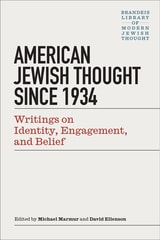
cover of American Jewish Thought Since 1934: Writings on Identity, Engagement, and Belief

American Jewish Thought Since 1934

Writings on Identity, Engagement, and Belief

Edited by Michael Marmur and David Ellenson

Brandeis University Press, 2020

What is the role of Judaism and Jewish existence in America? And what role does America play in matters Jewish? This anthology considers these questions and offers a look at how the diverse body of Jewish thought developed within the historical and intellectual context of America.

In this volume, editors Michael Marmur and David Ellenson bring together the distinctive voices of those who have shaped the bold and shifting soundscape of American Jewish thought over the last few generations. The contributors tackle an array of topics including theological questions; loyalty and belonging; the significance of halakhic, spiritual, and ritual practice; secularization and its discontents; and the creative recasting of Jewish peoplehood. The editors are careful to point out how a plurality of approaches emerged in response to the fundamental ruptures and challenges of continuity posed by the Holocaust, the establishment of the state of Israel, and the civil rights movement in the twentieth century.

This volume also includes a wide swath of the most distinctive currents and movements over the last eighty years: post-Holocaust theology, secular forms of Jewish spirituality, ultra-orthodoxy, American neo-orthodoxy, neo-Hasidism, feminism and queer theory, diasporist critiques of Zionism, and Zionist militancy. This collection will serve as both a testament to the creativity of American Jewish thought so far, and as an inspiration for the new thinkers of its still unwritten future.
[more]
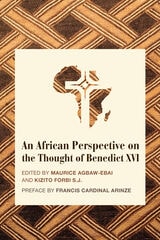
cover of An African Perspective on the Thought of Benedict XVI

An African Perspective on the Thought of Benedict XVI

Agbaw-ebai

St. Augustine's Press, 2023
Catholicism continues to experience an exponential growth in Africa. Going by the figures and the intensity of religious practice, Africa can unarguably be described as the new center of the Christianity in general, and Catholicism in particular. With over 236 million Catholics, Africa considers itself as having come of age and capable of making its voice heard on matters pertaining to global Catholicism/Christianity. And if there is a contemporary theologian greatly loved and admired by African scholars, Joseph Ratzinger/Benedict XVI ranks premium on that list. His convening a second synod on Africa on the theme of justice, peace and reconciliation, further endeared him to the African theologians. This book is a testimony to the affection that the Church in Africa has for Benedict XVI. In effect, as Africa finds its voice on the stage of global Catholicism, the theology of Joseph Ratzinger/Benedict XVI provides a fruitful space for Africa's engagement with the wider Church. Benedict XVI described Africa as the spiritual lung of the world. This volume testifies to the vitality and healthiness of that lung, a must read for all interested in African Catholicism and its definite impact on global Christianity as a whole. 
[more]
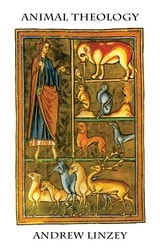
cover of Animal Theology

Animal Theology

Andrew Linzey

University of Illinois Press, 1995

“What are we to say of a theology which has so proceeded on the basis of a moral neglet of God’s creatures?” asks Andrew Linzey. In Animal Theology, he seeks ways in which doctrine can help morally motivated Christians to perceive meaning in animal suffering.

In Linzey’s view, animal rights is synonymous with animal theology. Linzey argues that historical theology, creatively defined, must reject humanocentricity. Questioning the assumption that if theology is to speak on this issue, “it must only do so on the side of the oppressors,” Linzey investigates not only the abstractions of theory, but also the realities of hunting, animal experimentation, and genetic engineering. His is a pioneering, vital, and unequivocally Christian voice advocating on behalf of the countless creatures who share our world and our lives but cannot speak for themselves.
[more]
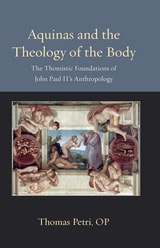
cover of Aquinas and the Theology of the Body

Aquinas and the Theology of the Body

Thomas Petri

Catholic University of America Press, 2016
Pope John Paul's Theology of the Body catecheses has garnered tremendous popularity in theological and catechetical circles. Students of the Theology of the Body have generally interpreted it as innovative not only in its presentation of the Church's teaching on marriage and sexuality, but also as radically advancing that teaching. Aquinas and the Theology of the Body offers a somewhat different interpretation. Fr. Thomas Petri argues that the philosophy and theology of Thomas Aquinas substantially contributed to John Paul's intellectual formation, which he never abandoned. A correct interpretation of the Theology of the Body requires, therefore, a thorough understanding of Thomistic anthropology and theology, which has been mostly lacking in commentaries on the pope's important contributions on the subject of marriage and sexuality.
[more]
cover of At a Breezy Time of Day: Selected Schall Interviews on Just about Everything

At a Breezy Time of Day

Selected Schall Interviews on Just about Everything

James V. Schall

St. Augustine's Press, 2016

We have books that contain collected essays, verse, and humor. What we see less often are books that contain collected interviews on various topics. Interviews have a certain outside discipline about them. The one interviewed responds to a question someone else asks of him. Often the questions are unexpected, sometimes annoying. Answers have a freshness to them. They can be more personal, frank. 
            The responses in At a Breezy Time of Day are occasioned when someone writes or phones with a request for an interview. There may be a common theme but often side questions come up. We are curious about what someone has to say –  about sports, about God, about Plato, about education, about books, about just about anything. Usually central questions occur. The same question can be answered in different ways. We often have more to say on a given topic than we do say on our first being asked about it.
            These interviews appeared in various on-line and printed sources. Having them collected in one text makes the interview form itself seem more substantial. Interviews too often seem to be passing, ephemeral things, but often we want to hold on to them. There is something more existential about them. Yet there is also something more lightsome about them also. The truth of things seems more bearable when it is spoken, when it has a human voice. 
So, as the title of this collection intimates, we begin with the very first interview in the Garden of Eden. We touch many places and issues. The interview always has somewhere even in its written form the touch of the human voice. The one who interviews invites us to speak, to tell us what we hold, why we hold it. Interviews are themselves part of that engagement in conversation that defines our kind in its search for a full knowledge of what is. 
We know that when we have said the last word, much remains to be said. We can rejoice both in what we know, and in what we know that we do not know. I believe it was Socrates who, in an earlier form of interview at the end of The Apology, alerted us to be aware of what we know and to await the many other interviews that we hope to carry on with so many others of our kind in the Isles of the Blessed.
 
[more]
cover of Augustine in His Own Words

Augustine in His Own Words

William Harmless

Catholic University of America Press, 2010

This volume offers a comprehensive portrait--or rather, self-portrait, since its words are mostly Augustine's own--drawn from the breadth of his writings and from the long course of his career
[more]