Results by title
6 books match the query 'There Is'
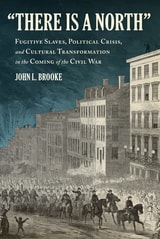
"There Is a North"
Fugitive Slaves, Political Crisis, and Cultural Transformation in the Coming of the Civil WarJohn L. Brooke
University of Massachusetts Press, 2019
How does political change take hold? In the 1850s, politicians and abolitionists despaired, complaining that the "North, the poor timid, mercenary, driveling North" offered no forceful opposition to the power of the slaveholding South. And yet, as John L. Brooke proves, the North did change. Inspired by brave fugitives who escaped slavery and the cultural craze that was Uncle Tom's Cabin, the North rose up to battle slavery, ultimately waging the bloody Civil War.
While Lincoln's alleged quip about the little woman who started the big war has been oft-repeated, scholars have not fully explained the dynamics between politics and culture in the decades leading up to 1861. Rather than simply viewing the events of the 1850s through the lens of party politics, “There Is a North” is the first book to explore how cultural action—including minstrelsy, theater, and popular literature—transformed public opinion and political structures. Taking the North's rallying cry as his title, Brooke shows how the course of history was forever changed.

Leading for School Librarians
There Is No Other OptionHilda K. Weisburg
American Library Association, 2017
There Is No Making It Out
Stories-So-Far and the Possibilities of New StoriesRomeo García
Utah State University Press, 2025
There Is a Tree More Ancient Than Eden
Leon Forrest
University of Chicago Press, 2001
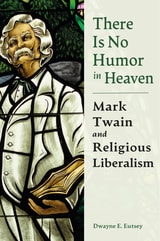
There is No Humor in Heaven
Mark Twain and Religious LiberalismDwayne E. Eutsey
University of Missouri Press, 2025
In There is No Humor in Heaven, Dwayne Eutsey challenges the persistent view of Twain as a hostile critic of religion by placing him within the prevailing liberal religious ethos of his time. From Hannibal to the western frontier and from Hartford to the wider world, Eutsey contends Twain’s vocation as a humorist was rooted in his frustrated youthful ambition to become a preacher of the Gospel. Throughout his life, his friendships with several influential liberal ministers, each of them espousing various forms of the era’s diverse progressive theology, informed not only Twain’s evolving religious worldview but his lecture performances and literary output.
There is No Humor in Heaven traces unconventional theological influences on Twain ranging from African-American spirituality, Freemasonry, and frontier Unitarianism to devout Liberal Christianity, radical Free Religion, and esoteric Hinduism. Drawing from Twain’s writings, documents, personal notes, and more, There is No Humor in Heaven offers readers a radical re-examination of the spiritually creative vitality of a controversial literary giant.
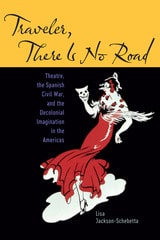
Traveler, There Is No Road
Theatre, the Spanish Civil War, and the Decolonial Imagination in the AmericasLisa Jackson-Schebetta
University of Iowa Press, 2017
This book offers a unique perspective on 1930s theatre and performance, encompassing the theatrical work of the Cuban, Puerto Rican, and Spanish diasporas in the United States, as well as the better-known Anglophone communities. Jackson-Schebetta situates well-known figures, such as Langston Hughes and Clifford Odets, alongside lesser-known ones, such as Erasmo Vando, Franca de Armiño, and Manuel Aparicio. The milicianas, female soldiers of the Spanish Republic, stride on stage alongside the male fighters of the Lincoln Brigade. They and many others used the multiple visions of Spain forged during the civil war to foment decolonial practices across the pasts, presents, and futures of the Americas. Traveler conclusively demonstrates that theatre and performance scholars must position US performances within the Americas writ broadly, and in doing so they must recognize the centrality of the hemisphere’s longest-lived colonial power, Spain.