Results by title

8 books match the query 'Thing'
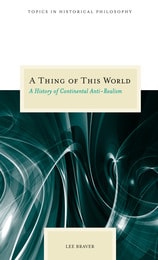
cover of A Thing of This World: A History of Continental Anti-Realism

A Thing of This World

A History of Continental Anti-Realism

Lee Braver

Northwestern University Press, 2007

At a time when the analytic/continental split dominates contemporary philosophy, this ambitious work offers a careful and clear-minded way to bridge that divide.  Combining conceptual rigor and clarity of prose with historical erudition, A Thing of This World shows how one of the standard issues of analytic philosophy--realism and anti-realism--has also been at the heart of continental philosophy. 
 
Using a framework derived from prominent analytic thinkers, Lee Braver traces the roots of anti-realism to Kant's idea that the mind actively organizes experience.  He then shows in depth and in detail how this idea evolves through the works of Hegel, Nietzsche, Heidegger, Foucault, and Derrida.  This narrative presents an illuminating account of the
history of continental philosophy by explaining how these thinkers build on each other's attempts to develop new concepts of reality and truth in the wake of the rejection of realism.  Braver demonstrates that the analytic and continental traditions have been discussing the same issues, albeit with different vocabularies, interests, and approaches.
By developing a commensurate vocabulary, his book promotes a dialogue between the two branches of philosophy in which each can begin to learn from the other.
[more]
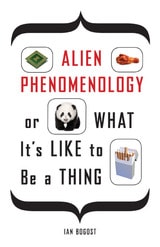
cover of Alien Phenomenology, or What It’s Like to Be a Thing

Alien Phenomenology, or What It’s Like to Be a Thing

Ian Bogost

University of Minnesota Press, 2012

Humanity has sat at the center of philosophical thinking for too long. The recent advent of environmental philosophy and posthuman studies has widened our scope of inquiry to include ecosystems, animals, and artificial intelligence. Yet the vast majority of the stuff in our universe, and even in our lives, remains beyond serious philosophical concern.

In Alien Phenomenology, or What It’s Like to Be a Thing, Ian Bogost develops an object-oriented ontology that puts things at the center of being—a philosophy in which nothing exists any more or less than anything else, in which humans are elements but not the sole or even primary elements of philosophical interest. And unlike experimental phenomenology or the philosophy of technology, Bogost’s alien phenomenology takes for granted that all beings interact with and perceive one another. This experience, however, withdraws from human comprehension and becomes accessible only through a speculative philosophy based on metaphor.

Providing a new approach for understanding the experience of things as things, Bogost also calls on philosophers to rethink their craft. Drawing on his own background as a videogame designer, Bogost encourages professional thinkers to become makers as well, engineers who construct things as much as they think and write about them.

[more]
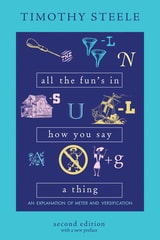
cover of All the Fun’s in How You Say a Thing: An Explanation of Meter and Versification

All the Fun’s in How You Say a Thing

An Explanation of Meter and Versification

Timothy Steele

Ohio University Press, 1999
Perfect for the general reader of poetry, students and teachers of literature, and aspiring poets, All the Fun’s in How You Say a Thing is a lively and comprehensive study of versification by one of our best contemporary practitioners of traditional poetic forms. Emphasizing both the coherence and the diversity of English metrical practice from Chaucer’s time to ours, Timothy Steele explains how poets harmonize the fixed units of meter with the variable flow of idiomatic speech, and examines the ways in which poets have used meter, rhyme, and stanza to communicate and enhance meaning. Steele illuminates as well many practical, theoretical, and historical issues in English prosody, without ever losing sight of the fundamental pleasures, beauties, and insights that fine poems offer us. Written lucidly, with a generous selection of helpful scansions and explanations of the metrical effects of the great poets of the English language, All the Fun’s in How You Say a Thing is not only a valuable handbook on technique; it is also a wide-ranging study of English verse and a mine of entertaining information for anyone wishing more fully to write, enjoy, understand, or teach poetry.
[more]
cover of All the Fun’s in How You Say a Thing: An Explanation of Meter and Versification

All the Fun’s in How You Say a Thing

An Explanation of Meter and Versification

Timothy Steele

Ohio University Press, 2024
25th Annniversary Edition, with a new preface by the author Perfect for the general reader of poetry, students and teachers of literature, and aspiring poets, All the Fun’s in How You Say a Thing is a lively and comprehensive study of versification by one of our best contemporary practitioners of traditional poetic forms. Emphasizing both the coherence and the diversity of English metrical practice from Chaucer’s time to ours, Timothy Steele explains how poets harmonize the fixed units of meter with the variable flow of idiomatic speech, and examines the ways in which poets have used meter, rhyme, and stanza to communicate and enhance meaning. Steele illuminates as well many practical, theoretical, and historical issues in English prosody, without ever losing sight of the fundamental pleasures, beauties, and insights that fine poems offer us. Written lucidly, with a generous selection of helpful scansions and explanations of the metrical effects of the great poets of the English language, All the Fun’s in How You Say a Thing is not only a valuable handbook on technique; it is also a wide-ranging study of English verse and a mine of entertaining information for anyone wishing more fully to write, enjoy, understand, or teach poetry.
[more]
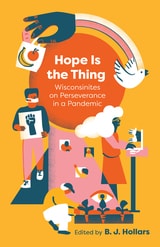
cover of Hope is the Thing: Wisconsinites on Perseverance in a Pandemic

Hope is the Thing

Wisconsinites on Perseverance in a Pandemic

B. J. Hollars

Wisconsin Historical Society Press, 2021

In March 2020, as a pandemic began to ravage our world, writer and professor B. J. Hollars started a collaborative writing project to bridge the emotional challenges created by our physical distancing. Drawing upon Emily Dickinson’s famous poem “‘Hope’ is the thing with feathers,” Hollars called on Wisconsinites to reflect on their own glimpses of hope in the era of COVID-19. The call resulted in an avalanche of submissions, each reflecting on hope’s ability to persist and flourish, even in the darkest times.

As the one hundred essays and poems gathered here demonstrate, hope comes in many forms: a dad dance, a birth plan, an unblemished banana, a visit from a neighborhood dog, the revival of an old tradition, empathy. The contributors are racially, geographically, and culturally diverse, representing a rough cross section of Wisconsin voices, from truck driver to poet laureate, from middle school student to octogenarian, from small business owner to seasoned writer. The result is a book-length exploration of the depth and range of hope experienced in times of crisis, as well as an important record of what Wisconsinites were facing and feeling through these historic times.
[more]
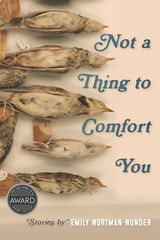
cover of Not a Thing to Comfort You

Not a Thing to Comfort You

Emily Wortman-Wunder

University of Iowa Press, 2019
From a lightning death on an isolated peak to the intrigues of a small town orchestra, the glimmering stories in this debut collection explore how nature—damaged, fierce, and unpredictable—worms its way into our lives. Here moths steal babies, a creek seduces a lonely suburban mother, and the priorities of a passionate conservationist are thrown into confusion after the death of her son. Over and over, the natural world reveals itself to be unknowable, especially to the people who study it most. These tales of scientists, nurses, and firefighters catalog the loneliness within families, betrayals between friends, and the recurring song of regret and grief.
[more]
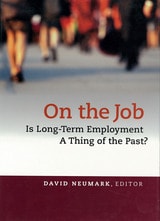
cover of On the Job: Is Long-Term Employment a Thing of the Past?

On the Job

Is Long-Term Employment a Thing of the Past?

David, editor Neumark

Russell Sage Foundation, 2000
In recent years, a flurry of reports on downsizing, outsourcing, and flexible staffing have created the impression that stable, long-term jobs are a thing of the past. According to conventional wisdom, workers can no longer count on building a career with a single employer, and job security is a rare prize. While there is no shortage of striking anecdotes to fuel these popular beliefs, reliable evidence is harder to come by. Researchers have yet to determine whether we are witnessing a sustained, economy-wide decline in the stability of American jobs, or merely a momentary rupture confined to a few industries and a few classes of workers. On the Job launches a concerted effort to reconcile the conflicting evidence about job stability and security. The book examines the labor force as a whole, not merely the ousted middle managers who have attracted the most publicity. It looks at the situation of women as well as men, young workers as well as old, and workers on part-time, non-standard, or temporary work schedules. The evidence suggests that long-serving managers and professionals suffered an unaccustomed loss of job security in the 1990s, but there is less evidence of change for younger, newer recruits. The authors bring our knowledge of the labor market up to date, connecting current conditions in the labor market with longer-term trends that have evolved over the past two decades. They find that  layoffs in the early 1990s disrupted the implicit contract between employers and staff, but it is too soon to declare a permanent revolution in the employment relationship. Having identified the trends, the authors seek to explain  them and to examine their possible consequences. If the bonds between employee and employer are weakening, who stands to benefit? Frequent job-switching can be a sign of success for a worker, if each job provides a stepping stone to something better, but research in this book shows that workers gained less from changing jobs in the 1980s and 1990s than in earlier decades. The authors also evaluate the third-party intermediaries, such as temporary help agencies, which profit from the new flexibility in the matching of workers and employers. Besides opening up new angles on the evidence, the authors mark out common ground and pin-point those areas where gaps in our knowledge remain and popular belief runs ahead of reliable evidence. On the Job provides an authoritative basis for spotting the trends and interpreting the fall-out as U.S. employers and employees rethink the terms of their relationship.
[more]
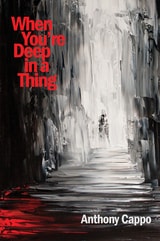
cover of When You’re Deep in a Thing

When You’re Deep in a Thing

Anthony Cappo

Four Way Books, 2022

When You're Deep in a Thing reimagines the coming of age book and the masculine tropes of the bildungsroman, suggesting that adulthood never vanquishes the kids we were. When Cappo's speaker returns home for holidays, "memories / of hangdog childhood seep in / like methane." Despite temporal distance, he perpetually finds himself in the museum of paternal absence, the house his father left, where "ghosts whisper" and "frames / fade to shame." From this possessed site, the collection bravely asks, how does one make sense of boyhood? Become a man without guidance? As the certainties of a religious upbringing vanish, the physical and spiritual boundaries of the world threaten to disintegrate. From depression, to political violence, to the certainty of death, Cappo's exigent debut ventures to discover an intimate humanity against all odds. At these poems' horizons, a tenacity remains, a determination to find sweetness, candor, and connection in this troubled world, where "the air's still, // The ground a trembling silence," yet "scathed we set out again."
[more]