Results by title
5 books match the query 'Thinker'
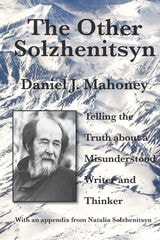
The Other Solzhenitsyn
Telling the Truth about a Misunderstood Writer and ThinkerDaniel J. Mahoney
St. Augustine's Press, 2014
The great Russian writer Aleksandr Solzhenitsyn (1918–2008) is widely recognized as one of the most consequential human beings of the twentieth century. Through his writings and moral witness, he illumined the nature of totalitarianism and helped bring down an ‘evil empire.’ His courage and tenacity are acknowledged even by his fiercest critics. Yet the world-class novelist, historian, and philosopher (one uses the latter term in its capacious Russian sense) has largely been eclipsed by a caricature that has transformed a measured and self-critical patriot into a ferocious nationalist, a partisan of local self-government into a quasi-authoritarian, a man of faith and reason into a narrow-minded defender of Orthodoxy. The caricature, widely dispensed in the press, and too often taken for granted, gets in the way of a thoughtful and humane confrontation with the “other” Solzhenitsyn, the true Solzhenitsyn, who is a writer and thinker of the first rank and whose spirited defense of liberty is never divorced from moderation. It is to the recovery of this Solzhenitsyn that this book is dedicated.
This book above all explores philosophical, political, and moral themes in Solzhenitsyn’s two masterworks, The Gulag Archipelago and The Red Wheel, as well as in his great European novel In the First Circle. We see Solzhenitsyn as analyst of revolution, defender of the moral law, phenomenologist of ideological despotism, and advocate of “resisting evil with force.” Other chapters carefully explore Solzhenitsyn’s conception of patriotism, his dissection of ideological mendacity, and his controversial, but thoughtful and humane discussion of the “Jewish Question” in the Russian – and Soviet twentieth century. Some of Solzhenitsyn’s later writings, such as the “binary tales” that he wrote in the 1990s, are subject to critically appreciative analysis. And a long final chapter comments on Solzhenitsyn’s July 2007 Der Spiegel interview, his last word to Russia and the West. He is revealed to be a man of faith and freedom, a patriot but not a nationalist, and a principled advocate of self-government for Russia and the West.
A final Appendix reproduces the beautiful Introduction (“The Gift of Incarnation”) that the author’s widow, Natalia Solzhenitsyn, wrote to the 2009 Russian abridgment of The Gulag Archipelago, a work that is now taught in Russian high schools.
[more]
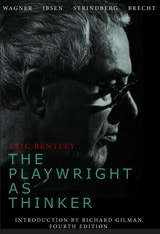
The Playwright as Thinker
A Study of Drama in Modern Times, Fourth EditionEric Bentley
University of Minnesota Press, 2010
First published in 1946, The Playwright as Thinker is a classic work of drama criticism that helped create the intellectual environment in which serious American theater would thrive in the second half of the twentieth century. At the time of publishing, most drama critics believed dramatic art deserved no intellectual status; Eric Bentley set out to prove them wrong. Focusing on the canonic playwrights Strindberg, Ibsen, Pirandello, Sartre, and Brecht, Bentley viewed the playwright as thinker, and his survey of over 150 years of dramatic art provided, in essence, an intellectual history of Europe. This edition not only contains the original, long-suppressed foreword, in which Bentley lambastes the climate of Broadway at the time, but also the author's 1987 afterword.
[more]

The Thinker As Artist
From Homer To Plato and AristotleGeorge Anastaplo
Ohio University Press, 1997
In an attempt to subject representative texts of a dozen ancient authors to a more or less Socratic inquiry, the noted scholar George Anastaplo suggests in The Thinker as Artist how one might usefully read as well as enjoy such texts, which illustrate the thinking done by the greatest artists and how they “talk” among themselves across the centuries. In doing so, he does not presume to repeat the many fine things said about these and like authors, but rather he discusses what he himself has noticed about them, text by text. Drawing upon a series of classical authors ranging from Homer and Sappho to Plato and Aristotle, Anastaplo examines issues relating to chance, art, nature, and divinity present in the artful works of philosophers and other thinkers. As he has done in his earlier work, Anastaplo mines the great texts to help us discover who we are and what we should be. Some of the works used are familiar, while others were once better known than they are now. The approach to all of them is fresh and provocative, demonstrating the value of such texts in showing the reader what to look for and how to talk about matters that have always engaged thoughtful human beings. These imaginative yet disciplined discussions of important texts of ancient Greek thought and of Raphael’s The School of Athens should appeal to both the specialist and the general reader.
[more]
Thinker On Stage
Nietzsche’s MaterialismPeter Sloterdijk
University of Minnesota Press, 1989
[more]

Thinker, Faker, Spinner, Spy
Corporate PR and the Assault on DemocracyEdited by David Miller and William Dinan
Pluto Press, 2007
The public relations industry is not just about celebrity gossip. This book shows how, whenever big business is threatened, spin doctors, lobbyists, think tanks and front groups are on hand to push the corporate interest, often at the public's expense.
Written by leading activists and writers, this book reveals the secrets of the PR trade including deception, the use of fake 'institutes', spying and dirty tricks. The impact can be devastating -- when the public is denied access to the truth, the results are rising inequality and environmental catastrophe.
Exposing the misdeeds of famous companies including Coca Cola, British Aerospace, Exxon and Monsanto, and revealing information about the covert funding of various apparently independent thinks tanks and institutes, the authors offer a guide to campaigns that can help us roll back corporate power and resist deceptive PR.
[more]