Results by title
52 books match the query 'Thinking' and 4 start with a

A Reflective Practitioner's Guide to (Mis)Adventures in Drama Education - or - What Was I Thinking?
Edited by Peter Duffy
Intellect Books, 2015
This collection of essays from many of the world’s preeminent drama education practitioners captures the challenges and struggles of teaching with honesty, humor, openness, and integrity. Collectively the authors possess some two hundred years of shared experience in the field, and each essay investigates the mistakes of best-intentions, the lack of awareness, and the omissions that pock all of our careers. The authors ask, and answer quite honestly, a series of difficult and reflexive questions: What obscured our understanding of our students’ needs in a particular moment? What drove our professional expectations? And how has our practice changed as a result of those experiences? Modeled on reflective practice, this book will be an essential, everyday guide to the challenges of drama education.
[more]
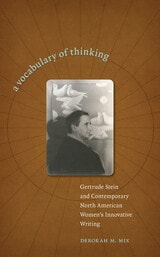
A Vocabulary of Thinking
Gertrude Stein and Contemporary North American Women's Innnovative WritingDeborah M. Mix
University of Iowa Press, 2007
Using experimental style as a framework for close readings of writings produced by late twentieth-century North American women, Deborah Mix places Gertrude Stein at the center of a feminist and multicultural account of twentieth-century innovative writing. Her meticulously argued work maps literary affiliations that connect Stein to the work of Harryette Mullen, Daphne Marlatt, Betsy Warland, Lyn Hejinian, and Theresa Hak Kyung Cha. By distinguishing a vocabulary-which is flexible, evolving, and simultaneously individual and communal--from a lexicon-which is recorded, fixed, and carries the burden of masculine authority--Mix argues that Stein's experimentalism both enables and demands the complex responses of these authors.
Arguing that these authors have received relatively little attention because of the difficulty in categorizing them, Mix brings the writing of women of color, lesbians, and collaborative writers into the discussion of experimental writing. Thus, rather than exploring conventional lines of influence, she departs from earlier scholarship by using Stein and her work as a lens through which to read the ways these authors have renegotiated tradition, authority, and innovation.
Building on the tradition of experimental or avant-garde writing in the United States, Mix questions the politics of the canon and literary influence, offers close readings of previously neglected contemporary writers whose work doesn't fit within conventional categories, and by linking genres not typically associated with experimentalism-lyric, epic, and autobiography-challenges ongoing reevaluations of innovative writing.
[more]
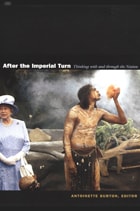
After the Imperial Turn
Thinking with and through the NationAntoinette Burton, ed.
Duke University Press, 2003
From a variety of historically grounded perspectives, After the Imperial Turn assesses the fate of the nation as a subject of disciplinary inquiry. In light of the turn toward scholarship focused on imperialism and postcolonialism, this provocative collection investigates whether the nation remains central, adequate, or even possible as an analytical category for studying history. These twenty essays, primarily by historians, exemplify cultural approaches to histories of nationalism and imperialism even as they critically examine the implications of such approaches.
While most of the contributors discuss British imperialism and its repercussions, the volume also includes, as counterpoints, essays on the history and historiography of France, Germany, Spain, and the United States. Whether looking at the history of the passport or the teaching of history from a postnational perspective, this collection explores such vexed issues as how historians might resist the seduction of national narratives, what—if anything—might replace the nation’s hegemony, and how even history-writing that interrogates the idea of the nation remains ideologically and methodologically indebted to national narratives. Placing nation-based studies in international and interdisciplinary contexts, After the Imperial Turn points toward ways of writing history and analyzing culture attentive both to the inadequacies and endurance of the nation as an organizing rubric.
While most of the contributors discuss British imperialism and its repercussions, the volume also includes, as counterpoints, essays on the history and historiography of France, Germany, Spain, and the United States. Whether looking at the history of the passport or the teaching of history from a postnational perspective, this collection explores such vexed issues as how historians might resist the seduction of national narratives, what—if anything—might replace the nation’s hegemony, and how even history-writing that interrogates the idea of the nation remains ideologically and methodologically indebted to national narratives. Placing nation-based studies in international and interdisciplinary contexts, After the Imperial Turn points toward ways of writing history and analyzing culture attentive both to the inadequacies and endurance of the nation as an organizing rubric.
Contributors. Tony Ballantyne, Antoinette Burton, Ann Curthoys, Augusto Espiritu, Karen Fang, Ian Christopher Fletcher, Robert Gregg, Terri Hasseler, Clement Hawes, Douglas M. Haynes, Kristin Hoganson, Paula Krebs, Lara Kriegel, Radhika Viyas Mongia, Susan Pennybacker, John Plotz, Christopher Schmidt-Nowara, Heather Streets, Hsu-Ming Teo, Stuart Ward, Lora Wildenthal, Gary Wilder
[more]
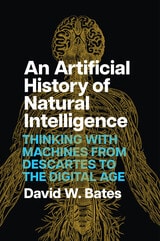
An Artificial History of Natural Intelligence
Thinking with Machines from Descartes to the Digital AgeDavid W. Bates
University of Chicago Press, 2024
A new history of human intelligence that argues that humans know themselves by knowing their machines.
We imagine that we are both in control of and controlled by our bodies—autonomous and yet automatic. This entanglement, according to David W. Bates, emerged in the seventeenth century when humans first built and compared themselves with machines. Reading varied thinkers from Descartes to Kant to Turing, Bates reveals how time and time again technological developments offered new ways to imagine how the body’s automaticity worked alongside the mind’s autonomy. Tracing these evolving lines of thought, An Artificial History of Natural Intelligence offers a new theorization of the human as a being that is dependent on technology and produces itself as an artificial automaton without a natural, outside origin.
We imagine that we are both in control of and controlled by our bodies—autonomous and yet automatic. This entanglement, according to David W. Bates, emerged in the seventeenth century when humans first built and compared themselves with machines. Reading varied thinkers from Descartes to Kant to Turing, Bates reveals how time and time again technological developments offered new ways to imagine how the body’s automaticity worked alongside the mind’s autonomy. Tracing these evolving lines of thought, An Artificial History of Natural Intelligence offers a new theorization of the human as a being that is dependent on technology and produces itself as an artificial automaton without a natural, outside origin.
[more]