Results by title
3 books match the query 'Thirteenth Century'

Maimonides' "Guide of the Perplexed" in Translation
A History from the Thirteenth Century to the TwentiethEdited by Josef Stern, James T. Robinson, and Yonatan Shemesh
University of Chicago Press, 2019
Moses Maimonides’s Guide of the Perplexed is the greatest philosophical text in the history of Jewish thought and a major work of the Middle Ages. For almost all of its history, however, the Guide has been read and commented upon in translation—in Hebrew, Latin, Spanish, French, English, and other modern languages—rather than in its original Judeo-Arabic. This volume is the first to tell the story of the translations and translators of Maimonides’ Guide and its impact in translation on philosophy from the Middle Ages to the present day.
A collection of essays by scholars from a range of disciplines, the book unfolds in two parts. The first traces the history of the translations of the Guide, from medieval to modern renditions. The second surveys its influence in translation on Latin scholastic, early modern, and contemporary Anglo-American philosophy, as well as its impact in translation on current scholarship. Interdisciplinary in approach, this book will be essential reading for philosophers, historians, and religious studies scholars alike.
A collection of essays by scholars from a range of disciplines, the book unfolds in two parts. The first traces the history of the translations of the Guide, from medieval to modern renditions. The second surveys its influence in translation on Latin scholastic, early modern, and contemporary Anglo-American philosophy, as well as its impact in translation on current scholarship. Interdisciplinary in approach, this book will be essential reading for philosophers, historians, and religious studies scholars alike.
[more]
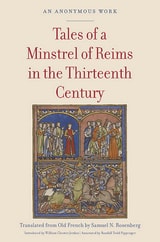
Tales of a Minstrel of Reims in the Thirteenth Century
Samuel N. Rosenberg
Catholic University of America Press, 2021
An anonymous minstrel in thirteenth-century France composed this gripping account of historical events in his time. Crusaders and Muslim forces battle for control of the Holy Land, while power struggles rage between and among religious authorities and their conflicting secular counterparts, pope and German emperor, the kings of England and the kings of France. Meanwhile, the kings cannot count on their independent-minded barons to support or even tolerate the royal ambitions. Although politics (and the collapse of a royal marriage) frame the narrative, the logistics of war are also in play: competing military machinery and the challenges of transporting troops and matariel. Inevitably, the civilian population suffers.
The minstrel was a professional story-teller, and his livelihood likely depended on his ability to captivate an audience. Beyond would-be objective reporting, the minstrel dramatizes events through dialogue, while he delves into the motives and intentions of important figures, and imparts traditional moral guidance. We follow the deeds of many prominent women and witness striking episodes in the lives of Eleanor of Aquitaine, Richard the Lionhearted, Blanche of Castile, Frederick the Great, Saladin, and others. These tales survive in several manuscripts, suggesting that they enjoyed significant success and popularity in their day.
Samuel N. Rosenberg produced this first scholarly translation of the Old French tales into English. References that might have been obvious to the minstrel’s original audience are explained for the modern reader in the indispensable annotations of medieval historian Randall Todd Pippenger. The introduction by eminent medievalist William Chester Jordan places the minstrel’s work in historical context and discusses the surviving manuscript sources.
[more]
The Signature in Law
From the Thirteenth Century to the FacsimileStephen Mason
University of London Press, 2022
This book considers the judicial development of the signature—its definition, purpose, and legal functions.
Since the thirteenth century, the signature has been used to demonstrate proof of intent. This book puts the concept of the signature into a broad legal context, setting out the purposes and functions of a signature. Drawing on cases from common law jurisdictions across the world, this book demonstrates that judges expanded the meaning of the signature as technologies developed and were used in unanticipated ways.
Following an overview of the historical methods used to demonstrate proof of intent and authentication, the book considers the judicial response to the variations in form that signatures have been subject to over the past two hundred years, from initials, partial signatures, and fingerprints to rubber stamps and typewriting. Past judicial decision-making not only demonstrates the flexibility of the form a signature can take but also confirms that judges had the flexibility of mind to accept the first forms of electronic signature (telex, facsimile transmission) without the aid of special legislation. In this way, the signature is a prime example of the inherent flexibility of the English common law.
[more]