Results by title
4 books match the query 'Thirties'
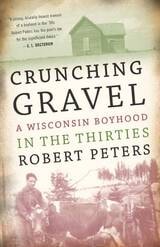
Crunching Gravel
A Wisconsin Boyhood in the ThirtiesRobert Louis Peters
University of Wisconsin Press, 1993
No nostalgic tale of the good old days, Robert Peters’s recollections of his adolescence vividly evoke the Depression on a hardscrabble farm near Eagle River: Dad driving the Vilas County Relief truck, Lars the Swede freezing to death on his porch, the embarassment of graduation in a suit from welfare. The hard efforts to put fish and potatoes and blueberries on the table are punctuated by occasional pleasures: the Memorial Day celebration, swimming at Perch Lake, the county fair with Mother’s prizes for jam and the exotic delights of the midway. Peters’s clear-eyed memoir reveals a poet’s eye for rich and stark detail even as a boy of twelve.
“Peters misses nothing, from the details of the town’s Fourth of July celebration to the cause and effect of a young cousin’s suicide to the calibrations of racism toward Indians that was so acceptable then. It is a fascinating, unsentimental look at a piece of our past.”—Margaret E. Guthrie, New York Times Book Review
“It’s unlikely that any other contemporary poet and scholar as distinguished has risen from quite so humble beginnings as Robert Peters. Born and raised by semiliterate parents on a subsistence farm in northeastern Wisconsin, Peters lived harrowingly close to the eventual stuff of his poetry—the dependency of humans on animal lives, the inexplicable and ordinary heroism and baseness of people facing extreme conditions, the urgency of physical desire. . . . Sterling childhood memoirs.”—Booklist
“Robert Peters has written a memoir exemplary because he insists on the specific, on the personal and the local. It is also enormously satisfying to read, and it is among the most authentic accounts of childhood and youth I know—a Wisconsin David Copperfield!”—Thom Gunn
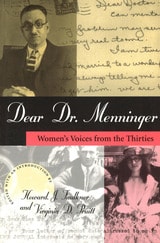
Dear Dr. Menninger
Women's Voices from the ThirtiesHoward J. Faulkner and Virginia D. Pruitt, eds.
University of Missouri Press, 1997
In 1930 Dr. Karl A. Menninger, one of America's most distinguished psychiatrists, was asked by the editor of Ladies' Home Journal to write a monthly column that would address mental health issues and answer questions from readers. The result was the widely popular column "Mental Hygiene in the Home," which ran for eighteen months at a time when the American public was just beginning to popularize the idea of mental hygiene and psychotherapy.
Of the thousands of letters Dr. Menninger received, only a small number were printed in the Journal. However, he wrote personal responses to all of them, over two thousand of which have been preserved. For this book, Howard J. Faulkner and Virginia D. Pruitt have selected more than eighty exchanges that provide intimate glimpses into the personal lives of women from across the country.
Most notable in this fascinating collection is the precision and clarity of the women's voices, as well as Dr. Menninger's incisive, analytical, and elegantly phrased replies. The topics that were of major concern to these women included their own sexuality, cheating husbands, problem children, and interfering in-lawsþin other words, the same issues that many women still face today. Although Dr. Menninger's advice may sometimes be questionable by modern standards, these letters provide a useful look at the social assumptions of the 1930s.
Included in the book is an excellent introduction by the editors that traces America's affection for advice columns, chronicles Dr. Menninger's life and work, and provides an overview of the development of psychotherapy. Entertaining as well as informative, these letters not only offer a valuable reflection of women's issues during the Depression era but also invite comparison and contrast with contemporary problems, attitudes, and values.

John Berryman and the Thirties
A MemoirE. M. Halliday
University of Massachusetts Press, 0
E. M. Halliday's "John Berryman and the Thirties: A Memoir" presents an intimate portrait of the celebrated poet during his formative years. Written by Berryman's Columbia College classmate and lifelong friend, the memoir traces Berryman's intellectual and personal development throughout the 1930s—a transformative decade that shaped his later career as one of America's most innovative poets.
Halliday offers rare firsthand insight into Berryman's early struggles, influences, and relationships during a period preceding his major publications and institutional recognition. The memoir explores the Depression-era intellectual landscape that molded Berryman's consciousness, his engagement with modernist poetry and criticism, and his complex personality navigating academic and artistic ambitions. Through personal anecdotes and literary analysis, Halliday documents Berryman's evolution from promising young poet to serious artist grappling with existential and aesthetic questions.
This work fills a crucial gap in Berryman scholarship, providing contextual understanding of the poet's formative years before his landmark works like "Homage to Mistress Bradstreet" and the Dream Songs. Essential for scholars of twentieth-century American poetry and biography, the memoir preserves irreplaceable memories of a major literary figure.
The Contemporáneos Group
Rewriting Mexico in the Thirties and FortiesBy Salvador A. Oropesa
University of Texas Press, 2003
In the years following the Mexican Revolution, a nationalist and masculinist image of Mexico emerged through the novels of the Revolution, the murals of Diego Rivera, and the movies of Golden Age cinema. Challenging this image were the Contemporáneos, a group of writers whose status as outsiders (sophisticated urbanites, gay men, women) gave them not just a different perspective, but a different gaze, a new way of viewing the diverse Mexicos that exist within Mexican society. In this book, Salvador Oropesa offers original readings of the works of five Contemporáneos—Salvador Novo, Xavier Villaurrutia, Agustín Lazo, Guadalupe Marín, and Jorge Cuesta—and their efforts to create a Mexican literature that was international, attuned to the realities of modern Mexico, and flexible enough to speak to the masses as well as the elites.
Oropesa discusses Novo and Villaurrutia in relation to neo-baroque literature and satiric poetry, showing how these inherently subversive genres provided the means of expressing difference and otherness that they needed as gay men. He explores the theatrical works of Lazo, Villaurrutia's partner, who offered new representations of the closet and of Mexican history from an emerging middle-class viewpoint. Oropesa also looks at women's participation in the Contemporáneos through Guadalupe Marín, the sometime wife of Diego Rivera and Jorge Cuesta, whose novels present women's struggles to have a view and a voice of their own. He concludes the book with Novo's self-transformation from intellectual into celebrity, which fulfilled the Contemporáneos' desire to merge high and popular culture and create a space where those on the margins could move to the center.