Results by title
9 books match the query 'This World'

A Thing of This World
A History of Continental Anti-RealismLee Braver
Northwestern University Press, 2007
Using a framework derived from prominent analytic thinkers, Lee Braver traces the roots of anti-realism to Kant's idea that the mind actively organizes experience. He then shows in depth and in detail how this idea evolves through the works of Hegel, Nietzsche, Heidegger, Foucault, and Derrida. This narrative presents an illuminating account of the
history of continental philosophy by explaining how these thinkers build on each other's attempts to develop new concepts of reality and truth in the wake of the rejection of realism. Braver demonstrates that the analytic and continental traditions have been discussing the same issues, albeit with different vocabularies, interests, and approaches.
By developing a commensurate vocabulary, his book promotes a dialogue between the two branches of philosophy in which each can begin to learn from the other.
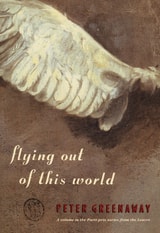
Flying Out of this World
Peter Greenaway
University of Chicago Press, 1994
As guest curator, Greenaway selected from the Louvre's collection of European prints and drawings ninety-one masterpieces that illustrate the human longing for flight. Greenaway's text, a compilation of brief commentaries that combine description, allusion, and interpretation, illuminate the images as depictions of flight desired and denied. Including works by Redon, Goya, Brueghel, Michelangelo, Mantegna, Rubens, Poussin, and Delacroix, this volume offers a combination of literary and visual art, of sight and insight.
A pursuit through the Bible, classical mythology, cosmology, theology, etymology, ornithology, and meteorology, Flying out of This World is not just an illustrated history of imagined flight, but a meditation on its meaning as a metaphor for the human condition, caught between a weighty body and a soaring spirit.
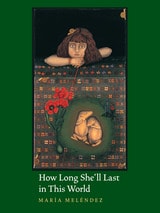
How Long She'll Last in This World
Maria Melendez
University of Arizona Press, 2006
With this invocation, María Meléndez beckons us on a journey—an exotic expedition through life’s mysteries in search of the finer strands of experience. In a Latina voice laced with a naturalist’s sense of wonder, she weaves bold images reflecting a world threaded by unseen wounds, now laid before us with an unflinching love of life and an exquisite precision of language. Adopting multiple guises—field researcher, laboring mother, grief-stricken lover—Meléndez casts aside stereotypes and expectations to forge a new language steeped in life and landscape. Whether meditating on a controlled prairie burn or contemplating the turquoise cheek of a fathead minnow, she weaves words and memories into a rich tapestry that resonates with sensual detail and magnifies her sense of maternal wildness, urging us to “Love as much as you / can, don’t throw your heart / away to just one god.” In her paean to the Aztec deity Tonacacihuatl, mother of the gods, Meléndez muses that “How many spirits she’s twin to, and how long she’ll last in this world, / are secrets stashed in the rattle / of corn ears, in the coils / of venomous snakes.”
Through stunning images and stark realism, her poems embrace motherhood and vocation, love and grief, land and life, to bring new meaning to the natural world and how we experience it.
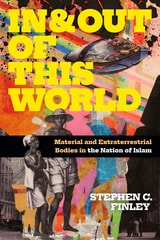
In and Out of This World
Material and Extraterrestrial Bodies in the Nation of IslamStephen C. Finley
Duke University Press, 2022
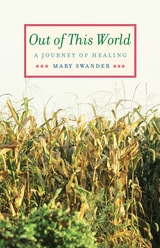
Out of This World
A Journey of HealingMary Swander
University of Iowa Press, 1995
From her perch in rural Kalona, Iowa, Swander discovers new strength and self-reliance along with a community of hardworking and hospitable neighbors. Raising goats and poultry, participating in barn raisings and auctions, protecting her garden from a plague of grasshoppers, creating a living crèche at Christmastime, all the while laughing at her attempts to wrestle with the pioneer challenges of midwestern winters and summers, she explores what it means to be a lone physical and spiritual homesteader at the end of the twentieth century.
Out of This World
Afro-German AfrofuturismPriscilla Dionne Layne
Northwestern University Press, 2025
Examining Afro-German artists’ use of Afrofuturist tropes to critique German racial history
The term Afrofuturism was first coined in the 1990s to describe African diasporic artists’ use of science fiction, speculative fiction, and fantasy to reimagine the diaspora’s pasts and to counter not only Eurocentric prejudices but also pessimistic narratives. Out of This World: Afro-German Afrofuturism focuses on contemporary Black German Afrofuturist literature and performance that critiques Eurocentrism and, specifically, German racism and colonial history. This young generation has, Priscilla Layne argues, engaged with Afrofuturism to disrupt linear time and imagine alternative worlds, to introduce non-Western technologies into the German cultural milieu, and to consider the possibilities of posthumanism. Their experiments in futurist and speculative narratives offer new tools for breaking with the binary thinking about race, culture, and gender identity that have been enforced by repressive ideological and state apparatuses, such as educational, cultural, and police institutions. Rather than providing escapism or purely imaginary alternatives, however, they have created a space—outer and artistic—in which their lives matter.
Out of This World
Speculative Fiction in Translation from the Cold War to the New MillenniumRachel S. Cordasco
University of Illinois Press, 2021
An informative and one-of-a-kind guide, Out of This World offers readers and scholars alike a tour of speculative fiction's new globalized era.
This World, Other Worlds
Sickness, Suicide, Death, and the Afterlife among the Vaqueiros de Alzada of SpainMaría Cátedra
University of Chicago Press, 1992
Applying sensitive ethnographic insight to a rich body of oral testimony, Cátedra discloses an unsuspected symbolic universe native to the Vaqueiros. Death is seen here in close, coherent relation to pain, age, and suffering; sickness and suicide, one must understand the cultural valuation of different ways of dying and the conditions under which suicides take place. To understand what it means to be a Vaqueiro is to understand how suicide can be perceived by a people as acceptable.
A groundbreaking work in European ethnography, This World, Other Worlds takes symbolic analysis to a new level. In its illumination of local conceptions of death, grace, and sainthood, the book also makes a substantial contribution to the anthropology of religion.
We Are a People in This World
The Lakota Sioux and the Massacre at Wounded KneeConger Beasley Jr.
University of Arkansas Press, 1997