Results by title
3 books match the query 'Thomas Hardy'
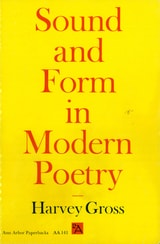
Sound and Form in Modern Poetry
A Study of Prosody from Thomas Hardy to Robert LowellHarvey Gross
University of Michigan Press, 1964
Sound and Form in Modern Poetry: A Study of Prosody from Thomas Hardy to Robert Lowell by Harvey Gross offers a comprehensive and nuanced exploration of poetic form and prosody in twentieth-century poetry. Delving deeply into the rhythmic and sonic dimensions that shape modern English verse, Gross guides readers through both traditional metrical conventions and the innovative departures of modern poets.Navigating the “dark wood” of conflicting theories and approaches to poetic rhythm, Gross traces the evolution of English-language prosody from the late nineteenth century to the mid-twentieth century. The book provides detailed analyses of the techniques and stylistic achievements of poets such as Thomas Hardy, W. B. Yeats, Robert Frost, Marianne Moore, Ezra Pound, T. S. Eliot, Hart Crane, W. H. Auden, Dylan Thomas, and Robert Lowell. Gross doesn't just analyze meter—he considers a broader concept of rhythmic structure, one that encompasses visual, syntactic, and auditory patterns and recognizes prosody as a vital means by which poetry communicates feeling, expectation, and psychological process.Blending close readings, literary criticism, and insights from linguistics and aesthetics, Sound and Form in Modern Poetry challenges simplistic accounts of meter and embraces the complexity of both metrical and nonmetrical verse. Generously referencing both classical and contemporary critics, the book supplies readers with a clear framework for understanding the convergences and tensions between tradition and innovation in modern poetry. Essential for students, scholars, and poetry lovers alike, Gross’s study reveals how the nuances of sound and rhythm are central to a poem’s expressive power.
[more]

The Phantom of Thomas Hardy
Floyd Skloot
University of Wisconsin Press, 2016
On a street in Dorchester, England, there is a gateway between real and imagined lives. A plaque identifies a Barclays Bank building as “lived in by the Mayor of Casterbridge in Thomas Hardy’s story of that name written in 1885.”
In this imaginative novel, worlds continue to collide as Floyd, an American writer recovering from a devastating neuro-viral attack, and his wife, Beverly, immerse themselves in Hardy’s world. While pondering the enigma of a fictional character living in a factual building, Floyd is approached by Hardy himself—despite his death in 1928.
This phantom—possibly conjured out of Floyd’s damaged brain—tasks the Americans with finding out what Hardy missed in love. Embarking on their quest, they visit Hardy’s birthplace, home, and grave, exploring the Dorset landscape and the famous novels with their themes of tormented love. Peering into the Victorian past, they slowly dismantle the clutter of screens that Hardy placed around his private life, even as their own love story unfolds, filled with healing and hope.
[more]

Thomas Hardy from Serial to Novel
Mary Chase
University of Minnesota Press, 1927
Thomas Hardy from Serial to Novel was first published in 1927. Minnesota Archive Editions uses digital technology to make long-unavailable books once again accessible, and are published unaltered from the original University of Minnesota Press editions.This volume is a valuable examination of Thomas Hardy’s revisions in The Mayor of Casterbridge, Tess of the D’Urbervilles, and Jude the Obscure that rendered them acceptable to the taste of the 1880s magazine reader. A fascinating study of authorship, a compelling study of Hardy’s major works, a historical study of literary construction: no one seriously interested in the art of the novel or in its relation to social history can neglect Professor Chase’s study. It is an indispensable Hardy “item” for libraries, collectors, and all students of literature.
[more]