Results by title

10 books match the query 'Thomism'
cover of A Short History of Thomism

A Short History of Thomism

Romanus Cessario, O.P.

Catholic University of America Press, 2005
Using carefully selected resources, Romanus Cessario has composed a short account of the history of the Thomist tradition as it manifests itself through the more than seven hundred years that have elapsed since the death of Saint Thomas
[more]
cover of Creation through Evolution: New Perspectives from Thomistic Theology and Philosophy

Creation through Evolution

New Perspectives from Thomistic Theology and Philosophy

Nicanor Pier Giorgio Austriaco

Catholic University of America Press, 2025
Written and revised over the past three years, Creation through Evolution contains ten new essays that directly respond to the most common philosophical and theological objections put forward by Catholics who are skeptical about evolutionary theory. Significantly, the authors use the conceptual framework of St. Thomas Aquinas as a starting point to engage in the faith and science dialogue and they take the Catechism of the Catholic Church as their starting point. The contributors believe that the solutions proposed by these essays to the disputed questions raised by skeptics are novel and robust. The contents of the essays were presented at colloquia at the University of Oxford and Providence College and were revised in response to criticisms and comments raised by the other participants at these meetings. The chapters were written to respond to Catholic skeptics of Darwinian evolution. They are meant to be read not only by scholars but also by graduate and undergraduate students. Creation through Evolution will be of interest to the informed Catholic reader who is struggling to reconcile evolutionary theory with the claims of the Catechism of the Catholic Church.
[more]
cover of Grace, Predestination, and the Permission of Sin: A Thomistic Analysis

Grace, Predestination, and the Permission of Sin

A Thomistic Analysis

Taylor O'Neill

Catholic University of America Press, 2019
Grace, Predestination, and the Permission of Sin seeks to analyze a revisionist movement within Thomism in the 20th century over and against the traditional or classical Thomistic commentatorial treatment of physical premotion, grace, and the permission of sin, especially as these relate to the mysteries of predestination and reprobation. The over-arching critique leveled by the revisionists against the classic treatment is that Bañezian scholasticism had disregarded the dissymmetry between the line of good (God's causation of salutary acts) and the line of evil (God's permission of defect and sin). The teaching of St. Thomas is explored via intimate consideration of his texts. The thought of St. Thomas is then compared with the work of Domingo Bañez and the foremost 'Bañezian' of the 20th century, Reginald Garrigou-Lagrange. The work then shifts to a consideration of the major players of the revisionist treatment, including Francisco Marín-Sola, Jacques Maritain, and Bernard Lonergan. Jean-Herve Nicolas is also taken up as one who had held both accounts during his lifetime. The work analyzes and critiques the revisionist theories according to the fundamental tenets of the classical account. Upon final analysis, it seeks to show that the classical account sufficiently distances God's causal role in regard to free salutary acts and His non-causal role in regard to free sinful acts. Moreover, the revisionist account presents significant metaphysical problems and challenges major tenets of classical theism, such as the divine omnipotence, simplicity, and the exhaustive nature of divine providence. Finally, the implications of the traditional view are considered in light of the spiritual life. It is argued that the classical account is the only one which provides an adequate theological foundation for the Church's robust mystical and spiritual tradition, and in particular, the abandonment to divine providence.
[more]
cover of Intelligibility of Nature: A William A. Wallace Reader

Intelligibility of Nature

A William A. Wallace Reader

William A. Wallace

Catholic University of America Press, 2022
The intelligibility of nature was a persistent theme of William A. Wallace, OP, one of the most prolific Catholic scholars of the late twentieth century. This Reader aims to make available a representative selection of his work in the history of science, natural philosophy, and theology illustrating his defense and development of this central theme. Wallace is among the most important Galileo scholars of the past fifty years and a key figure in the recent revival of scientific realism. Further, his long and productive scholarly career has been shaped by a continuous effort to bring the resources of the Aristotelian-Thomistic tradition to the solution of contemporary problems of philosophy and science. Through all of these contributions, Wallace has provided the foundation for a renewed confidence in the capacity of human knowers to attain understanding of the natural order. Consequently, the overall aim of this volume is to secure continued access to his scholarship for readers in the new millennium. The Intelligibility of Nature will contain twenty-nine previously published essays written by Wallace over a period of some forty years. Many of these essays are currently not readily accessible. They are arranged in five thematic groups, each representing a major subject-area of Wallace's scholarly interests. The first group is devoted to essays on making nature intelligible through the use of scientific models. The second group of essays investigates various ways in which the Aristotelian-Thomistic tradition is foundational to contemporary scientific research. Essays in the third group are historical studies on the origins of modern science. The fourth group of essays discuss the viability of the cosmological argument for the existence of God in light of natural science. The final group of essays consider the relation of science and religion. Together these essays provide a representative sample of Wallace's multifaceted contributions to scholarship.
[more]
cover of Plants, Animals, People, Aliens: An Aristotelian-Thomist Perspective on Life in the Universe

Plants, Animals, People, Aliens

An Aristotelian-Thomist Perspective on Life in the Universe

Marie I. George

Catholic University of America Press, 2026
Aristotle famously maintains in his treatise On the Soul that there are three kinds of living things-- plants, animals, and humans--and he speaks of each kind as having a soul. St. Thomas Aquinas adopts these same views. Nowadays, however, many thinkers reject them on the grounds that they are incompatible with modern science. Molecular biology is seen as affording a superior way of categorizing life forms. Evolutionary biology appears to have established that humans are simply primates with adaptations somewhat different from other primates. Plant physiology, uncovering plants’ directional responses to a wide variety of different stimuli, provides reason to think that plants sense light, pressure, odor, pathogens, etc., in which case plants are simply non-mobile animals, similar to coral. Neuroscience, by showing the dependency of thought, choice, perception, and emotion on the central nervous system, especially on the brain, seems to have eliminated any need to posit a soul. Plants, Animals, People, Aliens addresses these and a variety of other science-based claims about living things by bringing Aristotelian-Thomistic teachings to bear upon them. While not a systematic work, it both treats some of the most hotly debated philosophical questions concerning living things, such as what it means to be alive, as well as treating questions less often raised by philosophers, such as whether animals have a theory of mind. Though geared primarily to those conversant with the Aristotelian-Thomistic tradition, many of its key concepts are traced back to experiences that we all share in common, thus rendering these concepts intelligible, if not convincing, to those with scientific and other backgrounds who are curious about this philosophical approach to living things. The author strives to show how Aristotelian-Thomistic philosophy and science complement one another by sketching out the fuller understanding of the living realm that the two together provide. The book’s final section considers the possibility and the likelihood that embodied rational beings exist elsewhere in our universe. Here, theological arguments drawn from the Christian faith are presented alongside philosophical and scientific arguments. This section closes with a theological discussion of the disputed question of whether extraterrestrials, were they to exist, should be baptized.
[more]
cover of Praeambula Fidei: Thomism and the God of the Philosophers

Praeambula Fidei

Thomism and the God of the Philosophers

Ralph McInerny

Catholic University of America Press, 2006
In this book, renowned philosopher Ralph McInerny sets out to review what Thomas meant by the phrase and to defend a robust understanding of Thomas's teaching on the subject.
[more]
cover of The Discovery of Being and Thomas Aquinas

The Discovery of Being and Thomas Aquinas

Christopher M. Cullen, SJ

Catholic University of America Press, 2019

While there has been agreement among followers of Aquinas that being insofar as it is being (being qua being) is the subject of metaphysics, there is not agreement on how this being qua being is to be understood, nor on how we come to know the being that is the object of metaphysical investigation. The topic of what being is, as the object of the science of metaphysics, and how to account for the “discovery” of the being of metaphysics have emerged as central problems for the contemporary retrieval of Aquinas and for the larger project of post-Leonine Thomism in general. This lack of agreement has hampered the retrieval of Aquinas’s metaphysics.

The collection of essays within The Discovery of Being and Thomas Aquinas is divided into three major parts: the first set of essays concerns the foundation of metaphysics within Thomism; the second set exemplifies the use of metaphysics in fundamental philosophical issues within Thomism; and the third set employs metaphysics in central theological issues.

The Discovery of Being and Thomas Aquinas allows major scholars of the different types of Thomism to engage in a full-scale defense of their position, as well as expanding Thomistic metaphysics to the discipline of theology in important ways.
[more]
cover of The Personalism of Edith Stein: A Synthesis of Thomism and Phenomenology

The Personalism of Edith Stein

A Synthesis of Thomism and Phenomenology

Robert McNamara

Catholic University of America Press, 2023
Edith Stein’s life and thought intersect with many important movements of life and thought in the twentieth century. Through her life and eventual martyrdom, she gave witness to the primacy of truth and faith in the face of political totalitarianism, and in her philosophical works, she contributed to a synthesis of phenomenological thought with the thought of Aquinas, while also progressively advancing a compelling form of philosophical personalism. As a result, Stein represents one of the most important Catholic thinkers of the twentieth century and is a figure of growing fascination and devotion among believers and nonbelievers alike. The Personalism of Edith Stein is an investigation of Stein’s mature philosophical anthropology, exploring her engagement with the thought of Aquinas and Thomism while maintaining the phenomenological mode of investigation. Through a careful examination of Stein’s later works under the themes of human nature, the human individual, and the human being’s relation to God, McNamara shows that Stein’s mature personalism is considerably expanded and substantiated by her assimilation of key anthropological and metaphysical teachings of Aquinas and Thomism, and, conversely, that Stein significantly develops and deepens these same teachings through a phenomenological reconsideration of each from a personalist perspective. As a whole, the study reveals the profound accord between Stein’s mature thought and the received teachings of Aquinas, while yet carefully attending to the remaining differences between them. Ultimately, the author proposes that Stein imbues the teachings of Aquinas with a fundamental personalization such that her mature anthropology can be understood as a Thomistically informed personalism that represents a significant, original contribution to the anthropological dimension of the philosophia perennis.
[more]
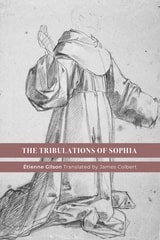
cover of The Tribulations of Sophia

The Tribulations of Sophia

Etienne Gilson

St. Augustine's Press, 2021

The Tribulations of Sophia was the last of Étienne Gilson's books to appear during his lifetime (1967). French readers would have recognized the title's echo of a nineteenth century children's book by the Countess of Ségur, the Misfortunes of Sophia. Its disobedient protagonist, young Sophia (of whom the American Dennis the Menace was to be a very pale imitation) is the cause of a sequence of minor domestic catastrophes. One wonders if Gilson is proposing that the Catholic intellectual world of his day is fraught with her descendants. 

The heart of the book is entitled, “Three Lectures on Thomism and its Current Situation.” During the Second Vatican Council and its immediate aftermath, the status of Thomism in Catholic intellectual circles and institutions was vigorously challenged. Once again, the problem of Thomism emerges: What is Thomism and where does it belong? Gilson’s devotion to elaborating the nature of Christian philosophy compels him to confront this question head-on. Indeed, because Gilson approaches Thomism as the veritable model for Christian philosophy he cannot ignore the attempts to suppress or supplant it. 

And yet this section also contains a fourth lecture on Teilhard de Chardin, whom Gilson knew and held in high esteem. Was Teilhard's thought to become the new Christian philosophy and theology? Was it even appropriate to label his thought as proper philosophy and theology?

The second, somewhat shorter, portion of the book wrestles with the theme of dialogue that was very much in vogue in the 1960s. The central figure here is the French Marxist Roger Garaudy, internationally known for his call to dialogue with Christians. Gilson denies any possibility of such a dialogue, and certainly any usefulness in it. “I regret to say—not having myself any of the virtues of a skilled dialoguer, which are not to listen to what is being said and to take it in a sense that makes it easy to refute. It is a chimerical hope that there should be two people who proceed otherwise.” But specifically on the point of Christian and Marxist dialogue, from the massive ideological, bestial corpus of Marxism Gilson carves out its fundamental need for the world and serves it back to Garaudy, but without garnish, for among Marxists each has his own particular manner of impoverishing the concept of man.  

What might be called the postscript of the book, “Wandering Amid the Ruins,” shares some of Gilson's own experiences and unease in the unsettled situation of the Catholic Church at that time. “The Council was the work of truly supernatural courage. For more than three centuries the Church was harshly blamed for not having taken the initiative to make necessary reforms in the sixteenth century.” Yet Gilson laments that perhaps the manner of enacting reform is confused and not in all cases simply intent on reversing the trends of empty churches and the vocations drought. Perhaps we have not understood the Council at all. Gilson’s kind but clear description of the turmoil in Catholic teaching and thought is for the reader essential to any understanding of the tension and transitions of this period of history. 
[more]
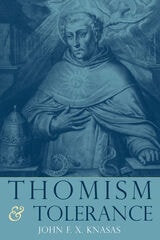
cover of Thomism and Tolerance

Thomism and Tolerance

John F. X. Knasas

University of Scranton Press, 2010

In this incisive study, John F. X. Knasas grounds the ideal of tolerance in Aquinas’s natural law ethics and connects the virtue of civic tolerance to the concept of being. If God is the source of being, argues Knasas, then we are the articulation of being, and it is in this capacity that we recognize our bond with other people and thus acknowledge our duty to be tolerant of one another. An important contribution to practical metaphysics and the philosophical foundations of political theory, Thomism and Tolerance will appeal to philosophy scholars and students at the undergraduate and graduate level.

[more]