Results by title
25 books match the query 'Thought and thinking'
An Artificial History of Natural Intelligence
Thinking with Machines from Descartes to the Digital AgeDavid W. Bates
University of Chicago Press, 2024
We imagine that we are both in control of and controlled by our bodies—autonomous and yet automatic. This entanglement, according to David W. Bates, emerged in the seventeenth century when humans first built and compared themselves with machines. Reading varied thinkers from Descartes to Kant to Turing, Bates reveals how time and time again technological developments offered new ways to imagine how the body’s automaticity worked alongside the mind’s autonomy. Tracing these evolving lines of thought, An Artificial History of Natural Intelligence offers a new theorization of the human as a being that is dependent on technology and produces itself as an artificial automaton without a natural, outside origin.
Autoaffection
Unconscious Thought in the Age of TechnologyPatricia Ticineto Clough
University of Minnesota Press, 2000
Explores the connection between new theories, new technologies, and new ways of thinking.
In this book, Patricia Ticineto Clough reenergizes critical theory by viewing poststructuralist thought through the lens of "teletechnology," using television as a recurring case study to illuminate the changing relationships between subjectivity, technology, and mass media.
Autoaffection links diverse forms of cultural criticism-feminist theory, queer theory, film theory, postcolonial theory, Marxist cultural studies and literary criticism, the cultural studies of science and the criticism of ethnographic writing—to the transformation and expansion of teletechnology in the late twentieth century. These theoretical approaches, Clough suggests, have become the vehicles of unconscious thought in our time.In individual chapters, Clough juxtaposes the likes of Derridean deconstruction, Deleuzian philosophy, and Lacanian psychoanalysis. She works through the writings of Fredric Jameson, Donna Haraway, Judith Butler, Bruno Latour, Nancy Fraser, Elizabeth Grosz—to name only a few—placing all in dialogue with a teletechnological framework. Clough shows how these cultural criticisms have raised questions about the foundation of thought, allowing us to reenvision the relationship of nature and technology, the human and the machine, the virtual and the real, the living and the inert.
Gesture and Thought
David McNeill
University of Chicago Press, 2005
Gesture and Thought expands on McNeill’s acclaimed classic Hand and Mind. While that earlier work demonstrated what gestures reveal about thought, here gestures are shown to be active participants in both speaking and thinking. Expanding on an approach introduced by Lev Vygotsky in the 1930s, McNeill posits that gestures are key ingredients in an “imagery-language dialectic” that fuels both speech and thought. Gestures are both the “imagery” and components of “language.” The smallest element of this dialectic is the “growth point,” a snapshot of an utterance at its beginning psychological stage. Utilizing several innovative experiments he created and administered with subjects spanning several different age, gender, and language groups, McNeill shows how growth points organize themselves into utterances and extend to discourse at the moment of speaking.
An ambitious project in the ongoing study of the relationship of human communication and thought, Gesture and Thought is a work of such consequence that it will influence all subsequent theory on the subject.

Global Europe
The External Relations of the European UnionOtto Holman
Amsterdam University Press, 2019
These questions and more are answered in 'Global Europe' in the context of the current impasse in the integration process. A clear analysis of the history of the EU's external relations up to now provides us with a better insight into the feasibility of EU strategies directed at the outside world.
Hand and Mind
What Gestures Reveal about ThoughtDavid McNeill
University of Chicago Press, 1992
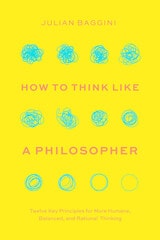
How to Think like a Philosopher
Twelve Key Principles for More Humane, Balanced, and Rational ThinkingJulian Baggini
University of Chicago Press, 2023
By now, it should be clear: in the face of disinformation and disaster, we cannot hot take, life hack, or meme our way to a better future. But how should we respond instead? In How to Think like a Philosopher, Julian Baggini turns to the study of reason itself for practical solutions to this question, inspired by our most eminent philosophers, past and present.
Baggini offers twelve key principles for a more humane, balanced, and rational approach to thinking: pay attention; question everything (including your questions); watch your steps; follow the facts; watch your language; be eclectic; be a psychologist; know what matters; lose your ego; think for yourself, not by yourself; only connect; and don’t give up. Each chapter is chockful of real-world examples showing these principles at work—from the discovery of penicillin to the fight for trans rights—and how they lead to more thoughtful conclusions. More than a book of tips and tricks (or ways to be insufferably clever at parties), How to Think like a Philosopher is an invitation to develop the habits of good reasoning that our world desperately needs.

Inspired Thinking
Big Ideas to Enrich Yourself and Your CommunityDorothy Stoltz
American Library Association, 2020
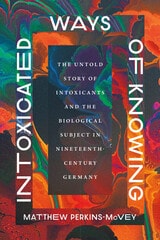
Intoxicated Ways of Knowing
The Untold Story of Intoxicants and the Biological Subject in Nineteenth-Century GermanyMatthew Perkins-McVey
University of Chicago Press, 2026
Intoxicating substances can be found lurking in every corner of modern life, and Matthew Perkins-McVey’s pathbreaking book offers the untold story of how they were implicated in shifting perceptions of embodiment found in the emerging sciences of the body and mind in late-nineteenth-century Germany. Their use in this experimental context gave rise to a dynamic conception of the subject within the scientific, psychological, philosophical, and sociological milieu of the era. The history of the modern biological subject, Perkins-McVey argues, turns on “intoxicated ways of knowing.”
Intoxicated Ways of Knowing identifies the state of intoxication as a tacit form of thinking and knowing with the body. Intoxicants force us to feel, intervening directly in our perceptional awareness, and, Perkins-McVey contends, they bring latent conceptual associations into the foreground of conscious thought, engendering new ways of knowing the world. The book unfurls how intoxicants affected nineteenth-century German science and how, ultimately, the connection between mental life and intoxication is taken up in the works of Friedrich Nietzsche, Max Weber, and Sigmund Freud, bringing the biological subject out of the lab and into the worlds of philosophy, psychoanalysis, sociology, and politics.
John Dewey's Essays in Experimental Logic
John Dewey. Edited by D. Micah Hester, and Robert B. Talisse. Introduction by Tom Burke
Southern Illinois University Press, 2007
Offering a new edition of Dewey’s 1916 collection of essays
This critical edition of John Dewey’s 1916 collection of writings on logic, Essays in Experimental Logic—in which Dewey presents his concept of logic as the theory of inquiry and his unique and innovative development of the relationship of inquiry to experience—is the first scholarly reprint of the work in one volume since 1954. Essays in Experimental Logic, edited by D. Micah Hester and Robert B. Talisse, uses the authoritative texts from the Collected Works of John Dewey, 1882–1953 (published by Southern Illinois University Press) and includes as well articles from leading journals representing various contemporary schools of philosophy that criticized Dewey’s experimentalism.
Culling materials from six volumes of the chronologically arranged Collected Works, this single-volume edition of Essays marks a crucial point in Dewey’s intellectual development: one in which Dewey critically engages idealistic and intuitionist theorists and lays the groundwork for his mature theory of inquiry. The text includes a new introduction by renowned Dewey scholar Tom Burke that places Essays in philosophical and historical context. In addition to the original essays, Essays in Experimental Logic also features five critical essays by Dewey’s contemporaries, including Bertrand Russell, Wendell T. Bush, R. F. Alfred Hoernlé, H. T. Costello, and C. S. Peirce.
Neuropolitics
Thinking, Culture, SpeedWilliam E. Connolly
University of Minnesota Press, 2002
On the Way to Theory
Lawrence Grossberg
Duke University Press, 2024
Patterns, Thinking, and Cognition
A Theory of JudgmentHoward Margolis
University of Chicago Press, 1988
Illusions of judgment—standard anomalies where people consistently misjudge or misperceive what is logically implied or really present—are often used in cognitive science to explore the workings of the cognitive process. The explanations given for these anomalous results have generally explained only the anomaly under study and nothing more. Margolis provides a provocative and systematic analysis of these illusions, which explains why such anomalies exist and recur.
Offering empirical applications of his theory, Margolis turns to historical cases to show how an individual's cognitive repertoire—the available cognitive patterns and their relation to cues—changes or resists changes over time. Here he focuses on the change in worldview occasioned by the Copernican discovery: not only how an individual might come to see things in a radically new way, but how it is possible for that new view to spread and become the dominant one. A reanalysis of the trial of Galileo focuses on social cognition and its interactions with politics.
In challenging the prevailing paradigm for understanding how the human mind works, Patterns, Thinking, and Cognition is certain to stimulate fruitful debate.
The First Moderns
Profiles in the Origins of Twentieth-Century ThoughtWilliam R. Everdell
University of Chicago Press, 1997
"This exceptionally wide-ranging history is chock-a-block with anecdotes, factoids, odd juxtapositions, and useful insights. Most impressive. . . . For anyone interested in learning about late 19th- and early 20th- century imaginative thought, this engagingly written book is a good place to start."—Washington Post Book World
"The First Moderns brilliantly maps the beginning of a path at whose end loom as many diasporas as there are men."—Frederic Morton, The Los Angeles Times Book Review
"In this truly exciting study of the origins of modernist thought, poet and teacher Everdell roams freely across disciplinary lines. . . . A brilliant book that will prove useful to scholars and generalists for years to come; enthusiastically recommended."—Library Journal, starred review
"Everdell has performed a rare service for his readers. Dispelling much of the current nonsense about 'postmodernism,' this book belongs on the very short list of profound works of cultural analysis."—Booklist
"Innovative and impressive . . . [Everdell] has written a marvelous, erudite, and readable study."-Mark Bevir, Spectator
"A richly eclectic history of the dawn of a new era in painting, music, literature, mathematics, physics, genetics, neuroscience, psychiatry and philosophy."—Margaret Wertheim, New Scientist
"[Everdell] has himself recombined the parts of our era's intellectual history in new and startling ways, shedding light for which the reader of The First Moderns will be eternally grateful."—Hugh Kenner, The New York Times Book Review
"Everdell shows how the idea of "modernity" arose before the First World War by telling the stories of heroes such as T. S. Eliot, Max Planck, and Georges Serault with such a lively eye for detail, irony, and ambiance that you feel as if you're reliving those miraculous years."—Jon Spayde, Utne Reader
The Intellective Space
Thinking beyond CognitionLaurent Dubreuil
University of Minnesota Press, 2015
The Intellective Space explores the nature and limits of thought. It celebrates the poetic virtues of language and the creative imperfections of our animal minds while pleading for a renewal of the humanities that is grounded in a study of the sciences.
According to Laurent Dubreuil, we humans both say more than we think and think more than we say. Dubreuil’s particular interest is the intellective space, a space where thought and knowledge are performed and shared. For Dubreuil, the term “cognition” refers to the minimal level of our mental operations. But he suggests that for humans there is an excess of cognition due to our extensive processing necessary for verbal language, brain dynamics, and social contexts. In articulating the intellective, Dubreuil includes “the productive undoing of cognition.”
Dubreuil grants that cognitive operations take place and that protocols of experimental psychology, new techniques of neuroimagery, and mathematical or computerized models provide access to a certain understanding of thought. But he argues that there is something in thinking that bypasses cognitive structures. Seeking to theorize with the sciences, the book’s first section develops the “intellective hypothesis” and points toward the potential journey of ideas going beyond cognition, after and before computation. The second part, “Animal Meditations,” pursues some of the consequences of this hypothesis with regard to the disparaged but enduring project of metaphysics, with its emphasis on categories such as reality, humanness, and the soul.
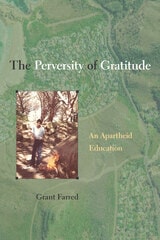
The Perversity of Gratitude
An Apartheid EducationFarred, Grant
Temple University Press, 2024
Unsentimental about his education, Farred’s critique recognizes the impact of four exceptional teachers—all engaging pedagogical figures who cultivated a great sense of possibility in how thinking could be learned through a disenfranchised South African education.
The Perversity of Gratitude brings to bear the work of influential philosophers such as Martin Heidegger and Jacques Derrida. The book tackles broad philosophical concepts—transgression, withdrawal, and the dialectic. This leads to the creation of a new concept, “the diaspora-in-place,” which Farred explains, “is having left a place before one physically removes oneself from this place.”
Farred’s apartheid education in South Africa instilled in him a lifelong commitment to learning thinking. “And for that I am grateful,” Farred writes in The Perversity of Gratitude. His autopoiesis is sure to provoke and inspire readers.
The Roots Of Thinking
Maxine Sheets-Johnstone
Temple University Press, 1990
The Truth about Language
What It Is and Where It Came FromMichael C. Corballis
University of Chicago Press, 2017
But as Michael C. Corballis shows in The Truth about Language, it’s time to reconsider those assumptions. Language, he argues, is not the product of some “big bang” 60,000 years ago, but rather the result of a typically slow process of evolution with roots in elements of grammatical language found much farther back in our evolutionary history. Language, Corballis explains, evolved as a way to share thoughts—and, crucially for human development, to connect our own “mental time travel,” our imagining of events and people that are not right in front of us, to that of other people. We share that ability with other animals, but it was the development of language that made it powerful: it led to our ability to imagine other perspectives, to imagine ourselves in the minds of others, a development that, by easing social interaction, proved to be an extraordinary evolutionary advantage.
Even as his thesis challenges such giants as Chomsky and Stephen Jay Gould, Corballis writes accessibly and wittily, filling his account with unforgettable anecdotes and fascinating historical examples. The result is a book that’s perfect both for deep engagement and as brilliant fodder for that lightest of all forms of language, cocktail party chatter.
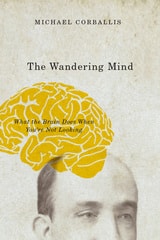
The Wandering Mind
What the Brain Does When You're Not LookingMichael C. Corballis
University of Chicago Press, 2015
That may be bad news for me, but is it bad news for people in general? Does the fact that as much as fifty percent of our waking hours find us failing to focus on the task at hand represent a problem? Michael Corballis doesn’t think so, and with The Wandering Mind, he shows us why, rehabilitating woolgathering and revealing its incredibly useful effects. Drawing on the latest research from cognitive science and evolutionary biology, Corballis shows us how mind-wandering not only frees us from moment-to-moment drudgery, but also from the limitations of our immediate selves. Mind-wandering strengthens our imagination, fueling the flights of invention, storytelling, and empathy that underlie our shared humanity; furthermore, he explains, our tendency to wander back and forth through the timeline of our lives is fundamental to our very sense of ourselves as coherent, continuing personalities.
Full of unusual examples and surprising discoveries, The Wandering Mind mounts a vigorous defense of inattention—even as it never fails to hold the reader’s.
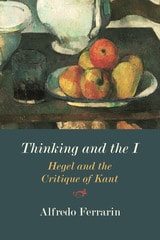
Thinking and the I
Hegel and the Critique of KantAlfredo Ferrarin
Northwestern University Press, 2019
What is the relation between thinking and the I that thinks? And what is the relation between thought and reality? The ordinary view shared by modern philosophers from Descartes to Kant, as well as by common sense, is that there is only thought when someone thinks something, and thoughts and concepts are mental acts that refer to objects outside us.
In Thinking and the I: Hegel and the Critique of Kant, Alfredo Ferrarin shows that Hegel’s philosophy entails a radical criticism of this ordinary conception of thinking. Breaking with the habitual presuppositions of both modern philosophy and common sense, Ferrarin explains that thought, negation, truth, reflection, and dialectic for Hegel are not properties of an I and cannot be reduced to the subjective activity of a self-conscious subject. Rather, he elucidates, thought is objective for Hegel in different senses. Reality as a whole is animated by a movement of thought and an unconscious logic as a spontaneity that reifies itself in determinate forms. Ferrarin concludes the book with a comprehensive comparison of Hegel’s and Kant’s concepts of reason.
While it mainly focuses on Hegel’s Phenomenology, Science of Logic, and Encyclopaedia, this ambitious book covers all aspects of Hegel’s philosophy. Its originality and strength lie in its recovery of the original core of Hegel’s dialectic over and above its currently predominant transcendental, neopragmatist, or realist appropriations. It will be essential reading for all students of Hegel, Kant, and German idealism in general for years to come.
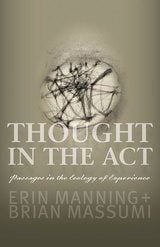
Thought in the Act
Passages in the Ecology of ExperienceErin Manning
University of Minnesota Press, 2014
“Every practice is a mode of thought, already in the act. To dance: a thinking in movement. To paint: a thinking through color. To perceive in the everyday: a thinking of the world’s varied ways of affording itself.” —from Thought in the Act
Combining philosophy and aesthetics, Thought in the Act is a unique exploration of creative practice as a form of thinking. Challenging the common opposition between the conceptual and the aesthetic, Erin Manning and Brian Massumi “think through” a wide range of creative practices in the process of their making, revealing how thinking and artfulness are intimately, creatively, and inseparably intertwined. They rediscover this intertwining at the heart of everyday perception and investigate its potential for new forms of activism at the crossroads of politics and art.
Emerging from active collaborations, the book analyzes the experiential work of the architects and conceptual artists Arakawa and Gins, the improvisational choreographic techniques of William Forsythe, the recent painting practice of Bracha Ettinger, as well as autistic writers’ self-descriptions of their perceptual world and the experimental event making of the SenseLab collective. Drawing from the idiosyncratic vocabularies of each creative practice, and building on the vocabulary of process philosophy, the book reactivates rather than merely describes the artistic processes it examines. The result is a thinking-with and a writing-in-collaboration-with these processes and a demonstration of how philosophy co-composes with the act in the making. Thought in the Act enacts a collaborative mode of thinking in the act at the intersection of art, philosophy, and politics.
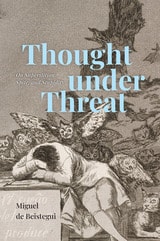
Thought under Threat
On Superstition, Spite, and StupidityMiguel de Beistegui
University of Chicago Press, 2022
Thought under Threat is an attempt to understand the tendencies that threaten thinking from within. These tendencies have always existed. But today they are on the rise and frequently encouraged, even in our democracies. People “disagree” with science and distrust experts. Political leaders appeal to the hearts and guts of “the people,” rather than their critical faculties. Stupidity has become a right, if not a badge of honor; superstition is on the rise; and spite is a major political force. Thinking is considered “elitist.”
To see those obstacles as vices of thought, Miguel de Beistegui argues, we need to understand stupidity not as a lack of intelligence or judgment, but as the tendency to raise false problems and trivial questions. Similarly, we need to see spite not as a moral vice, but as a poison that blurs and distorts our critical faculties. Finally, superstition is best described not as a set of false beliefs, but as a system that neutralizes one’s ability to think for oneself.
For de Beistegui, thinking is intrinsically democratic and a necessary condition for the exercise of freedom. Thought under Threat shows how a training of thought itself can be used to ward off those vices, lead to productive deliberation, and, ultimately, create a thinking community.
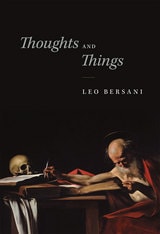
Thoughts and Things
Leo Bersani
University of Chicago Press, 2014
Thoughts and Things posits what would appear to be an irreducible gap between our thoughts (the human subject) and things (the world). Bersani departs from his psychoanalytic convictions to speculate on the oneness of being—of our intrinsic connectedness to the other that is at once external and internal to us. He addresses the problem of formulating ways to consider the undivided mind, drawing on various sources, from Descartes to cosmology, Freud, and Genet and succeeds brilliantly in diagramming new forms as well as radical failures of connectedness. Ambitious, original, and eloquent, Thoughts and Things will be of interest to scholars in philosophy, film, literature, and beyond.
Transformations
Thinking after HeideggerGail Stenstad
University of Wisconsin Press, 2006
How are we to think and act constructively in the face of today’s environmental and political catastrophes? Gail Stenstad finds inspiring answers in the thought of German philosopher Martin Heidegger. Rather than simply describing or explaining Heidegger’s transformative way of thinking, Stenstad’s writing enacts it, bringing new insight into contemporary environmental, political, and personal issues. Readers come to understand some of Heidegger’s most challenging concepts through experiencing them. This is a truly creative scholarly work that invites all readers to carry Heidegger’s transformative thinking into their own areas of deep concern.
William Lawrence and the Organ of Mind
The Theology, Medicine and Politics of the BrainElfed Huw Price
University College London, 2025
Elfed Huw Price studies the radical history behind the idea that thought and consciousness are rooted in the brain, tracing its emergence in early nineteenth-century Britain. Centered on the controversy surrounding Lawrence’s Lectures on Physiology, Zoology, and the Natural History of Man, this book reveals how his arguments on the sentient brain challenged both medical tradition and religious orthodoxy, provoking backlash from the establishment.
Drawing on archival sources including unpublished material from Bethlem Hospital, Price situates Lawrence’s work within the rise of Christian mortalist thought and the broader shift toward Victorian naturalism. Despite Lawrence’s silencing, his ideas endured, shaping a transformation that redefined human exceptionality through biology rather than theology.
Bridging science, medicine, philosophy, and religion, William Lawrence and the Organ of Mind illuminates a pivotal yet overlooked moment in the history of mind and brain studies, offering fresh insights into the intellectual struggles that helped reshape modern thought.
Women, Fire, and Dangerous Things
What Categories Reveal about the MindGeorge Lakoff
University of Chicago Press, 1987
In Women, Fire, and Dangerous Things, George M. Lakoff takes on the classical theory of categorization, which argues that the classes into which our minds and language group things and people are clearly defined and have strict boundaries. Lakoff argues instead that the mind and language build categories around protoypical examples, and that categories then radiate out from those central types. The book argues for embodied cognition and makes a powerful case that meaning cannot be reduced to abstract symbols or removed from the physical experiences of human perception.