Results by title
6 books match the query 'Three Acts'
Attila
Dramma lirico in a Prologue and Three ActsGiuseppe Verdi
University of Chicago Press, 2013
Verdi’s Attila, his ninth opera, had its premiere at Venice’s Teatro La Fenice in March 1846. Based on the German play Attila, King of the Huns, the libretto has its own storied history: as Verdi fell seriously ill before the work’s completion, the main librettist moved permanently to Madrid, leaving the last act of Attila only a sketch. It was then that Verdi called upon Francesco Maria Piave, the librettist for two of his earlier works, who at the composer’s behest scratched plans for a large choral finale and decided instead to concentrate on the dramatic roles of the protagonists.
In years since, Attila has become one of Verdi’s most popular and oft-staged early works. The composer's inimitable vitality, soaring arcs of melody, grand choruses, and passion are here amply apparent. This critical edition, based on Verdi’s autograph full score preserved at the British Library, restores the opera’s original text and accurately reflects the composer's colorful and elaborate musical setting, while Helen M. Greenwald’s masterful introduction discusses the opera’s origins, sources, and performance questions, and her critical commentary details editorial problems and their solutions.
Il corsaro
Melodramma tragico in Three Acts, Libretto by Francesco Maria PiaveGiuseppe Verdi Edited by Elizabeth Hudson
University of Chicago Press, 1998
The full score of Il corsaro, published here for the first time, as well as recent revivals based on pre-publication proofs of this critical edition, reveal the work to be far more rewarding than even Verdi himself would later admit. Showing the gradual consolidation of Verdi's mature style through his contacts with French opera, Il corsaro well repays the renewed attention it is receiving.
La traviata
Melodramma in Three Acts, Libretto by Francesco Maria PiaveGiuseppe Verdi
University of Chicago Press, 1997
This critical edition presents the 1854 version as the main score, and also makes available for the first time in full score the original 1853 settings of the revised pieces. For this edition Fabrizio della Seta used not only the composer's autograph and many secondary sources, but also Verdi's previously unknown sketches. These sketches helped corroborate the original readings and illuminate the work's compositional stages. The editor's wide-ranging introduction traces the opera's genesis, sources, performance history and practices, and a detailed critical commentary discusses source problems and ambiguities.
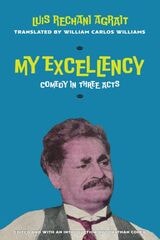
My Excellency
Comedy in Three ActsLuis Rechani Agrait
Swan Isle Press, 2025
William Carlos Williams’s passion for his matrilineal Puerto Rican roots led him to visit Puerto Rico for the first time in 1941. There at a writers’ conference, he befriended the playwright Luis Rechani Agrait, who gave him his play Mi señoría, staged to acclaim the previous year.
My Excellency, as Williams calls the play in his translation, is a political farce set in an “imaginary country” that resembles Puerto Rico during the Great Depression, with its high unemployment and labor unrest. The play focuses on the plight of an idealistic but naive man, Buenaventura Padilla, in a completely corrupt political system. Through an unscrupulous election, he becomes the nation’s leader.
The play is successful as a satire largely because of Buenaventura’s hilarious language—recreated by Williams—with its pompous style combined with stunning malapropisms and clownish errors in history and grammar. The play’s very title is a laughable malapropism. My Excellency shows the corrupting power of success and the tragic flaw of materialism. Driving the comedy in Williams’s translation is his firm command of the play’s dialogue interwoven with popular idioms in which the charm of pure nonsense abounds. This edition is Luis Rechani Agrait’s debut as a playwright in English.
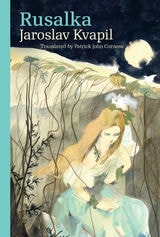
Rusalka
A Lyrical Fairy-tale in Three ActsJaroslav Kvapil
Karolinum Press, 2020
Transposed into the folkloric topos of a landlocked Bohemia, the mermaid is rendered here as a Slavic rusalka—a dangerous water nymph—who must choose between love and immortality. Thus, Rusalka, while certainly paying homage to the original story’s Scandinavian roots, is still a distinct work of modern Czech literature. Newly translated by Patrick Corness, Kvapil’s work will now find a fresh group of readers looking to get lost in one of Europe’s great lyrical fairy tale traditions.
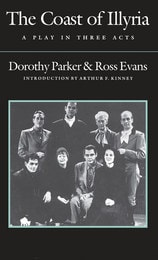
The Coast of Illyria
A Play in Three ActsDorothy Parker
University of Iowa Press, 1990