Results by title
11 books match the query 'Three Plays'
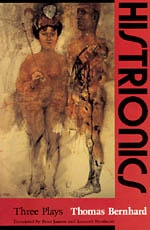
Histrionics
Three PlaysThomas Bernhard
University of Chicago Press, 1990
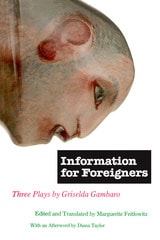
Information for Foreigners
Three PlaysGriselda Gambaro
Northwestern University Press, 1992
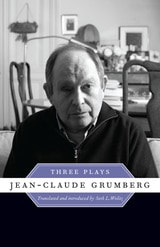
Jean-Claude Grumberg
Three PlaysBy Jean-Claude Grumberg and Seth Wolitz
University of Texas Press, 2014
Winner of seven Molières, the Pulitzer Prize of France, Jean-Claude Grumberg is one of France’s leading dramatists and a distinguished voice of modern European Jewry after the Shoah. His success in portraying contemporary Parisian Jews on the stage represents a new development in European theater and a new aesthetic expression of European Jewish experience and sensibility of the Holocaust and its aftermath, a perspective quite different from either the American or the Israeli one. Grumberg’s Jews are French to their fingertips, yet they have been made more consciously Jewish by the war and the difficulties of reintegrating into a society in which too many neighbors denounced them or ignored their pleas to save their children. Affirming the new status of Jewish culture, Grumberg’s plays insist on the recognition of Jewish identity and uniqueness within the majority societies of Europe.
This volume offers the first English translation of three of Grumberg’s prize-winning plays: The Workplace (L’Atelier, 1979), On the Way to the Promised Land (Vers toi Terre promise, 2006) and Mama’s Coming Back, Poor Orphan (Maman revient, pauvre orphelin, 1994). Presented in the order of the history they record and steeped in Grumberg’s personal experience and insights into contemporary Parisian life, these plays serve as documentary witnesses that begin with the immediate postwar reality and continue up to the end of the twentieth century. Seth Wolitz provides notes on the plays’ themes, structures, characters, and settings, along with an introduction that discusses Grumberg’s place within the emergence of French-Jewish drama and a translation of an interview with the playwright himself.
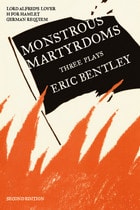
Monstrous Martyrdoms
Three PlaysEric Bentley
Northwestern University Press, 2004
Recipient of 2007 The Robert Chesley Foundation Lifetime Achievement Award in Playwriting
Winner of 2006 Village Voice OBIE Awards Lifetime Achievement Award
"The road will be red with monstrous martyrdoms, but we shall win." Oscar Wilde wrote these words at the end of the nineteenth century after serving two years at hard labor for the crime of being homosexual. This modern martyrdom is the subject of Lord Alfred's Lover, Eric Bentley's Brechtian dramatization of Wilde's last days.
H for Hamlet is another variation on the modern martyr play, this time in homage to Pirandello. The protagonist thinks, or once thought, he was Hamlet. Fantasy? Perhaps. But, to paraphrase Marianne Moore, there was a real toad in the imaginary garden--a real martyr in the toy theatre.
In German Requiem, Bentley takes inspiration from Heinrich von Kleist's play The Schroffenstein Family, which in turn is a version of Shakespeare's Romeo and Juliet. The young star-crossed lovers in his play are martyrs of an internecine conflict much like those seen in recent history in Ireland and the Middle East.
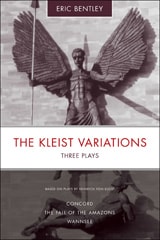
The Kleist Variations
Three PlaysEric Bentley
Northwestern University Press, 2005
Winner of 2006 Village Voice OBIE Awards Lifetime Achievement Award
In this collection, Eric Bentley presents Concord, a comedy adapted from Kleist's The Broken Jug;The Fall of the Amazons, a tragedy written in response to Kleist's Penthesilea; and Wannsee, a tragic-comedy which is Bentley's rendering of Kleist's Cathy of Heilbronn.
Bentley sets Concord in a courthouse during the early days of the Republic. Convened to discover who broke an irreplaceable jug symbolic of the chivalric age of Sir Walter Raleigh, Judge Adam's madcap court flounders in hilarious chaos induced by huge lies to cover comic lust.
Fall of the Amazons is the story of Achilles and the Amazon queen, Penthesilea. Through this pagan play, Bentley explores improbably love, which he exemplifies in the biblical story of Abraham and Isaac: "In seeming to be cruel to both father and son, God has enabled them to find, in total vulnerability, total love," a theme that also pervades Wannsee.
Bentley's Wannsee is a play of pageantry: emperors, counts, dueling knights, a young beauty of seemingly low birth, cherubs, and witches masked in loveliness. A fabulous love story ostensibly designed to dissuade Kleist from self-destruction, Wannsee demonstrates with a flourish that, though devils roam the earth, there are also angels.
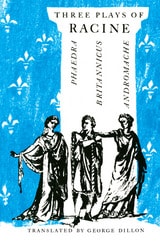
Three Plays of Racine
Phaedra, Andromache, and BritannicusJean Baptiste Racine
University of Chicago Press, 1961
"His literal and flexible blank verse actually forms the nearest thing in English to the longer-measured rhymed couplets of Racine; even an ordinary reading aloud of so faithful a rendering provides something of the experience that Proust described."—Elliott Coleman, Poetry
"A superb introduction . . . flawless translations, infused with poetic fire and charm."—Margaret Carpenter, Norfolk Virginian-Pilot
Three Plays
Dark River, Arthur Aronymus and His Ancestors, and I and IElse Lasker-Schuler
Northwestern University Press, 2005
Famous for her poetry and infamous for her bohemian lifestyle, as well as her association with political radicals, Else Lasker-Schüler (1869–1945) is only now returning to just renown as one of the few women writers within the Expressionist movement of the early twentieth century. These plays-Dark River, Arthur Aronymus and His Ancestors, and I and I-in Jane Curtis's fluid translation, allow readers of English to experience the radically avant-garde style that put Lasker-Schüler on a par with Brecht in her day, as well as the passionate treatment of questions of gender, ethnicity, and sexuality that placed her well ahead of her time. Lasker-Schüler's plays reflect her unusual life among the Berlin Moderns of the 1910s and 20s. The daughter of a well-to-do Jewish banker and builder, Else Schüler gave up her bourgeois existence as a doctor's wife for the artistic, social, and political uncertainties that would characterize the rest of her life. Many of her finest poems and plays were written amidst the cafe society of Berlin, where she knew some of the great expressionist artists of the period. The death of her beloved son in 1927, which led her to intense introspection and reflection on the Jewish tradition, especially mysticism and the Kabbalah, also marked the beginning of Lasker-Schüler's years of tragedy, loss, and dislocation, culminating in her flight from Nazi Germany to Switzerland and then Jerusalem, where she ended her days as an eccentric pauper.
The plays in this volume mark Lasker-Schüler's movement away from the traditional aesthetic canon, revealing a unique formal development from naturalistic expressionist episodes in the lyrical Dark River to a historicizing politicization of the theater in Arthur Aronymous to the forms of montage and "epic" presentations in I and I. A short preface by Inca Molina Rumold places each play in its historical, biographical, and artistic context.
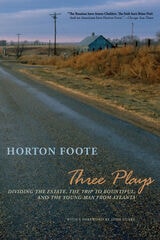
Three Plays
Dividing the Estate, The Trip to Bountiful, and The Young Man from AtlantaHorton Foote
Northwestern University Press, 2008
Three Plays
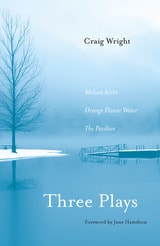
Melissa Arctic, Orange Flower Water, and The PavilionCraig Wright
Northwestern University Press, 2012
Craig Wright is one of the most widely produced, consistently entertaining playwrights of his generation. The three plays gathered in this volume—Melissa Arctic (winner of the 2005 Helen Hayes Award), Orange Flower Water, and The Pavilion—are all set in the fictional town of Pine City, Minnesota. The plays share a focus on love and relationships and feature a consistent undercurrent of observation and speculation about the nature of time. Melissa Arctic brings Shakespeare’s The Winter’s Tale into the present, retaining the original’s captivating mix of the comic and tragic. A brutally frank exploration of marriage, Orange Flower Water examines the irresistible lure and poisonous effects of unrealistic expectations within love, and portrays the inescapably compromised contours of relationships founded on adultery. The Pavilion, a lyrical and rueful homage to Our Town, is a meditation on dashed dreams and unquenchable hopes, set at a twenty-year high school reunion. In all three plays, Wright shows himself to be one of the most perceptive and engaging playwrights working today.
Three Plays
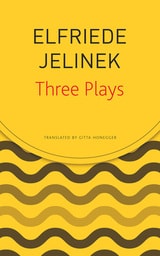
Rechnitz, The Merchant’s Contracts, Charges (The Supplicants)Elfriede Jelinek
Seagull Books, 2019
In “Rechnitz,” a chorus of messengers reports on the circumstances of the massacre of 180 Jews, an actual historical event that took place near the Austrian/Hungarian border town of Rechnitz. In “The Merchant’s Contracts,” Jelinek brings us a comedy of economics, where the babble and media spin of spectators leave small investors alienated and bearing the brunt of the economic crisis. In “Charges (The Supplicants),” Jelinek offers a powerful analysis of the plight of refugees, from ancient times to the present. She responds to the immeasurable suffering among those fleeing death, destruction, and political suppression in their home countries and, drawing on sources as widely separated in time and intent as up-to-the-minute blog postings and Aeschylus’s “The Supplicants,” Jelinek asks what refugees want, how we as a society view them, and what political, moral, and personal obligations they impose on us.
Underground, Monroe, and The Mamalogues
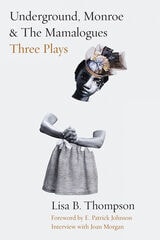
Three PlaysLisa B. Thompson; Foreword by E. Patrick Johnson; Interview with Joan Morgan
Northwestern University Press, 2020
The thriller Underground explores the challenges of radical black politics among the black middle class in the post-Obama era. Monroe, a period drama about the Great Migration, depicts the impact of a lynching on a family and community in 1940s Louisiana. The Mamalogues, a satirical comedy, focuses on three middle-class black single mothers as they lean in, stress out, and guide precocious black children from diapers to college in a dangerous world. This collection will be compelling to readers interested in African American studies; drama, theater, and performance; feminist and gender studies; popular culture and media studies; and American studies.