Results by title
3 books match the query 'Throne'
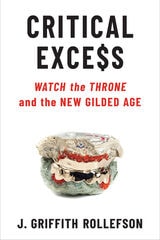
Critical Excess
Watch the Throne and the New Gilded AgeJ. Griffith Rollefson
University of Michigan Press, 2021
Jay-Z and Kanye West’s 2011 Watch the Throne is a self-avowed “luxury rap” album centered on Eurocentric conceptions of nobility, artistry, and haute couture. Critical Excess performs a close reading of the sonic and social commentary on this album, examining how the album alternately imagines and critiques the mutually reinforcing ideas of Europe, nobility, old money, art, and their standard bearer, whiteness. Reading the album alongside Black critical theory and work on the prophetic nature of music, Rollefson argues that through their performance of black excellence, opulence, and decadence, Jay-Z and Kanye West poured gas on the white resentment of the Obama presidency—a resentment that would ultimately spill over into public life, make audible the dog whistling of the Far Right, and embolden white supremacists to come out from under their rocks. Ultimately, Rollefson argues, Jay-Z and Kanye West’s performance of what Rollefson calls “critical excess” on this hip hop album exceeds the limits of conspicuous consumption and heralds the final stage of late capitalism—“the New Gilded Age.”
[more]
Ladies of the Throne
Léonora Miano
Diaphanes, 2025
An astonishing new narrative of Mandu Yenu, a throne from the ancient Kingdom of Bamum.
“Most of the time, it is the power of men that we remember.” With these words, which open Léonora Miano’s text for Objects Talk Back, an astonishing new narrative unfurls around Mandu Yenu, a throne from the ancient Kingdom of Bamum (present day Cameroon).
The Germans long claimed the object was a gift from King Njoya to Kaiser Wilhelm II. Miano reads “between the lines of beads and cowrie shells” to show the complex intricacies of colonial and gender relations. Dismissing all pretense of egalitarianism between colonizer and colonized, she hones in on the very nature of power—how and by whom it is defined-wielded-subverted.
King Njoya said he “felt like a woman in his relationship with the Germans.” Miano takes this as a prompt to examine contrasting cultural notions of femininity and thus reveals how central women are to the story of the throne. As the very name of the object suggests, it is the power of women we should remember.
[more]
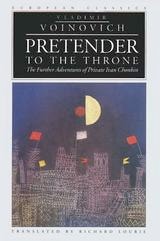
Pretender to the Throne
Further Adventures of Private Ivan ChonkinVladimir Voinovich
Northwestern University Press, 1995
This hilarious novel following the continuing adventures of Ivan Chonkin, a simple peasant who has been arrested as a traitor after spending World War II happily tending a garden. In this sequel to The Extraordinary Life and Adventures of Private Ivan Chonkin, Vladimir Voinovich ridicules everything sacred to the Soviet Union—the army, the justice system, the press, and Stalin himself—in a refreshing combination of dissident conscience and universal humor.
[more]