Results by title
2 books match the query 'Tichi, Cecelia'
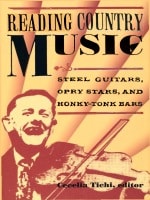
Reading Country Music
Steel Guitars, Opry Stars, and Honky Tonk BarsCecelia Tichi, ed.
Duke University Press, 1998
Bringing together a wide range of scholars and critics from literature, communications, history, sociology, art, and music, this anthology looks at everything from the inner workings of the country music industry to the iconography of certain stars to the development of distinctive styles within the country music genre. Essays include a look at the shift from "hard-core" to "soft-shell" country music in recent years; Johnny Cash as lesbian icon; gender, class, and region in Dolly Parton’s star image; and bluegrass’s gothic tradition. Originally published as a special issue of South Atlantic Quarterly, this expanded book edition includes new articles on the spirituality of Willie Nelson, the legacy and tradition of stringed music, and the revival of Stephen Foster’s blackface musical, among others.
Contributors. Mary A. Bufwack, Don Cusic, Curtis W. Ellison, Mark Fenster, Vivien Green Fryd, Teresa Goddu, T. Walter Herbert, Christine Kreyling, Michael Kurek, Amy Schrager Lang, Charmaine Lanham, Bill Malone, Christopher Metress, Jocelyn Neal, Teresa Ortega, Richard A. Peterson, Ronnie Pugh, John W. Rumble, David Sanjek, Cecelia Tichi, Pamela Wilson, Charles K. Wolfe
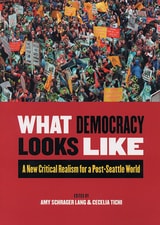
What Democracy Looks Like
A New Critical Realism for a Post-Seattle WorldLang, Amy
Rutgers University Press, 2006
The convergence of activists in Seattle during the World Trade Organization meetings captured the headlines in 1999. These demonstrations marked the first major expression on U.S. soil of worldwide opposition to inequality, privatization, and political and intellectual repression. This turning point in world politics coincided with an ongoing quandary in academia-particularly in the humanities where the so-called "death of theory" has left the field on tenuous footing.
In What Democracy Looks Like, the editors and twenty-seven contributors argue that these crises-in the world and the academy-are not unrelated. The essays insist that, in the wake of "Seattle," teachers and scholars of American literature and culture are faced with the challenge of addressing new points of intersection between American studies and literary studies. The narrative, the poem, the essay, and the drama need to be reexamined in ways that are relevant to the urgent social and political issues of our time.
Collectively urging scholars and educators to pay fresh attention to the material conditions out of which literature arises, this path-breaking book inaugurates a new critical realism in American literary studies. It provides a crucial link in the growing need to merge theory and practice with the goal of reconnecting the ivory tower elite to the activists on the street.