Results by title
4 books match the query 'Ties That Bind'
Inventing the Ties That Bind
Imagined Relationships in Moral and Political LifeFrancesca Polletta
University of Chicago Press, 2020
At a time of deep political divisions, leaders have called on ordinary Americans to talk to one another: to share their stories, listen empathetically, and focus on what they have in common, not what makes them different. In Inventing the Ties that Bind, Francesca Polletta questions this popular solution for healing our rifts. Talking the way that friends do is not the same as equality, she points out. And initiatives that bring strangers together for friendly dialogue may provide fleeting experiences of intimacy, but do not supply the enduring ties that solidarity requires. But Polletta also studies how Americans cooperate outside such initiatives, in social movements, churches, unions, government, and in their everyday lives. She shows that they often act on behalf of people they see as neighbors, not friends, as allies, not intimates, and people with whom they have an imagined relationship, not a real one. To repair our fractured civic landscape, she argues, we should draw on the rich language of solidarity that Americans already have.
[more]
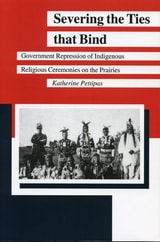
Severing the Ties that Bind
Government Repression of Indigenous Religious Ceremonies on the PrairiesKatherine Pettipas
University of Manitoba Press, 1994
Religious ceremonies were an inseparable part of Aboriginal traditional life, reinforcing social, economic, and political values. However, missionaries and government officials with ethnocentric attitudes of cultural superiority decreed that Native dances and ceremonies were immoral or un-Christian and an impediment to the integration of the Native population into Canadian society. Beginning in 1885, the Department of Indian Affairs implemented a series of amendments to the Canadian Indian Act, designed to eliminate traditional forms of religious expression and customs, such as the Sun Dance, the Midewiwin, the Sweat Lodge, and giveaway ceremonies.However, the amendments were only partially effective. Aboriginal resistance to the laws took many forms; community leaders challenged the legitimacy of the terms and the manner in which the regulations were implemented, and they altered their ceremonies, the times and locations, the practices, in an attempt both to avoid detection and to placate the agents who enforced the law.Katherine Pettipas views the amendments as part of official support for the destruction of indigenous cultural systems. She presents a critical analysis of the administrative policies and considers the effects of government suppression of traditional religious activities on the whole spectrum of Aboriginal life, focussing on the experiences of the Plains Cree from the mid-1880s to 1951, when the regulations pertaining to religious practices were removed from the Act. She shows how the destructive effects of the legislation are still felt in Aboriginal communities today, and offers insight into current issues of Aboriginal spirituality, including access to and use of religious objects held in museum repositories, protection of sacred lands and sites, and the right to indigenous religious practices in prison.
[more]
The Ties That Bind
Julius M. Moravcsik
Central European University Press, 2004
This book, like in classical times of Plato and Aristotle, treats individual and communal ethics as intertwined. At its heart lies the quartet of respect, concern for welfare of others, trust, and care as the basic communal ties. The community needs to be built on these. Acquisition and practice of other values and goods are within the frame of the four underlying "pillars." The four basic notions are attitudes and as such consist of both rational and emotional elements. Thus our ethics is neither based purely on sentiment nor purely on reason. As such they will yield us guidelines, to be filled in contextually, not rigid rule systems. Moravcsik's proposal for ethics is pluralistic but not relativistic. It does not deny some objective ground for sound communal life, but leaves many alternatives within which the four basic ties can be implemented.
[more]
The Ties That Bind
The Economic Relationships of Twelve Tebtunis FamiliesEdited by Ryosuke Takahashi
University of London Press, 2021
An intimate insight into the lives of twelve families in the Ancient Egyptian village of Tebtunis.
Tebtunis, an ancient village formerly located in lower Egypt, is one of the most enduring subjects of study from the civilization's Roman era. This fascinating volume details a dozen newly-discovered family papers that have survived from the second century AD. Belonging to families of various different classes, this unique documentation provides a rare opportunity to explore how local elites under Roman rule exploited their wealth in the countryside and interacted with its rural inhabitants.
Ties That Bind is the first book to investigate these family papers holistically, focusing on the economic activities in which the families engaged: land leases, loans in cash and kind, and the employment of managers and laborers on landed estates. This study also addresses strategy and decision-making among both elite families and villagers, the complexity of interfamilial relationships, and the implications of this social networking. This micro-historical study elucidates the diversity of socio-economic life in a village where no single family dominated.
[more]