Results by title
5 books match the query 'Tillich, Paul'
Biblical Religion and the Search for Ultimate Reality
Paul Tillich
University of Chicago Press, 1955
Dr. Tillich shows here that in spite of the contrast between philosophical and biblical language, it is neither necessary nor possible to separate them from each other. On the contrary, all the symbols used in biblical religion drive inescapably toward the philosophical quest for being. An important statement of a great theologian's position, this book presents an eloquent plea for the essential function of philosophy in religious thought.
[more]
Systematic Theology, Volume 1
Paul Tillich
University of Chicago Press, 1951
This is the first part of Paul Tillich's three-volume Systematic Theology, one of the most profound statements of the Christian message ever composed and the summation and definitive presentation of the theology of the most influential and creative American theologian of the twentieth century.
In this path-breaking volume Tillich presents the basic method and statement of his system—his famous "correlation" of man's deepest questions with theological answers. Here the focus is on the concepts of being and reason. Tillich shows how the quest for revelation is integral to reason itself. In the same way a description of the inner tensions of being leads to the recognition that the quest for God is implied in finite being.
Here also Tillich defines his thought in relation to philosophy and the Bible and sets forth his famous doctrine of God as the "Ground of Being." Thus God is understood not as a being existing beside other beings, but as being-itself or the power of being in everything. God cannot be made into an object; religious knowledge is, therefore, necessarily symbolic.
[more]
Systematic Theology, Volume 2
Paul Tillich
University of Chicago Press, 1957
In this volume, the second of his three-volume reinterpretation of Christian theology, Paul Tillich comes to grips with the central idea of his system—the doctrine of the Christ. Man's predicament is described as the state of "estrangement" from himself, from his world, and from the divine ground of his self and his world. This situation drives man to the quest for a new state of things, in which reconciliation and reunion conquer estrangement. This is the quest for the Christ.
[more]
Systematic Theology, Volume 3
Paul Tillich
University of Chicago Press, 1963
In this volume, the third and last of his Systematic Theology, Paul Tillich sets forth his ideas of the meaning of human life, the doctrine of the Spirit and the church, the trinitarian symbols, the relation of history to the Kingdom of God, and the eschatological symbols. He handles this subject matter with powerful conceptual ability and intellectual grace.
The problem of life is ambiguity. Every process of life has its contrast within itself, thus driving man to the quest for unambiguous life or life under the impact of the Spritual Presence. The Spritual Presence conquers the negativities of religion, culture, and morality, and the symbols anticipating Eternal Life present the answer to the problem of life.
The problem of life is ambiguity. Every process of life has its contrast within itself, thus driving man to the quest for unambiguous life or life under the impact of the Spritual Presence. The Spritual Presence conquers the negativities of religion, culture, and morality, and the symbols anticipating Eternal Life present the answer to the problem of life.
[more]
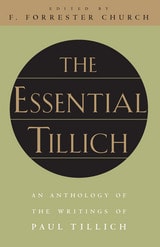
The Essential Tillich
Paul Tillich
University of Chicago Press, 1999
An essential collection of the best work by renowned Christian theologian Paul Tillich
In his lifetime, Paul Tillich became that rarest of things: a famous theologian. Known for marrying an approachable personal and intellectual manner with rigorous religious thought and analysis, Tillich was as influential as any writer on religion at mid-century, listened to not just by parishioners and students but by political leaders, intellectuals, artists, and scientists as well.
This volume collects Tillich's best and most important work. Editor F. Forrester Church has structured the book around eight key areas of Tillich's thought, titled: Ultimate Concern; Symbols of Faith; The Protestant Principle; Addressing the Situation; Love, Power, and Justice; The Courage to Be; The Future of Religions; and Living on the Boundary. Through them we get a clear picture of the work of a man whom Church describes as “a man of rare genius and perspecuity, a modern man whose heart was in Jerusalem, whose spirit was with the ancient Greeks, and whose soul was committed to a better future.”
[more]