Results by title
4 books match the query 'Tilly, Charles'
Big Structures, Large Processes, Huge Comparisons
Charles Tilly
Russell Sage Foundation, 1984
How Social Movements Matter
Marco Giugni
University of Minnesota Press, 1999
Provides original assessments of the consequences of social movements.
We have all witnessed social movements and felt their effects-some subtle, others profound. But to truly understand their impact over time, in different countries, and on various segments of society requires the kind of rare insight this book provides. Bringing together several well-known scholars, this volume offers an assessment of the consequences of social movements in Western countries.
Policy, institutional, cultural, short- and long-term, and intended and unintended outcomes are among the types of consequences the authors consider in depth. They also compare political outcomes of several contemporary movements-specifically, twomen’s, peace, ecology, and extreme-right movements-in different countries. Contributors: Edwin Amenta, New York U; Paul Burstein, U of Washington; Donatella della Porta, U of Florence; Joyce Gelb, CUNY; Vivien Hart, U of Sussex; Ruud Koopmans, Science Center, Berlin; Hanspeter Kriesi, U of Geneva; David S. Meyer, CUNY; Kelly Moore, Columbia U; Dieter Rucht, U of Kent, Canterbury; Paul Statham, Science Center, Berlin; Sidney Tarrow, Cornell U; Dominique Wisler, U of Geneva; Michael P. Young.ISBN 0-8166-2914-5 Cloth £00.00 $57.95xxISBN 0-8166-2915-3 Paper £00.00 $22.95x336 Pages 10 tables, 4 figures 5 7/8 x 9 AugustSocial Movements, Protest and Contention Series, volume 10Translation inquiries: University of Minnesota Press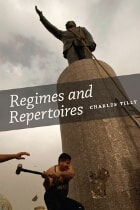
Regimes and Repertoires
Charles Tilly
University of Chicago Press, 2006
The means by which people protest—that is, their repertoires of contention—vary radically from one political regime to the next. Highly capable undemocratic regimes such as China's show no visible signs of popular social movements, yet produce many citizen protests against arbitrary, predatory government. Less effective and undemocratic governments like the Sudan’s, meanwhile, often experience regional insurgencies and even civil wars. In Regimes and Repertoires, Charles Tilly offers a fascinating and wide-ranging case-by-case study of various types of government and the equally various styles of protests they foster.
Using examples drawn from many areas—G8 summit and anti-globalization protests, Hindu activism in 1980s India, nineteenth-century English Chartists organizing on behalf of workers' rights, the revolutions of 1848, and civil wars in Angola, Chechnya, and Kosovo—Tilly masterfully shows that such episodes of contentious politics unfold like loosely scripted theater. Along the way, Tilly also brings forth powerful tools to sort out the reasons why certain political regimes vary and change, how the people living under them make claims on their government, and what connections can be drawn between regime change and the character of contentious politics.

Remapping Memory
The Politics of TimeSpaceJonathan Boyarin, EditorAfterword by Charles Tilly
University of Minnesota Press, 1994
Remapping Memory was first published in 1994. Minnesota Archive Editions uses digital technology to make long-unavailable books once again accessible, and are published unaltered from the original University of Minnesota Press editions.
The essays in this book focus on contested memories in relation to time and space. Within the context of several profound cultural and political conflicts in the contemporary world, the contributors analyze historical self-configurations of human groups, and the construction by these groups of the spaces they shape and that shape them. What emerges is a view of the state as a highly contingent artifact of groups vying for legitimacy-whether through their own sense of "insiderhood," their control of positions within hierarchies, or their control of geographical territories.
Boyarin's lead essay shows how the supposedly "objective" categories of space and time are, in fact, specific products of European modernity. Each case study, in turn, addresses the (re)constitution of space, time, and memory in relation to an event either of historical significance, like the dropping of the atomic bomb on Hiroshima, or of cultural importance, like the Indian preoccupation with reincarnation. These ethnographic studies explore fundamental questions about the nature of memory, the limits of politics, and the complex links between them.
By focusing on personal and collective identity as the site where constructions of memory and dimensionality are tested, shaped, and effected, the authors offer a new way of understanding how the politics of space, time and memory are negotiated to bring people to terms with their history.
Contributors: Akhil Gupta, Stanford University;
Charles R. Hale, University of California, Davis; Carina Perelli, PEITHO, Montevideo, Uruguay; Jennifer Schirmer, Center for European Studies, Harvard; Daniel A. Segal, Pitzer College, Claremont, California; Lisa Yoneyama, University of California, San Diego.