Results by title

8 books match the query 'Time management'
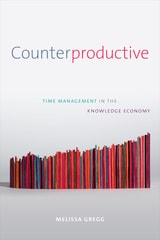
cover of Counterproductive: Time Management in the Knowledge Economy

Counterproductive

Time Management in the Knowledge Economy

Melissa Gregg

Duke University Press, 2018
As online distractions increasingly colonize our time, why has productivity become such a vital demonstration of personal and professional competence? When corporate profits are soaring but worker salaries remain stagnant, how does technology exacerbate the demand for ever greater productivity? In Counterproductive Melissa Gregg explores how productivity emerged as a way of thinking about job performance at the turn of the last century and why it remains prominent in the different work worlds of today. Examining historical and archival material alongside popular self-help genres—from housekeeping manuals to bootstrapping business gurus, and the growing interest in productivity and mindfulness software—Gregg shows how a focus on productivity isolates workers from one another and erases their collective efforts to define work limits. Questioning our faith in productivity as the ultimate measure of success, Gregg's novel analysis conveys the futility, pointlessness, and danger of seeking time management as a salve for the always-on workplace.
[more]
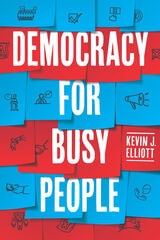
cover of Democracy for Busy People

Democracy for Busy People

Kevin J. Elliott

University of Chicago Press, 2023

Advances an alternative approach to democratic reform that focuses on building institutions that empower people who have little time for politics.
 
How do we make democracy more equal? Although in theory, all citizens in a democracy have the right to participate in politics, time-consuming forms of participation often advantage some groups over others. Where some citizens may have time to wait in long lines to vote, to volunteer for a campaign, to attend community board meetings, or to stay up to date on national, state, and local news, other citizens struggle to do the same. Since not all people have the time or inclination to devote substantial energy to politics, certain forms of participation exacerbate existing inequalities.
 
Democracy for Busy People takes up the very real challenge of how to build a democracy that empowers people with limited time for politics. While many plans for democratic renewal emphasize demanding forms of political participation and daunting ideals of democratic citizenship, political theorist Kevin J. Elliott proposes a fundamentally different approach. He focuses instead on making democratic citizenship undemanding so that even busy people can be politically included. This approach emphasizes the core institutions of electoral democracy, such as political parties, against deliberative reforms and sortition. Timely and action-focused, Democracy for Busy People is necessary reading.
[more]
cover of Fighting For Time: Shifting Boundaries of Work and Social Life

Fighting For Time

Shifting Boundaries of Work and Social Life

Cynthia Fuchs Epstein

Russell Sage Foundation, 2004

Though there are still just twenty-four hours in a day, society's idea of who should be doing what and when has shifted. Time, the ultimate scarce resource, has become an increasingly contested battle zone in American life, with work, family, and personal obligations pulling individuals in conflicting directions. In Fighting for Time, editors Cynthia Fuchs Epstein and Arne Kalleberg bring together a team of distinguished sociologists and management analysts to examine the social construction of time and its importance in American culture. Fighting for Time opens with an exploration of changes in time spent at work—both when people are on the job and the number of hours they spend there—and the consequences of those changes for individuals and families. Contributors Jerry Jacobs and Kathleen Gerson find that the relative constancy of the average workweek in America over the last thirty years hides the fact that blue-collar workers are putting in fewer hours while more educated white-collar workers are putting in more. Rudy Fenwick and Mark Tausig look at the effect of nonstandard schedules on workers' health and family life. They find that working unconventional hours can increase family stress, but that control over one's work schedule improves family, social, and health outcomes for workers. The book then turns to an examination of how time influences the organization and control of work. The British insurance company studied by David Collinson and Margaret Collinson is an example of a culture where employees are judged on the number of hours they work rather than on their productivity. There, managers are under intense pressure not to take legally guaranteed parental leave, and clocks are banned from the office walls so that employees will work without regard to the time. In the book's final section, the contributors examine how time can have different meanings for men and women. Cynthia Fuchs Epstein points out that professional women and stay-at-home fathers face social disapproval for spending too much time on activities that do not conform to socially prescribed gender roles—men are mocked by coworkers for taking paternity leave, while working mothers are chastised for leaving their children to the care of others. Fighting for Time challenges assumptions about the relationship between time and work, revealing that time is a fluid concept that derives its importance from cultural attitudes, social psychological processes, and the exercise of power. Its insight will be of interest to sociologists, economists, social psychologists, business leaders, and anyone interested in the work-life balance.
[more]
cover of Patterns of Time in Hospital Life: A Sociological Perspective

Patterns of Time in Hospital Life

A Sociological Perspective

Eviatar Zerubavel

University of Chicago Press, 1979

This volume presents an original study in the sociology of time: a case-description and conceptual analysis of the ways in which the temporal frameworks we customarily take for granted structure social reality. The study is based on the author's observation of the activities of medical professionals in a large teaching hospital: there, he collected data to show that the rhythms of organizational life have particular moral and cognitive dimensions, beyond simple regulative functions. While individuals customarily adapt to a variety of contexts for anchoring events in time, the temporal coordination necessary for collective efforts enforces social controls at multiple levels. This "sociotemporal order," an inherent constituent of social life, offers researchers and theoreticians alike a fresh and rewarding analytic perspective.

Patterns of Time will be valued for its several distinctive achievements. Foremost among these is a demonstration of the importance of "temporality" as a topic in its own right. Because measurements of time are a commonplace of social life, sociologists have tended to ignore the significance of temporality as a feature of social organizations. Zerubavel's work is a corrective to this neglect. In addition, the author's imaginative integration of ethnographic description and theoretical analysis bridges the gap between contrasting methods that has characterized much recent sociological and anthropological work. Finally, because of the author's selection of the hospital setting, sociologists of medicine and the professions will find his study useful for its rich and well-observed ethnography, as well as its novel analytical approach.

[more]
cover of Self-Control in Seven Steps

Self-Control in Seven Steps

Christine B. Whelan

Templeton Press, 2012

When you want to get up for an early flight, what do you do? You set an alarm. If you want to benchpress your body weight, how do you start? You slowly build up your muscles so you can achieve your goal. And when you’ve got a big deadline looming, what’s the best way to handle it? Plan out your time.
If you’re like most people, you know all these things are true, but at some point or another, you’ve dropped the ball: You’ve missed a flight because you cut it too close, you’ve overestimated what you can physically do, hurting yourself in the process, or you’ve tried to cram in a month’s worth of work into a frantic forty-eight-hour panic fest. Yes?
You’re not alone. Even Aristotle knew this when he said, “I count him braver who overcomes his desires than him who conquers his enemies; for the hardest victory is over self.”
You want the secret to success. You want to take control of your life and achieve your goals. We all do. Since research has repeatedly shown that self-control is like a muscle, think of this book as your personal trainer to build up your skills and strength. Self-Control in 7 Steps offers the proven mental tricks, organizational strategies, and tools to transform the bored, unfocused, and lazy in all of us.
[more]
cover of The Changing Rhythms of American Family Life

The Changing Rhythms of American Family Life

Suzanne M. Bianchi

Russell Sage Foundation, 2006
Over the last forty years, the number of American households with a stay-at-home parent has dwindled as women have increasingly joined the paid workforce and more women raise children alone. Many policy makers feared these changes would come at the expense of time mothers spend with their children. In Changing Rhythms of American Family Life, sociologists Suzanne M. Bianchi, John P. Robinson, and Melissa Milkie analyze the way families spend their time and uncover surprising new findings about how Americans are balancing the demands of work and family. Using time diary data from surveys of American parents over the last four decades, Changing Rhythms of American Family Life finds that—despite increased workloads outside of the home—mothers today spend at least as much time interacting with their children as mothers did decades ago—and perhaps even more. Unexpectedly, the authors find mothers' time at work has not resulted in an overall decline in sleep or leisure time. Rather, mothers have made time for both work and family by sacrificing time spent doing housework and by increased "multitasking." Changing Rhythms of American Family Life finds that the total workload (in and out of the home) for employed parents is high for both sexes, with employed mothers averaging five hours more per week than employed fathers and almost nineteen hours more per week than homemaker mothers. Comparing average workloads of fathers with all mothers—both those in the paid workforce and homemakers—the authors find that there is gender equality in total workloads, as there has been since 1965. Overall, it appears that Americans have adapted to changing circumstances to ensure that they preserve their family time and provide adequately for their children. Changing Rhythms of American Family Life explodes many of the popular misconceptions about how Americans balance work and family. Though the iconic image of the American mother has changed from a docile homemaker to a frenzied, sleepless working mom, this important new volume demonstrates that the time mothers spend with their families has remained steady throughout the decades.
[more]
cover of The Three Sustainabilities: Energy, Economy, Time

The Three Sustainabilities

Energy, Economy, Time

Allan Stoekl

University of Minnesota Press, 2021

Bringing the word sustainability back from the brink of cliché—to a substantive, truly sustainable future 
 

Is sustainability a hopelessly vague word, with meager purpose aside from a feel-good appeal to the consumer? In The Three Sustainabilities, Allan Stoekl seeks to (re)valorize the word, for a simple reason: it is useful. Sustainability designates objects in time, their birth or genesis, their consistency, their survival, their demise. And it raises the question, as no other word does, of the role of humans in the survival of a world that is quickly disappearing—and perhaps in the genesis of another world. 

Stoekl considers a range of possibilities for the word, touching upon questions of object ontology, psychoanalysis, urban critique, technocracy, and religion. He argues that there are three varieties of sustainability, seen from philosophical, cultural, and economic perspectives. One involves the self-sustaining world “without us”; another, the world under our control, which can run the political spectrum from corporatism to Marxism to the Green New Deal; and a third that carries a social and communitarian charge, an energy of the “universe” affirmed through, among other things, meditation and gifting. Each of these carves out a different space in the relations between objects, humans, and their survival and degradation. Each is necessary, unavoidable, and intimately bound with, and infinitely distant from, the others.

Along the way, Stoekl cites a wide range of authors, from philosophers to social thinkers, literary theorists to criminologists, anthropologists to novelists. This beautifully written, compelling, and nuanced book is a must for anyone interested in questions of ecology, energy, the environmental humanities, contemporary theories of the object, postmodern and posthuman aesthetics, or religion and the sacred in relation to community.
[more]
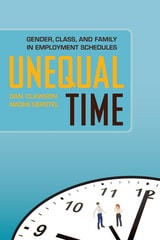
cover of Unequal Time: Gender, Class, and Family in Employment Schedules

Unequal Time

Gender, Class, and Family in Employment Schedules

Dan Clawson is professor of sociology at the University of Massachusetts, Amherst. Naomi Gerstel is a distinguished university professor of sociology at the University of Massachusetts, Amherst.

Russell Sage Foundation, 2014

Life is unpredictable. Control over one’s time is a crucial resource for managing that unpredictability, keeping a job, and raising a family. But the ability to control one’s time, much like one’s income, is determined to a significant degree by both gender and class. In Unequal Time, sociologists Dan Clawson and Naomi Gerstel explore the ways in which social inequalities permeate the workplace, shaping employees’ capacities to determine both their work schedules and home lives, and exacerbating differences between men and women, and the economically privileged and disadvantaged. Unequal Time investigates the interconnected schedules of four occupations in the health sector—professional-class doctors and nurses, and working-class EMTs and nursing assistants. While doctors and EMTs are predominantly men, nurses and nursing assistants are overwhelmingly women. In all four occupations, workers routinely confront schedule uncertainty, or unexpected events that interrupt, reduce, or extend work hours. Yet, Clawson and Gerstel show that members of these four occupations experience the effects of schedule uncertainty in very distinct ways, depending on both gender and class. But doctors, who are professional-class and largely male, have significant control over their schedules and tend to work long hours because they earn respect from their peers for doing so. By contrast, nursing assistants, who are primarily female and working-class, work demanding hours because they are most likely to be penalized for taking time off, no matter how valid the reasons. Unequal Time also shows that the degree of control that workers hold over their schedules can either reinforce or challenge conventional gender roles. Male doctors frequently work overtime and rely heavily on their wives and domestic workers to care for their families. Female nurses are more likely to handle the bulk of their family responsibilities, and use the control they have over their work schedules in order to dedicate more time to home life. Surprisingly, Clawson and Gerstel find that in the working class occupations, workers frequently undermine traditional gender roles, with male EMTs taking significant time from work for child care and women nursing assistants working extra hours to financially support their children and other relatives. Employers often underscore these disparities by allowing their upper-tier workers (doctors and nurses) the flexibility that enables their gender roles at home, including, for example, reshaping their workplaces in order to accommodate female nurses’ family obligations. Low-wage workers, on the other hand, are pressured to put their jobs before the unpredictable events they might face outside of work. Though we tend to consider personal and work scheduling an individual affair, Clawson and Gerstel present a provocative new case that time in the workplace also collective. A valuable resource for workers’ advocates and policymakers alike, Unequal Time exposes how social inequalities reverberate through a web of interconnected professional relationships and schedules, significantly shaping the lives of workers and their families.
[more]