Results by title
6 books match the query 'Time measurements'
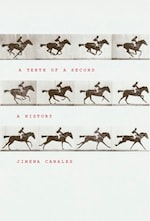
A Tenth of a Second
A HistoryJimena Canales
University of Chicago Press, 2009
In the late fifteenth century, clocks acquired minute hands. A century later, second hands appeared. But it wasn’t until the 1850s that instruments could recognize a tenth of a second, and, once they did, the impact on modern science and society was profound. Revealing the history behind this infinitesimal interval, A Tenth of a Second sheds new light on modernity and illuminates the work of important thinkers of the last two centuries.
Tracing debates about the nature of time, causality, and free will, as well as the introduction of modern technologies—telegraphy, photography, cinematography—Jimena Canales locates the reverberations of this “perceptual moment” throughout culture. Once scientists associated the tenth of a second with the speed of thought, they developed reaction time experiments with lasting implications for experimental psychology, physiology, and optics. Astronomers and physicists struggled to control the profound consequences of results that were a tenth of a second off. And references to the interval were part of a general inquiry into time, consciousness, and sensory experience that involved rethinking the contributions of Descartes and Kant.
Considering its impact on much longer time periods and featuring appearances by Henri Bergson, Walter Benjamin, and Albert Einstein, among others, A Tenth of a Second is ultimately an important contribution to history and a novel perspective on modernity.
Fighting For Time
Shifting Boundaries of Work and Social LifeCynthia Fuchs Epstein
Russell Sage Foundation, 2004
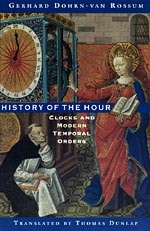
History of the Hour
Clocks and Modern Temporal OrdersGerhard Dohrn-van Rossum
University of Chicago Press, 1996
"In tracing the evolution of time consciousness with scholarship and skill . . . Dohrn-van Rossum evokes the many ways that the small moments of life have come to be reckoned with the passage of time."—Dava Sobel, Civilization
"Dohrn-van Rossum paints a highly nuanced picture of time's conquest of modern life."—Steven Lagerfeld, Wilson Quarterly
"This book is definitive in showing the clock's pervasive influence over European society."—Virginia Quarterly Review
"[A] delightful, excellently translated history."—Choice
"Dohrn-van Rossum has produced a persuasive and brilliantly documented new understanding of how modern time-consciousness arose."—Owen Gingerich, Nature
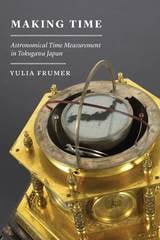
Making Time
Astronomical Time Measurement in Tokugawa JapanYulia Frumer
University of Chicago Press, 2017
In the mid-sixteenth century, when the first mechanical clocks arrived in Japan from Europe, the Japanese found them interesting but useless, because they failed to display time in units that changed their length with the seasons, as was customary in Japan at the time. In 1873, however, the Japanese government adopted the Western equal-hour system as well as Western clocks. Given that Japan carried out this reform during a period of rapid industrial development, it would be easy to assume that time consciousness is inherent to the equal-hour system and a modern lifestyle, but Making Time suggests that punctuality and time-consciousness are equally possible in a society regulated by a variable-hour system, arguing that this reform occurred because the equal-hour system better reflected a new conception of time — as abstract and universal—which had been developed in Japan by a narrow circle of astronomers, who began seeing time differently as a result of their measurement and calculation practices. Over the course of a few short decades this new way of conceptualizing time spread, gradually becoming the only recognized way of treating time.
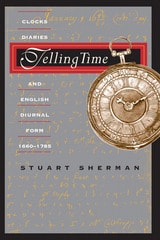
Telling Time
Clocks, Diaries, and English Diurnal Form, 1660-1785Stuart Sherman
University of Chicago Press, 1997
Through brilliant readings of Samuel Pepys's diary, Joseph Addison and Richard Steele's daily Spectator, the travel writings of Samuel Johnson and James Boswell, and the novels of Daniel Defoe and Frances Burney, Sherman traces the development of a new way of counting time in prose—the diurnal structure of consecutively dated installments—within the cultural context of the daily institutions which gave it form and motion. Telling Time is not only a major accomplishment for seventeenth- and eighteenth-century literary studies, but it also makes important contributions to current discourse in cultural studies.

The Textures of Time
Agency and Temporal ExperienceAuthored by Michael G. Flaherty
Temple University Press, 2010
What do we mean when we say, "I made the time pass more quickly," or, "I’m creating some ‘me’ time"? InThe Textures of Time, Michael Flaherty examines how we alter or customize our experience of time. His detailed analysis reveals different strategies we use to try to manipulate time, further describing and defining those strategies within six discrete time categories: Duration, Frequency, Sequence, Timing, Allocation, and Taking Time.
Using in-depth interviews and analyzing responses through a sociological lens, Flaherty unearths folk theories and practices, which he calls "time work," that construct circumstances in order to provoke desired forms of temporal experience. As such, time is not justinflicted on us; rather, its various textures result from our intervention, and/or from our efforts to create different forms of temporal experience. These first-person accounts also highlight ongoing tensions between agency and determinism in social groups. Ultimately, in keeping with his central thesis, Flaherty's lucid prose make this book a quick read, and the strategies he describes reveal the profound and inventive ways we "manage the clock."