Results by title
2 books match the query 'Time perception in literature'
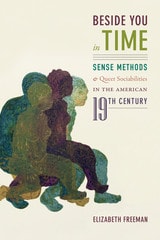
Beside You in Time
Sense Methods and Queer Sociabilities in the American Nineteenth CenturyElizabeth Freeman
Duke University Press, 2019
In Beside You in Time Elizabeth Freeman expands biopolitical and queer theory by outlining a temporal view of the long nineteenth century. Drawing on Foucauldian notions of discipline as a regime that yoked the human body to time, Freeman shows how time became a social and sensory means by which people assembled into groups in ways that resisted disciplinary forces. She tracks temporalized bodies across many entangled regimes—religion, secularity, race, historiography, health, and sexuality—and examines how those bodies act in relation to those regimes. In analyses of the use of rhythmic dance by the Shakers; African American slave narratives; literature by Mark Twain, Pauline Hopkins, Herman Melville, and others; and how Catholic sacraments conjoined people across historical boundaries, Freeman makes the case for the body as an instrument of what she calls queer hypersociality. As a mode of being in which bodies are connected to others and their histories across and throughout time, queer hypersociality, Freeman contends, provides the means for subjugated bodies to escape disciplinary regimes of time and to create new social worlds.
[more]
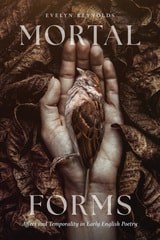
Mortal Forms
Affect and Temporality in Early English PoetryEvelyn Reynolds
The Ohio State University Press, 2026
In Mortal Forms, Evelyn Reynolds introduces the concept of the “absorption-denial dynamic” to explore how medieval English poetic forms simultaneously invite and resist imaginative and affective engagement. She thus offers a model for understanding how language engages audiences with that which is beyond language. This new methodology helps us understand how poetic forms communicate the unspeakable—especially of loss and grief, pain and disgust, joy and eternity—without circumscribing it. Connecting medieval English poetics to modern aesthetic theory and broader questions about the limits of representation, Reynolds considers Old and Middle English poems alongside one another and reads texts achronologically, thus revising standard histories of English poetics that insist on dramatic change from Old to Middle English. Overall, Reynolds deftly deploys her innovative theoretical framework to attend to how medieval poems, from Beowulf to Piers Plowman, navigate the limits of the unspeakable—and thus to develop an understanding of poetics that can enrich our capacity to meet the losses of our own time.
[more]