Results by title
3 books match the query 'Timelessness'
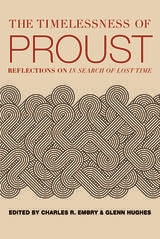
The Timelessness of Proust
Charles R. Embry
St. Augustine's Press, 2016
Marcel Proust’s À la recherche du temps perdu—In Search of Lost Time—is one of the most important and influential novels of the modern era. In recent decades, Proust has enjoyed a new surge of critical attention, as well as a sustained growth in readership—well beyond that of other prose masters of twentieth century modernism such as Joyce, Woolf, Kafka, and Beckett. The MLA Bibliography presently lists over 3,000 citations to scholarly works devoted to Proust’s novel, and if one Googles “Proust,” the number of hits exceeds 2,000,000.
The temporal nature of human existence and consciousness is one of the many themes explored in In Search of Lost Time, and it is this dimension of Proust’s work that unifies this collection of essays that grew from a roundtable discussion entitled “The Timelessness of Proust” conducted at the 31st annual meeting of the Eric Voegelin Society. The collection includes the following essays:
“In Search of Lost Time: Biographies of Consciousness,” Charles R. Embry
“Proust, Transcendence, and Metaxic Existence,” Glenn Hughes
“The Normative Flow of Consciousness and the Self: A Philosophical Meditation on
Proust’s In Search of Lost Time,” Thomas J. McPartland;
“Imprisonment and Freedom: Resisting and Embracing the Tension of Existence in
Marcel Proust’s In Search of Lost Time,” Paulette Kidder;
“Proust’s Luminous Memory and L’Homme Éternel: The Quest for Limitless Meaning,”
Michael Henry
“Unsought Revelations of Eternal Reality in Eliot’s Four Quartets and Proust’s In Search
of Lost Time,” Glenn Hughes
Persons who are interested not only in the philosophical importance of literary masterworks and in how the philosophical thought of Eric Voegelin may illuminate them, but also in letting Proust serve as a guide in the exploration and understanding of their own lives, will find these essays to be of lasting interest and value.
Waste of Timelessness and Other Early Stories
Anaïs Nin
Ohio University Press, 2017
Written when Anaïs Nin was in her twenties and living in France, the stories collected in Waste of Timelessness contain many elements familiar to those who know her later work as well as revelatory, early clues to themes developed in those more mature stories and novels. Seeded with details remembered from childhood and from life in Paris, the wistful tales portray artists, writers, strangers who meet in the night, and above all, women and their desires.
These experimental and deeply introspective missives lay out a central theme of Nin’s writing: the contrast between the public and private self. The stories are taut with unrealized sexual tension and articulate the ways that language and art can shape reality. Nin’s deft humor, ironic wit, and ecstatic prose display not only superb craftsmanship but also the author’s own constant balancing act between feeling and rationality, vulnerability and strength. Perhaps more than any other writer of the twentieth century, she mastered that act and wrote about it on her own terms, defying the literary and social norms of the time.
Waste of Timelessness and Other Early Stories
And Other Early StoriesAnaïs Nin
Ohio University Press, 1993
These stories precede all of Nin’s published work to date. In them are many sources of the more mature work that collectors and growing writers can appreciate.
Written when Anaïs Nin was in her twenties and living in Louveciennes, France, these stories contain many elements that will delight her readers: details remembered from childhood, of life in Paris, the cafés, theatres; characters including dancers, artists, writers, women who devote themselves to their work and visions as well as romance, strangers met in the night; themes such as the scruples of lovers, the search for brilliant, imaginative living; the writer’s experimentation with exotic words like “sybaritic” and “violaceous”. In the craft of these stories readers are treated to a deft sense of humor, ironic wit, much conversation as well as ecstatic prose, and surprise endings. Throughout all, the Nin personality shines, a wonderful mixture of feeling and rationality, of vulnerability and strength.